 Neha Redekar
As per Companies Act, 2013 the term "deposit" includes any receipt of money by way of deposit or loan or in any other form by a company, but does not include such categories of amount as may be prescribed in consultation with the Reserve Bank of India.
EXEMPTED DEPOSITS
According to the Rule 2(c) of The Companies (Acceptance of Deposits) Rules, 2014, "deposit" includes any receipt of money by way of deposit or loan or in any other form, by a company, but does not include the following:
- Any amount received from Central Government or a State Government, or such source where the repayment will be guaranteed by the State or the Central.
- Any amount received from foreign banks or international banks, foreign governments, multilateral financial institutions subject to the provisions of FEMA, 1999
- Any amount received as a loan or facility from any banking company or from the State Bank of India or any of its subsidiary banks or from a banking institution notified by the Central Government.
- Any amount received as a loan or financial assistance from Public Financial Institutions notified by the Central Government or scheduled banks or insurance companies.
- Any amount received against issue of commercial paper or any other instruments.
- Any amount received by a company from any other company.
- Any amount received against an offer made towards subscription of any securities, including share application money or advance towards allotment of securities.

(the application money will be considered as a deposit, if the company fails to allot such securities within 60 days and after expiry of 60 days the same is not refunded within next 15 days)
- Any amount received from a person who is a director of the company (public or private) or a relative of the director of the private company.
- Any amount raised by the issue of bonds or debentures secured by a first charge.
- Any amount received from an employee of the company not exceeding his annual salary.
- Any non-interest-bearing amount received and held in trust.
- Any amount received in the course of, or for the purposes of, the business of the company.
- Any amount brought in by the promoters of the company by way of unsecured loan in pursuance of the stipulation of any lending financial institution or a bank.
- Any amount accepted by a Nidhi company.
- Any amount received by way of subscription in respect of a chit under the Chit Fund Act, 1982
- Any amount received by the company under any collective investment scheme.
- Any amount of Rs. 25 Lacs or more received by a start-up company, by way of a convertible note in a single tranche from a person.
- Any amount received by a company from Alternate Investment Funds, Domestic Venture Capital Funds and Mutual Funds registered with the SEBI.
PROVISIONS UNDER COMPANIES ACT, 2013 AND COMPANIES (ACCEPTANCE OF DEPOSITS) RULES, 2014
1. Pursuant to the provisions of section 73, the public company by passing ordinary resolution in general meeting, can accept deposits from its members, subject to the fulfilment of the following conditions:
- Issuance of circular to its members;
- Filing a copy of circular with Registrar within 30 days of issue of circular;
- Depositing not less than 20% of the amount of deposit maturing during financial year in deposit repayment reserve account on or before 30th of April every year;
- Providing deposit insurance;
- Certifying that the company has not committed any default in repayment of deposit;
- Providing security for repayment of deposit or interest thereon.
2. The private company can accept deposit from its members without complying with the above conditions if:
- The money provided does not exceed 100% of aggregate of the paid-up share capital, free reserves and securities premium account or;
- It is a start-up, for 5 years from the date of its incorporation or;
- It fulfils all of the following conditions:
- which is not an associate or a subsidiary company of any other company;
- if the borrowings of such a company from banks or financial institutions or any body corporate is less than twice of its paid up share capital or Rs. 50 crores, whichever is lower; and
- such a company has not defaulted in the repayment of such borrowings subsisting at the time of accepting deposits under this section.
3. Section 73(1) prohibits the company to invite, accept or renew deposit from the public. However, the following companies may accept deposits from public:
- Banking company
- Non-banking financial company
- Such other company as Central Government may specify
- Eligible company (Public Company having networth of Rs. 100 Crore or turnover of Rs. 500 Crore)
MANNER IN WHICH THE COMPANIES CAN ACCEPT DEPOSITS
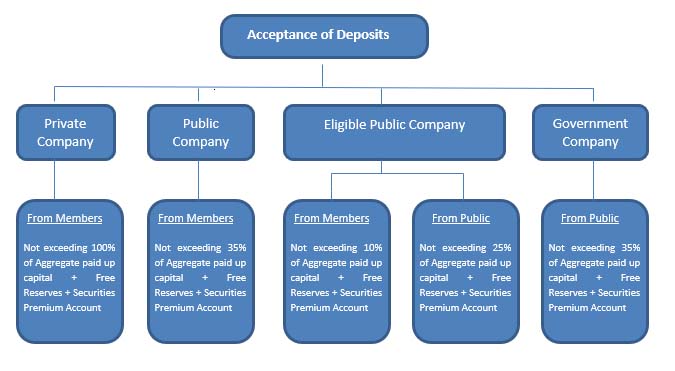
PROCEDURE FOR ACCEPTING DEPOSITS FROM MEMBERS/PUBLIC BY PUBLIC COMPANY
1. Call Meeting of Board of Directors
- Issue Notice of Board Meeting to all directors of the company at least 7 days before the date of Board Meeting.
2. Hold Board Meeting
- To consider and pass resolution for acceptance of deposits from members.
- To consider and approve draft circular in DPT-1
- To consider and approve appointment of trustee.
- To consider about getting credit rating.
- To approve the Notice for calling Extra Ordinary General Meeting.
3. Call Extra Ordinary General Meeting
- Issue Notice of Extra Ordinary General Meeting at least 21 days before the date of Meeting.
4. Hold Extra Ordinary General Meeting
- To consider and pass an ordinary resolution for acceptance of deposits from members.
5. Filing of Form MGT-14 with Registrar
- File Form MGT-14 with Registrar within 30 days of passing of Resolution.
6. Credit Rating
- The company shall obtain credit rating before accepting deposits.
- The company accepting deposits from public shall obtain credit rating every year and the copy of rating to be filed with Registrar along with Form DPT-3
7. Filing of Form DPT-1 with Registrar
- File Form DPT-1 with Registrar at least 30 days before the issue of circular.
8. Insurance Contract
- Enter into an insurance contract with the insurance company at least 30 days before the issue of circular.
9. Appointment of deposit trustee and execution of deposit trust deed
- If the company is inviting secured deposits it has to appoint deposit trustees and shall execute a deposit trust deed in Form DPT-2 at least 7 days before issuing any circular.
10. Circulate Form DPT-1
- Issue circular in Form DPT-1 to all members by registered post or speed post or by electronic mode.
- Publish the circular in an English newspaper and in vernacular newspaper having a wide circulation in the state in which the registered office of the Company is situated.
11. Website Disclosure
- The company accepting deposits from public shall upload a copy of the circular on its website.
12. Receiving the amount from members
- Once the money is received from members, issue receipts of deposits within 21 days from the date of receipt of money.
13. Maintaining Register of Deposits
- The company accepting deposits shall maintain the deposit register and make entries within 7 days of issuance of the deposit receipt.
14. Creation of Security
- The company shall create a charge on companies’ assets for such amount not less than the amount remaining unsecured by the deposit insurance.
15. Creation of Deposit Repayment Reserve Account
- The company shall deposit not less than 20% of the amount of deposit maturing during financial year in deposit repayment reserve account on or before 30th of April every year.
16. Return of Deposits to be filed with Registrar
- The company shall file a return of deposits in Form DPT-3 with Registrar on or before 30th of June every year furnishing the details as on 31st March of that year duly audited by the auditor of the company.
PENALTY FOR CONTRAVENTION
|
Penalty for contravention of Section 73 or 76 of the Companies Act, 2013 |
Company: In addition to the payment of the amount of deposits and the interest if any due, be punishable with a fine which shall not be less than Rs. 1 Crore or twice the amount of deposit accepted by the company, whichever is lower, but which may extend to Rs. 10 Crore. Officer in default: Every officer of the company who is in default shall be punishable with imprisonment which may extend to 7 years and with a fine which shall not be less than Rs. 25 Lacs but which may extend to Rs. 2 crores. The officer of the company who willfully defaulted any provisions shall be liable for action under section 447 |
|
Penalty for contravention of any provisions of Rules |
If the company or any other person contravenes any provision of these rules for which no punishment is provided in the Act, the company and every officer of the company who is in default shall be punishable with fine which may extend to Rs. 5,000/- and where the contravention is a continuing one, with a further fine which may extend to Rs. 500 for every day after the first day during which the contravention continues. |
The author can also be reached at csneharedekar@gmail.com
Disclaimer: Please note that the above article is based on the interpretation of related laws, which may differ from person to person and is not legal advice.











 CAclubindia
