The Institute of Chartered Accountants of India (ICAI) has released the revised Second Edition of its Handbook on E-Way Bill under GST, providing an updated practical reference on the rules, procedures and compliance requirements governing the movement of goods under GST.
The handbook, issued by ICAI's GST & Indirect Taxes Committee, has been updated up to 15 August 2026 and is intended to help Chartered Accountants, tax professionals, businesses, departmental officers and other stakeholders navigate the evolving e-way bill framework.
The revised publication comes at a time when e-way bill compliance has become an important part of day-to-day GST operations, particularly for businesses involved in interstate and intrastate movement of goods.
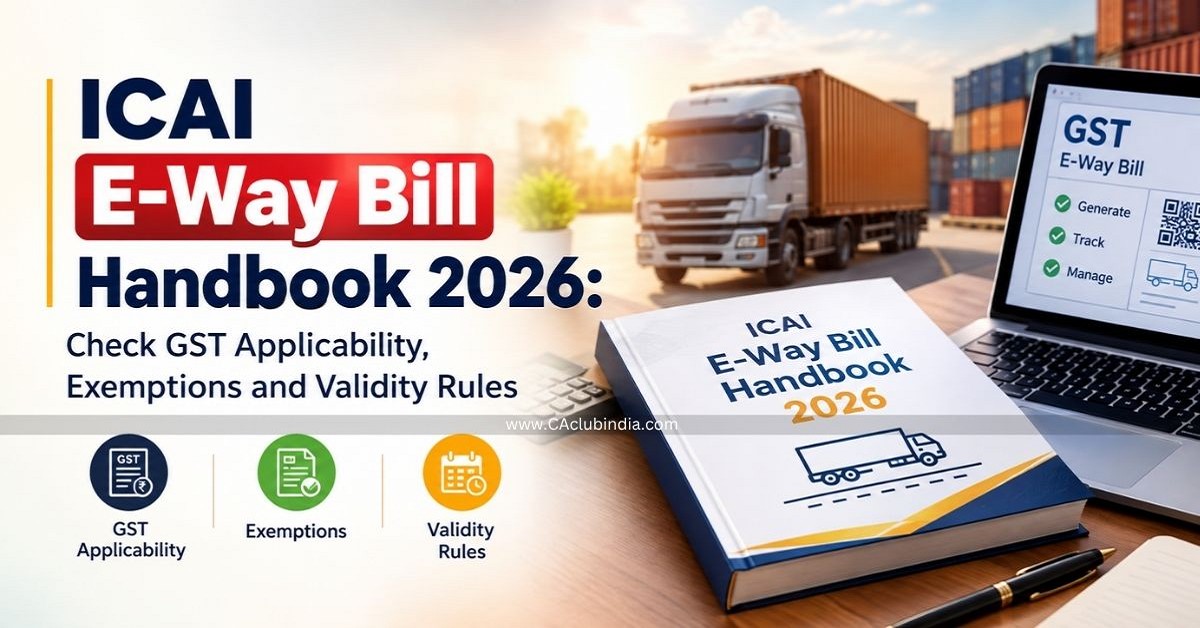
E-Way Bill Remains a Key GST Compliance Requirement
Under the GST framework, the e-way bill provides an electronic record of the movement of goods. It captures important information relating to the consignor, consignee, goods, quantity, value and transportation details.
ICAI notes that the e-way bill system has helped improve transparency, create a digital trail of transactions and strengthen monitoring of goods movement. It has also contributed to smoother logistics by replacing earlier check-post-based processes with an electronic compliance mechanism.
The legal framework is primarily governed by Section 68 of the CGST Act and Rules 138 to 138F of the CGST Rules.
When is an E-Way Bill Required?
For inter-State movement of goods, the handbook states that an e-way bill is generally required where the consignment value exceeds ₹50,000.
For intra-State movement, the applicable threshold is governed by the respective State or Union Territory's GST rules and notifications. Therefore, businesses undertaking intra-State movement need to check the applicable State-specific provisions rather than relying on a single nationwide threshold.
Importantly, e-way bill compliance is linked to the movement of goods, and not merely to whether there is a taxable sale.
The handbook highlights that movement for purposes such as job work, repairs, testing, exhibition, demonstration, replacement, return of goods and stock transfer may also require an e-way bill, subject to the applicable provisions and exemptions.
E-Invoice and E-Way Bill Are Not the Same
One important clarification in the ICAI handbook is that an e-invoice and e-way bill serve different purposes.
An e-invoice primarily establishes and authenticates the invoice or supply transaction through the Invoice Registration Portal, while the e-way bill is concerned with the movement of goods.
Where both requirements apply, generation of an e-invoice does not eliminate the requirement to generate an e-way bill. Similarly, an e-way bill does not replace the requirement of e-invoicing.
E-Way Bill May Apply Even Without a Sale
Businesses sometimes associate e-way bills only with sales transactions. However, the handbook makes it clear that the requirement can arise even where there is no transfer of ownership.
Movements involving job work, repairs, testing, exhibition, demonstration, own use, stock transfers or return of goods, among other situations, may fall within the e-way bill framework depending on the applicable conditions.
This makes it important for businesses to examine the actual movement of goods and the reason for movement, rather than simply checking whether a tax invoice has been issued.
Key E-Way Bill Exemptions
The handbook also lists circumstances where an e-way bill is not required under the applicable provisions.
These include, among others:
- Movement of specified exempt goods;
- Transportation through non-motorised conveyances;
- Certain movements involving customs clearance;
- Certain non-GST goods;
- Goods transported under customs control;
- Transit cargo to or from Nepal or Bhutan;
- Certain defence-related movements;
- Empty cargo containers;
- Certain movements to or from a weighbridge within the prescribed distance; and
- Movement of empty LPG cylinders in specified circumstances.
Businesses should nevertheless verify whether a particular movement falls within the relevant exemption before treating an e-way bill as unnecessary.
E-Way Bill Validity Linked to Distance
The revised handbook also explains the validity period of an e-way bill.
For ordinary consignments, the validity is generally calculated based on 200 km or part thereof, with one day allowed for the initial distance and an additional day for every additional 200 km or part thereof.
Different provisions apply to Over Dimensional Cargo (ODC) and specified multimodal shipments involving transport by ship.
The handbook also explains that validity extension is available through the e-way bill portal within the prescribed time window and based on the remaining distance to be travelled.
Who Has to Generate the E-Way Bill?
The person responsible for generating the e-way bill depends on the nature of the movement.
For a normal supply, the registered person causing the movement, generally the supplier or recipient, as applicable is responsible.
The handbook also covers specific situations such as:
- Exports and imports;
- Job work;
- SKD/CKD consignments;
- Line sales;
- Sales returns;
- Exhibition and fair movements;
- Own-use movements; and
- Repairs, testing, stock transfers and other business movements.
For example, where goods are sent by a principal to a job worker, the principal would generally generate the e-way bill. In certain cases involving movement initiated by the job worker, the job worker may generate it.
E-Way Bill Portal Offers Multiple Compliance Facilities
The handbook walks users through the various facilities available on the e-way bill portal, including generation, updating, cancellation, validity extension, consolidated e-way bills, reports and user management.
Businesses can also use facilities such as bulk upload, SMS, mobile applications and API integration, depending on the functionality available on the portal.
The portal also provides facilities for maintaining client, supplier, transporter and product masters, which can help reduce repetitive data entry and minimise errors while generating e-way bills.
Important Rules for Cancellation and Rejection
An incorrectly generated e-way bill can generally be cancelled within 24 hours of generation, subject to the conditions explained in the handbook.
However, once the movement has commenced, the e-way bill cannot simply be cancelled. Appropriate documentation and a fresh e-way bill may be required for a return or correction, depending on the circumstances.
The handbook also states that a recipient can reject an e-way bill within 72 hours of generation or before delivery of goods, whichever is earlier.
ICAI Handbook Provides Practical GST Compliance Reference
The revised ICAI handbook brings together the key aspects of e-way bill compliance, including applicability, generation, validity, exemptions, portal procedures, penalties, case laws and FAQs.
With the e-way bill system continuing to evolve alongside GST rules, portal changes and judicial developments, the handbook is positioned as a practical reference for professionals and businesses dealing with the movement of goods.
For taxpayers, one of the key takeaways is that e-way bill compliance should not be viewed merely as a document-generation exercise. The nature of movement, consignment value, applicable State rules, supporting documents and validity requirements all need to be considered before goods are moved.












 CAclubindia
