The GST Portal has introduced a new 'Multi-State Registration' facility from October 1, 2026, aimed at making the GST registration process easier for businesses that need registrations across multiple States or Union Territories.
The new facility allows eligible normal taxpayers to initiate registration applications for multiple States/UTs through a single application flow instead of starting a separate registration process for each State.
How the New Multi-State Registration Facility Works
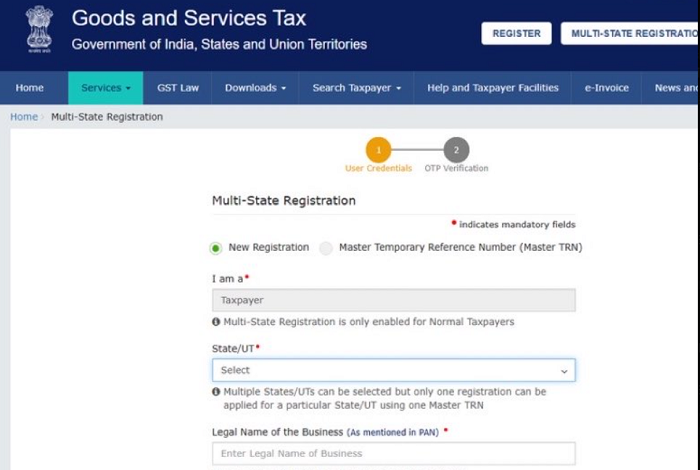
Under the new functionality, applicants can select the States or Union Territories where they require GST registration and provide common details such as:
- Legal name of the business
- PAN
- Email address
- Mobile number and other basic details
Once the preliminary details and OTP verification are completed, the portal generates a single Master Temporary Reference Number (Master TRN) for the selected States/UTs.
The common information entered by the applicant is then used to create State-specific TRNs, reducing the need to repeatedly enter the same basic information for every registration application.
Separate GSTINs Will Still Be Issued
The new facility does not create one GST registration covering all States.
GST registration continues to be State/UT-specific, meaning the taxpayer will receive separate GSTINs for the respective States or Union Territories after the individual applications are processed and approved.
The change is primarily in the application process, where common preliminary information can now be submitted through a unified workflow.
What It Means for Businesses and Tax Professionals
For businesses operating across several States, the feature could reduce repetitive data entry and make the initial registration process more streamlined.
Tax professionals handling registrations for multi-State businesses may also find the common application process useful, particularly where the same PAN and legal-name information has to be entered repeatedly.
However, applicants should not treat the Master TRN as a substitute for State-wise compliance. Each registration remains separately linked to the relevant State/UT and may require State-specific information and verification.
Accuracy of Information Remains Important
The new facility makes it particularly important to check the common information before submitting the application. Since details entered during the initial process can flow into the respective State-specific TRNs, an error in common particulars could potentially result in repeated corrections.
Applicants should therefore carefully verify details such as the PAN, legal name, email address and mobile number before proceeding.
The facility is currently indicated for Normal Taxpayers, with the taxpayer option pre-selected in the new registration flow.
Official copy of the Advisory is as follows
1. It is informed that an option for "Multistate Registration" has been introduced. The functionality enables taxpayers to apply for registration in multiple States/UTs simultaneously. Taxpayers seeking GST registration in more than one State/UT under the same PAN can use this functionality. Currently, the functionality is available only for Normal Taxpayers.
2. A "Multistate Registration" tab has been introduced in the homepage of the Common Portal, where Taxpayers can select multiple States/UTs for registration. Upon selection of the required States/UTs, a Master TRN is generated.
3. Using the Master TRN, the applicant can provide the Common Registration Information (CRI), comprising details such as Business Details, Promoter/Partner details, Authorised signatory, Authorised representative, and Goods and Services. The Master TRN is required to be submitted within 15 days.
4. Once the CRI is submitted, individual TRNs are generated for each selected State/UT. In the respective individual TRN, the common information already provided through the CRI is auto populated and remains editable. Further, the applicant is required to provide the remaining information such as Principal Place of Business (PPoB), Additional Place of Business (APoB), State-specific Information, and Aadhaar authentication.
5. Thus, the applicant is not required to enter the common information separately for each State/UT Registration application. The functionality reduces repetitive data entry and facilitates ease of doing business.












 CAclubindia
