A Rs 58-crore tax bill has triggered a wider conversation on taxation, public spending and the value taxpayers receive in return.
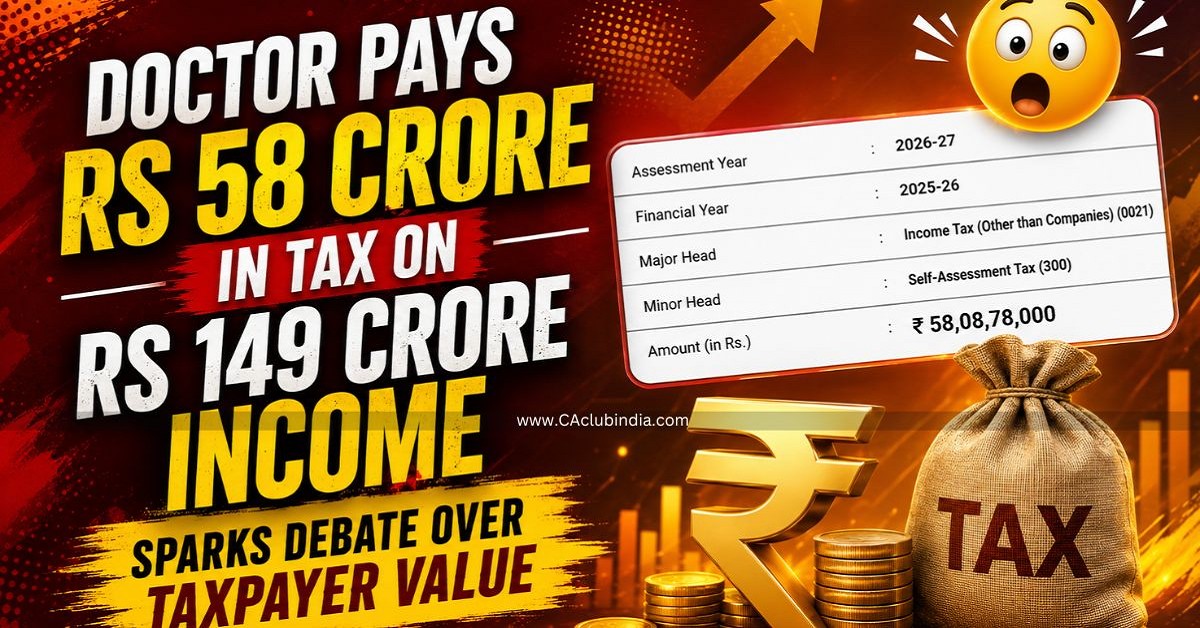
Mumbai-based IVF specialist and investor Dr Aniruddha Malpani recently shared a screenshot of his self-assessment tax payment for FY 2025-26 on X. The amount shown was Rs 58.08 crore, putting the scale of his reported taxable income at roughly Rs 149 crore.
Malpani, who runs the Malpani Infertility Clinic with his wife Dr Anjali Malpani and is also an early-stage investor through Malpani Ventures, said he does not object to paying taxes. His concern, however, is whether taxpayers receive adequate value for the money collected by the government.
Why Rs 58 Crore Tax Has Become a Talking Point
For most taxpayers, a tax payment running into crores is difficult to imagine. Malpani's decision to publicly share the figure therefore attracted considerable attention on social media.
His post effectively raised a question that goes beyond his personal tax liability:
If a taxpayer contributes tens of crores to the exchequer, what should they reasonably expect in return?
The discussion quickly moved from Malpani's personal finances to broader issues such as infrastructure, civic services, government expenditure and taxpayer accountability.
Some users admired the transparency involved in publicly showing such a large tax payment. Others questioned whether India's tax collections translate into better public services and infrastructure.
From Tax Payment to Public Spending
One of the strongest reactions centred on the perceived gap between taxation and everyday civic infrastructure.
Malpani subsequently highlighted images of garbage and poor roads in Gurugram, describing them as an example of what taxpayers see around them.
The debate also drew comparisons with jurisdictions such as Texas, where people pointed to different tax structures and lower personal-tax burdens. Such comparisons, however, do not necessarily account for differences in public services, state-level taxation, social-security systems and overall government expenditure.
Malpani's Response: Happy to Pay Tax, But Wants Value
Interestingly, Malpani did not frame his argument as opposition to taxation.
His position was that he earned his wealth in India and is therefore comfortable contributing taxes to the government. His frustration is about how effectively that money is ultimately used.
This distinction has become central to the online discussion: the debate is less about whether high-income individuals should pay taxes and more about what constitutes value for money from the taxpayer's perspective.
Wealth Creation Also Became Part of the Debate
Malpani's disclosure also prompted discussions about how such a large taxable income was generated. Beyond his medical practice, his investments and wealth-management activities have contributed to his overall financial profile.
That has added another dimension to the conversation: India's tax system increasingly captures income not just from traditional professions and businesses, but also from investments and accumulated wealth.
The Bigger Question for Indian Taxpayers
The controversy ultimately reflects a much larger issue.
India's tax base and compliance ecosystem have expanded significantly, with the Income Tax Department reporting more than 7.8 crore ITRs filed for AY 2026-27 by August 31, 2026.
As more taxpayers participate in the formal tax system, expectations around transparency, infrastructure and public-service delivery are likely to become increasingly important.
Malpani's Rs 58-crore tax payment has therefore become more than a personal financial disclosure. It has opened up a familiar but important debate:
Paying tax is one side of the equation. What taxpayers receive in return is the other.
Ongoing Reactions on X
The discussion on X has broadly fallen into a few camps:
- Admiration: Users praised Malpani for openly disclosing such a large tax payment.
- Taxpayer accountability: Many asked whether high tax collections are translating into better roads, sanitation and public infrastructure.
- Government spending: Some questioned whether taxpayer money is being consumed by salaries and administrative expenditure instead of development.
- Relocation argument: A few users suggested that someone paying such high taxes could consider moving to lower-tax jurisdictions.
- Malpani's counterpoint: He maintained that he is willing to pay taxes in India because his wealth was earned in India, but expects better value from public spending.
The conversation is still evolving, but the central question remains straightforward: When taxpayers contribute Rs 58 crore, how should the government demonstrate that the money is being used effectively?












 CAclubindia
