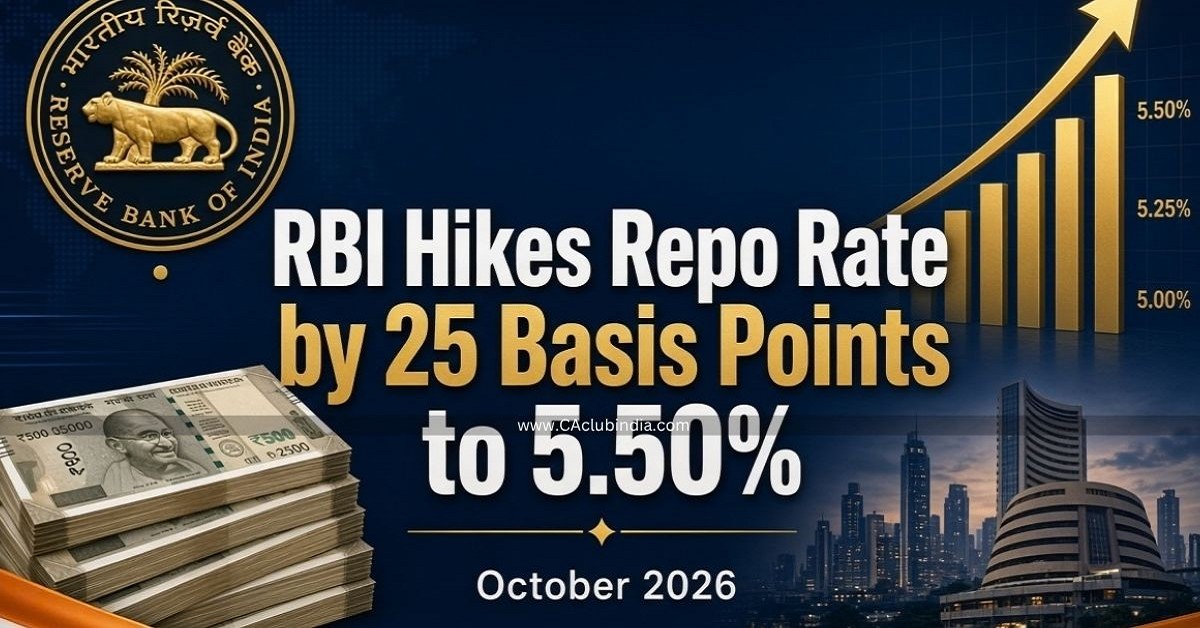
The Reserve Bank of India (RBI) has increased the policy repo rate by 25 basis points to 5.50% from 5.25%, following the Monetary Policy Committee (MPC) meeting held from October 5 to October 7, 2026. The decision was taken unanimously by the six-member committee amid rising inflationary pressures and global economic uncertainty.
Along with the repo rate hike, the RBI has shifted its monetary policy stance from 'neutral' to 'calibrated tightening', signalling a cautious approach towards future interest rate decisions.
RBI Repo Rate Hike: Key Details
The MPC has revised the key policy rates as follows:
- Policy Repo Rate: Increased by 25 basis points to 5.50%.
- Standing Deposit Facility (SDF) Rate: Adjusted to 5.25%.
- Marginal Standing Facility (MSF) Rate: Revised to 5.75%.
- Bank Rate: Revised to 5.75%.
Why Has RBI Increased the Repo Rate?
The RBI cited rising inflationary pressures and uncertainty in the global economic environment as key considerations behind the decision. The central bank noted that inflation expectations and broader price pressures require close monitoring, particularly amid volatile crude oil prices and geopolitical developments.
The MPC observed that headline CPI inflation is expected to average nearly 5.8% over the next three quarters, while core inflation is projected at 4.4% for the current financial year. Against this backdrop, the committee considered a policy rate adjustment necessary to support price stability.
RBI Signals No Near-Term Rate Cuts
With the change in stance to calibrated tightening, the RBI has indicated that rate cuts are off the table in the near term. Future policy decisions may involve either a further rate hike or a pause, depending on evolving inflation and growth conditions.
The RBI stated that the extent and duration of the rate-hiking cycle will depend on underlying inflation trends, the spread of price pressures and the impact of supply-side shocks on the economy.
The latest decision marks a significant shift in the RBI's monetary policy approach, with inflation management taking greater priority amid changing domestic and global economic conditions.
Source: Reserve Bank of India (RBI), Monetary Policy Statement 2026-27












 CAclubindia
