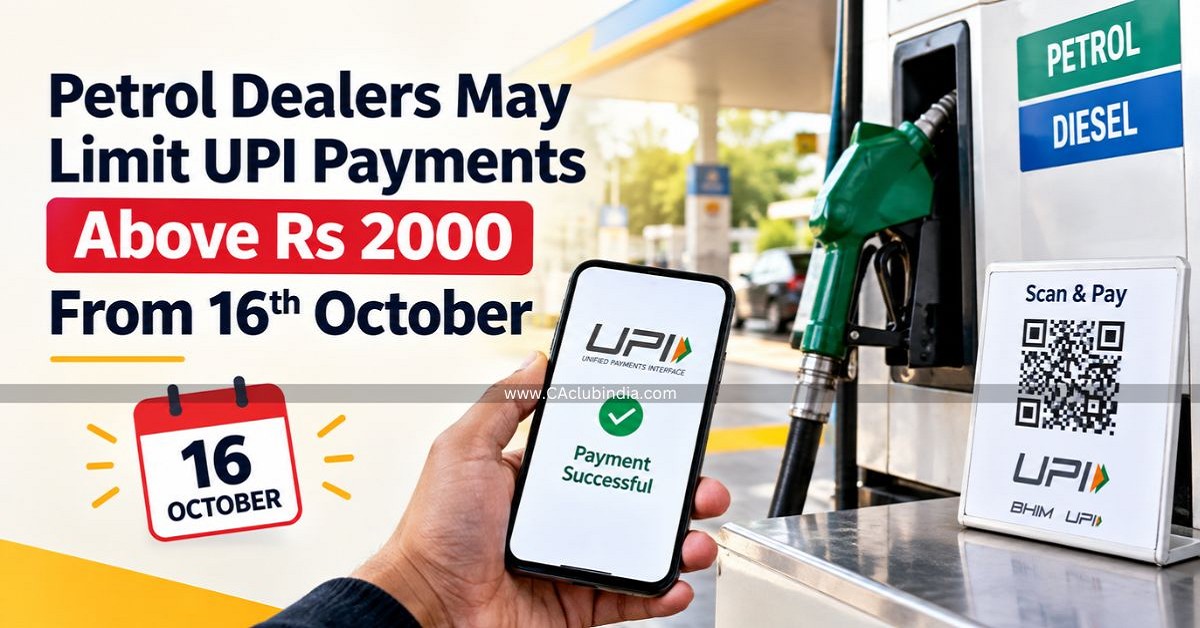
A new UPI payment rule is creating concern among petrol pump dealers, with some associations warning that they may stop accepting UPI payments above Rs 2,000 from October 16, 2026.
The issue is linked to the revised Merchant Discount Rate (MDR) framework that takes effect from October 15. Under the new arrangement, certain merchant transactions above Rs 2,000 will attract an MDR, while fuel stations will face a flat Rs 5 charge on eligible transactions.
For petrol dealers, the concern is straightforward: even a small charge can become significant when thousands of transactions are processed every month.
Why Are Petrol Dealers Concerned About Rs 5 MDR?
Unlike many businesses, petrol pumps typically operate on relatively narrow margins. Dealer associations have reportedly pointed to margins of around Rs 2.40 to Rs 3.40 per litre.
This is why dealers say the additional Rs 5 cost on a qualifying UPI transaction cannot simply be ignored.
Consider a customer who buys Rs 3,000 worth of petrol and pays through UPI. The customer is not supposed to pay an additional Rs 5. However, the petrol dealer may have to bear the MDR associated with that transaction.
For a busy fuel station handling hundreds or thousands of such payments, dealers argue that the cumulative cost could become substantial.
Petrol Pumps Could Restrict UPI Payments Above Rs 2,000
Some petrol dealer associations have already indicated that they may restrict UPI payments above Rs 2,000 if the MDR is not withdrawn or an exemption is provided for fuel retailers.
In Madhya Pradesh, for example, dealers have announced plans to stop accepting UPI payments above Rs 2,000 from October 16. Similar concerns have also been raised by dealer associations in other states.
This does not mean that UPI will stop working at petrol pumps altogether.
Customers may still be able to make UPI payments for transactions of Rs 2,000 or below, while larger purchases could require another payment method depending on the individual fuel station.
Will Customers Have to Pay the Rs 5 UPI Charge?
This is an important point.
The Rs 5 MDR is not a tax or a mandatory Rs 5 fee that petrol pump customers are supposed to pay.
The Finance Ministry has clarified that MDR is a charge within the payment ecosystem and is not a government tax being imposed directly on consumers.
Banks have also been instructed to ensure that merchants do not pass the MDR on to customers as a separate charge.
So, if a customer makes a Rs 2,500 fuel payment through UPI, the customer should not be told to pay Rs 2,505 simply because of the MDR.
The dispute is primarily between fuel dealers and the payment ecosystem over who bears the merchant-side cost.
What Changes From October 15?
The revised framework primarily affects certain Person-to-Merchant (P2M) transactions.
Here's what customers should keep in mind:
| Transaction | UPI Impact |
|---|---|
| Up to Rs 2,000 at eligible merchants | No MDR |
| Above Rs 2,000 at specified merchants | MDR may apply |
| Fuel transaction above Rs 2,000 | Flat Rs 5 MDR |
| Person-to-person UPI payment | Remains free |
| Customer directly paying MDR | Not permitted |
The government has maintained that the vast majority of UPI merchant transactions will continue without any impact under the new framework.
Why Is the Issue More Sensitive for Fuel Stations?
The concern at petrol pumps is not simply about the size of the charge.
Fuel stations deal with high transaction volumes and relatively low margins . A Rs 5 charge on a single transaction may appear small, but the total cost can increase quickly when a station processes a large number of high-value digital payments every day.
Dealers are therefore seeking relief rather than asking customers to pay an additional fee.
Their argument is that fuel retailers should continue to receive an exemption from MDR, given the nature of the business and the margins involved.
What Should Customers Do?
For customers, there is no need to stop using UPI.
However, if petrol pumps in a particular state or location implement the proposed restriction, customers making fuel purchases above Rs 2,000 may need to keep an alternative payment option available.
For example:
- Rs 1,500 fuel purchase: UPI can be used.
- Rs 2,000 fuel purchase: UPI can be used.
- Rs 2,500 fuel purchase: A Rs 5 MDR may apply to the merchant, but it should not be separately collected from the customer.
- If a petrol pump restricts high-value UPI: Customers may need to use cash or a card.
The actual implementation could differ from one petrol pump or state to another depending on decisions taken by local dealer associations.
UPI MDR Debate Could Affect Everyday Payments
The petrol pump issue highlights a larger debate around the future economics of India's UPI ecosystem.
UPI has become a routine payment option for everything from small grocery purchases to fuel bills. Any change to the cost structure can therefore have an impact on merchants, banks, payment companies and consumers.
The government's position is that the new MDR structure affects only a limited portion of merchant transactions, while the majority of UPI payments will remain unaffected.
Petrol dealers, however, are asking for a separate exemption because of the industry's thin margins and high transaction volumes.
With the revised rules scheduled to take effect from October 15 and some dealer associations planning restrictions from October 16, the focus will now be on whether further discussions result in any relief for fuel retailers.












 CAclubindia
