Union Minister for Finance and Corporate Affairs Smt Nirmala Sitharaman presented Union Budget 2025-26 in the Parliament today. The highlights of the budget are as follows:
Budget Estimates 2025-26
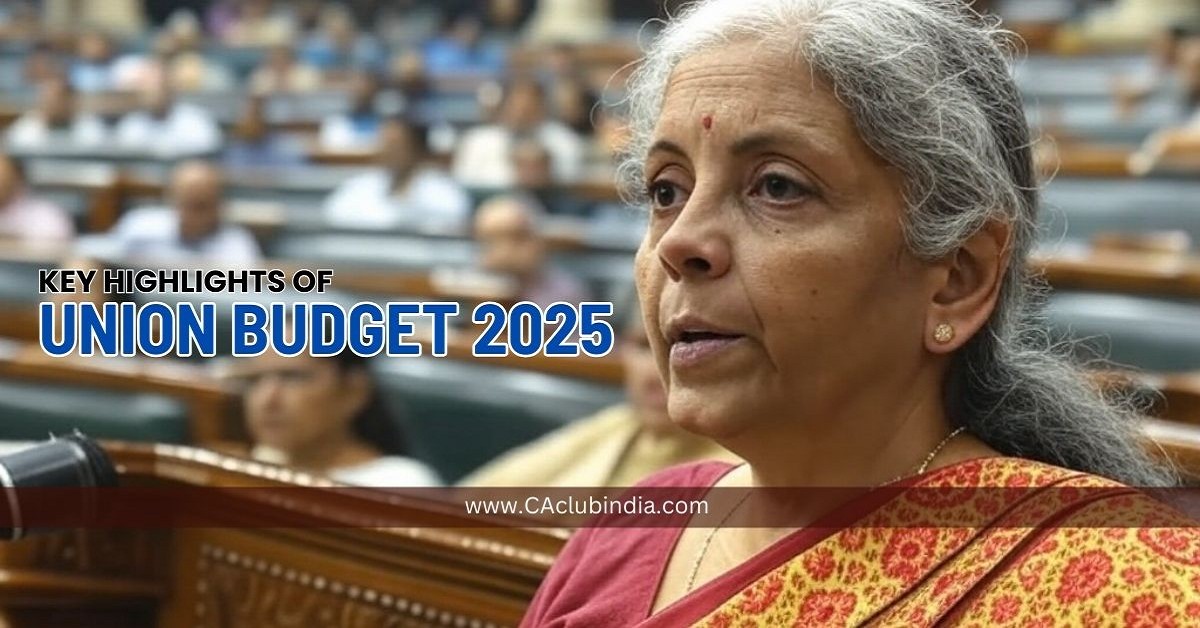
- The total receipts other than borrowings and the total expenditure are estimated at Rs 34.96 lakh crore and Rs 50.65 lakh crore respectively.
- The net tax receipts are estimated at Rs 28.37 lakh crore.
- The fiscal deficit is estimated to be 4.4 per cent of GDP.
- The gross market borrowings are estimated at Rs 14.82 lakh crore.
- Capex Expenditure of Rs 11.21 lakh crore (3.1% of GDP) earmarked in FY2025-26.
AGRICULTURE AS THE 1ST ENGINE OF DEVELOPMENT
Prime Minister Dhan-Dhaanya Krishi Yojana - Developing Agri Districts Programme
- The programme to be launched in partnership with the states, covering 100 districts with low productivity, moderate crop intensity and below-average credit parameters, to benefit 1.7 crore farmers.
Building Rural Prosperity and Resilience
- A comprehensive multi-sectoral programme to be launched in partnership with states to address under-employment in agriculture through skilling, investment, technology, and invigorating the rural economy.
- Phase-1 to cover 100 developing agri-districts.
Aatmanirbharta in Pulses
- Government to launch a 6-year "Mission for Aatmanirbharta in Pulses" with focus on Tur, Urad and Masoor.
- NAFED and NCCF to procure these pulses from farmers during the next 4 years.
Comprehensive Programme for Vegetables & Fruits
- A comprehensive programme to promote production, efficient supplies, processing, and remunerative prices for farmers to be launched in partnership with states.
Makhana Board in Bihar
- A Makhana Board to be established to improve production, processing, value addition, and marketing of makhana.
National Mission on High Yielding Seeds
- A National Mission on High Yielding Seeds to be launched aiming at strengthening the research ecosystem, targeted development and propagation of seeds with high yield, and commercial availability of more than 100 seed varieties.
Fisheries
- Government to bring a framework for sustainable harnessing of fisheries from Indian Exclusive Economic Zone and High Seas, with a special focus on the Andaman & Nicobar and Lakshadweep Islands.
Mission for Cotton Productivity
- A 5-year mission announced to facilitate significant improvements in productivity and sustainability of cotton farming, and promote extra-long staple cotton varieties.
Enhanced Credit through KCC
- The loan limit under the Modified Interest Subvention Scheme to be enhanced from Rs 3 lakh to Rs 5 lakh for loans taken through the KCC.
Urea Plant in Assam
- A plant with annual capacity of 12.7 lakh metric tons to be set up at Namrup, Assam.
MSMEs AS THE 2ND ENGINE OF DEVELOPMENT
Revision in classification criteria for MSMEs
- The investment and turnover limits for classification of all MSMEs to be enhanced to 2.5 and 2 times respectively.
Credit Cards for Micro Enterprises
- Customized Credit Cards with Rs 5 lakh limit for micro enterprises registered on Udyam portal, 10 lakh cards to be issued in the first year.
Fund of Funds for Startups
- A new Fund of Funds, with expanded scope and a fresh contribution of Rs 10,000 crore to be set up.
Scheme for First-time Entrepreneurs
- A new scheme for 5 lakh women, Scheduled Castes and Scheduled Tribes first-time entrepreneurs to provide term-loans upto Rs 2 crore in the next 5 years announced.
Focus Product Scheme for Footwear & Leather Sectors
- To enhance the productivity, quality and competitiveness of India's footwear and leather sector, a focus product scheme announced to facilitate employment for 22 lakh persons, generate turnover of Rs 4 lakh crore and exports of over Rs 1.1 lakh crore.
Measures for the Toy Sector
- A scheme to create high-quality, unique, innovative, and sustainable toys, making India a global hub for toys announced.
Support for Food Processing
- A National Institute of Food Technology, Entrepreneurship and Management to be set up in Bihar.
Manufacturing Mission - Furthering "Make in India"
- A National Manufacturing Mission covering small, medium and large industries for furthering "Make in India" announced.
INVESTMENT AS THE 3RD ENGINE OF DEVELOPMENT
- Investing in People
Saksham Anganwadi and Poshan 2.0
- The cost norms for the nutritional support to be enhanced appropriately.
Atal Tinkering Labs
- 50,000 Atal Tinkering Labs to be set up in Government schools in next 5 years.
Broadband Connectivity to Government Secondary Schools and PHCs
- Broadband connectivity to be provided to all Government secondary schools and primary health centres in rural areas under the Bharatnet project.
Bharatiya Bhasha Pustak Scheme
- Bharatiya Bhasha Pustak Scheme announced to provide digital-form Indian language books for school and higher education.
National Centres of Excellence for Skilling
- 5 National Centres of Excellence for skilling to be set up with global expertise and partnerships to equip our youth with the skills required for "Make for India, Make for the World" manufacturing.
Expansion of Capacity in IITs
- Additional infrastructure to be created in the 5 IITs started after 2014 to facilitate education for 6,500 more students.
Centre of Excellence in AI for Education
- A Centre of Excellence in Artificial Intelligence for education to be set up with a total outlay of Rs 500 crore.
Expansion of medical education
- 10,000 additional seats to be added in medical colleges and hospitals next year, adding to 75000 seats in the next 5 years.
Day Care Cancer Centres in all District Hospitals
- Government to set up Day Care Cancer Centres in all district hospitals in the next 3 years, 200 Centres in 2025-26.
Strengthening urban livelihoods
- A scheme for socio-economic upliftment of urban workers to help them improve their incomes and have sustainable livelihoods announced.
PM SVANidhi
- Scheme to be revamped with enhanced loans from banks, UPI linked credit cards with Rs 30,000 limit, and capacity building support.
Social Security Scheme for Welfare of Online Platform Workers
- Government to arrange for identity cards, registration on e-Shram portal and healthcare under PM Jan Arogya Yojna, for gig-workers.
- Investing in the Economy
Public Private Partnership in Infrastructure
- Infrastructure-related ministries to come up with a 3-year pipeline of projects in PPP mode, States also encouraged.
Support to States for Infrastructure
- An outlay of Rs 1.5 lakh crore proposed for the 50-year interest free loans to states for capital expenditure and incentives for reforms.
Asset Monetization Plan 2025-30
- Second Plan for 2025-30 to plough back capital of Rs 10 lakh crore in new projects announced.
Jal Jeevan Mission
- Mission to be extended until 2028 with an enhanced total outlay.
Urban Challenge Fund
- An Urban Challenge Fund of Rs 1 lakh crore announced to implement the proposals for 'Cities as Growth Hubs', 'Creative Redevelopment of Cities' and 'Water and Sanitation', allocation of Rs 10,000 crore proposed for 2025-26.
Nuclear Energy Mission for Viksit Bharat
- Amendments to the Atomic Energy Act and the Civil Liability for Nuclear Damage Act to be taken up.
- Nuclear Energy Mission for research & development of Small Modular Reactors (SMR) with an outlay of Rs 20,000 crore to be set up, 5 indigenously developed SMRs to be operational by 2033.
Shipbuilding
- The Shipbuilding Financial Assistance Policy to be revamped.
- Large ships above a specified size to be included in the infrastructure harmonized master list (HML).
Maritime Development Fund
- A Maritime Development Fund with a corpus of Rs 25,000 crore to be set up, with up to 49 per cent contribution by the Government, and the balance from ports and private sector.
UDAN - Regional Connectivity Scheme
- A modified UDAN scheme announced to enhance regional connectivity to 120 new destinations and carry 4 crore passengers in the next 10 years.
- Also to support helipads and smaller airports in hilly, aspirational, and North East region districts.
Greenfield Airport in Bihar
- Greenfield airports announced in Bihar, in addition to the expansion of the capacity of Patna airport and a brownfield airport at Bihta.
Western Koshi Canal Project in Mithilanchal
- Financial support for the Western Koshi Canal ERM Project in Bihar.
Mining Sector Reforms
- A policy for recovery of critical minerals from tailings to be brought out.
SWAMIH Fund 2
- A fund of Rs 15,000 crore aimed at expeditious completion of another 1 lakh dwelling units, with contribution from the Government, banks and private investors announced.
Tourism for employment-led growth
- Top 50 tourist destination sites in the country to be developed in partnership with states through a challenge mode.
- Investing in Innovation
Research, Development and Innovation
- Rs 20,000 crore to be allocated to implement private sector driven Research, Development and Innovation initiative announced in the July Budget.
Deep Tech Fund of Funds
- Deep Tech Fund of Funds to be explored to catalyze the next generation startups.
PM Research Fellowship
- 10,000 fellowships for technological research in IITs and IISc with enhanced financial support.
Gene Bank for Crops Germplasm
- 2nd Gene Bank with 10 lakh germplasm lines to be set up for future food and nutritional security.
National Geospatial Mission
- A National Geospatial Mission announced to develop foundational geospatial infrastructure and data.
Gyan Bharatam Mission
- A Gyan Bharatam Mission for survey, documentation and conservation of our manuscript heritage with academic institutions, museums, libraries and private collectors to be undertaken to cover more than 1 crore manuscripts announced.
EXPORTS AS THE 4TH ENGINE OF DEVELOPMENT
Export Promotion Mission
- An Export Promotion Mission, with sectoral and ministerial targets, driven jointly by the Ministries of Commerce, MSME, and Finance to be set up.
BharatTradeNet
- 'BharatTradeNet' (BTN) for international trade to be set-up as a unified platform for trade documentation and financing solutions.
National Framework for GCC
- A national framework to be formulated as guidance to states for promoting Global Capability Centres in emerging tier 2 cities.
REFORMS AS FUEL: FINANCIAL SECTOR REFORMS AND DEVELOPMENT
FDI in Insurance Sector
- The FDI limit for the insurance sector to be raised from 74 to 100 per cent, for those companies which invest the entire premium in India.
Credit Enhancement Facility by NaBFID
- NaBFID to set up a 'Partial Credit Enhancement Facility' for corporate bonds for infrastructure.
Grameen Credit Score
- Public Sector Banks to develop 'Grameen Credit Score' framework to serve the credit needs of SHG members and people in rural areas.
Pension Sector
- A forum for regulatory coordination and development of pension products to be set up.
High Level Committee for Regulatory Reforms
- A High-Level Committee for Regulatory Reforms to be set up for a review of all non-financial sector regulations, certifications, licenses, and permissions.
Investment Friendliness Index of States
- An Investment Friendliness Index of States to be launched in 2025 to further the spirit of competitive cooperative federalism anounced.
Jan Vishwas Bill 2.0
- The Jan Vishwas Bill 2.0 to decriminalize more than 100 provisions in various laws.
PART B
DIRECT TAX
- No personal income tax payable upto income of Rs 12 lakh (i.e. average income of Rs 1 lakh per month other than special rate income such as capital gains) under the new regime.
- This limit will be Rs 12.75 lakh for salaried tax payers, due to standard deduction of Rs 75,000.
- The new structure will substantially reduce the taxes of the middle class and leave more money in their hands, boosting household consumption, savings and investment.
- The new Income-Tax Bill to be clear and direct in text so as to make it simple to understand for taxpayers and tax administration, leading to tax certainty and reduced litigation.
- Revenue of about Rs 1 lakh crore in direct taxes will be forgone.
- Revised tax rate structure
- In the new tax regime, the revised tax rate structure will stand as follows:
|
0-4 lakh rupees |
Nil |
|
4-8 lakh rupees |
5 percent |
|
8-12 lakh rupees |
10 percent |
|
12-16 lakh rupees |
15 percent |
|
16-20 lakh rupees |
20 percent |
|
20- 24 lakh rupees |
25 percent |
|
Above 24 lakh rupees |
30 percent |
- TDS/TCS rationalization for easing difficulties
- Rationalization of Tax Deduction at Source (TDS) by reducing number of rates and thresholds above which TDS is deducted.
- The limit for tax deduction on interest for senior citizens doubled from the present Rs 50,000 to Rs 1 lakh.
- The annual limit of Rs 2.40 lakh for TDS on rent increased to Rs 6 lakh.
- The threshold to collect tax at source (TCS) on remittances under RBI's Liberalized Remittance Scheme (LRS) increased from Rs 7 lakh to Rs 10 lakh.
- The provisions of the higher TDS deduction will apply only in non-PAN cases.
- Decriminalization for the cases of delay of payment of TCS up to the due date of filing statement.
- Reducing Compliance Burden
- Reduction of compliance burden for small charitable trusts/institutions by increasing their period of registration from 5 years to 10 years.
- The benefit of claiming the annual value of self-occupied properties as nil will be extended for two such self-occupied properties without any condition.
- Ease of Doing Business
- Introduction of a scheme for determining arm's length price of international transaction for a block period of three years.
- Expansion of the scope of safe harbour rules to reduce litigation and provide certainty in international taxation.
- Exemption of withdrawals made from National Savings Scheme (NSS) by individuals on or after the 29th of August, 2024.
- Similar treatment to NPS Vatsalya accounts as is available to normal NPS accounts, subject to overall limits.
- Employment and Investment
Tax certainty for electronics manufacturing Schemes
- Presumptive taxation regime for non-residents who provide services to a resident company that is establishing or operating an electronics manufacturing facility.
- Introduction of a safe harbour for tax certainty for non-residents who store components for supply to specified electronics manufacturing units.
Tonnage Tax Scheme for Inland Vessels
The benefits of existing tonnage tax scheme to be extended to inland vessels registered under the Indian Vessels Act, 2021 to promote inland water transport in the country.
- Extension for incorporation of Start-Ups
Extension of the period of incorporation by 5 years to allow the benefit available to start-ups incorporated before 1.4.2030.
- Alternate Investment Funds (AIFs)
Certainty of taxation on the gains from securities to Category I and Category II AIFs which are undertaking investments in infrastructure and other such sectors.
- Extension of investment date for Sovereign and Pension Funds
Extension of the date of making investments in Sovereign Wealth Funds and Pension Funds by five more years, to 31st March, 2030, to promote funding from them to the infrastructure sector.
INDIRECT TAX
Rationalisation of Customs Tariff Structure for Industrial Goods
Union Budget 2025-26 proposes to:
- Remove seven tariff rates. This is over and above the seven tariff rates removed in 2023-24 budget. After this, there will be only eight remaining tariff rates including 'zero' rate.
- Apply appropriate cess to broadly maintain effective duty incidence except on a few items, where such incidence will reduce marginally.
- Levy not more than one cess or surcharge. Therefore Social Welfare Surcharge on 82 tariff lines that are subject to a cess, exempted.
Revenue of about Rs 2600 crore in indirect taxes will be forgone.
Relief on import of Drugs/Medicines
- 36 lifesaving drugs and medicines fully exempted from Basic Customs Duty (BCD).
- 6 lifesaving medicines to attract concessional customs duty of 5%.
- Specified drugs and medicines under Patient Assistance Programmes run by pharmaceutical companies fully exempted from BCD; 37 more medicines added along with 13 new patient assistance programmes.
Support to Domestic Manufacturing and Value addition
- Critical Minerals :
- Cobalt powder and waste, the scrap of lithium-ion battery, Lead, Zinc and 12 more critical minerals fully exempted from BCD.
- Textiles:
- Two more types of shuttle-less looms fully exempted textile machinery.
- BCD rate on knitted fabrics revised from "10% or 20%" to "20% or ` 115 per kg, whichever is higher.
- Electronic Goods:
- BCD on Interactive Flat Panel Display (IFPD) increased from 10% to 20% .
- BCD reduced to 5% on Open Cell and other components.
- BCD on parts of Open Cells exempted.
- Lithium Ion Battery:
- 35 additional capital goods for EV battery manufacturing, and 28 additional capital goods for mobile phone battery manufacturing exempted.
- Shipping Sector:
- Exemption of BCD on raw materials, components, consumables or parts for the manufacture of ships extended for another ten years.
- The same dispensation to continue for ship breaking.
- Telecommunication:
- BCD reduced from 20% to 10% on Carrier Grade ethernet switches.
Export Promotion
- Handicraft Goods:
- Time period for export extended from six months to one year, further extendable by another three months, if required.
- Nine items added to list of duty-free inputs.
- Leather sector:
- BCD on Wet Blue leather fully exempted.
- Crust leather exempted from 20% export duty.
- Marine products:
- BCD reduced from 30% to 5% on Frozen Fish Paste (Surimi) for manufacture and export of its analogue products.
- BCD reduced from 15% to 5% on fish hydrolysate for manufacture of fish and shrimp feeds.
- Domestic MROs for Railway Goods:
- Railways MROs to benefit similar to the aircraft and ships MROs in terms of import of repair items.
- Time limit extended for export of such items from 6 months to one year and made further extendable by one year.
Trade facilitation
- Time limit for Provisional Assessment:
- For finalising the provisional assessment, time-limit of two years fixed, extendable by a year.
- Voluntary Compliance:
- A new provision introduced to enable importers or exporters, after clearance of goods, to voluntarily declare material facts and pay duty with interest but without penalty.
- Extended Time for End Use:
- Time limit for the end-use of imported inputs in the relevant rules extended from six months to one year.
- Such importers to file only quarterly statements instead of a monthly statement.












 CAclubindia
