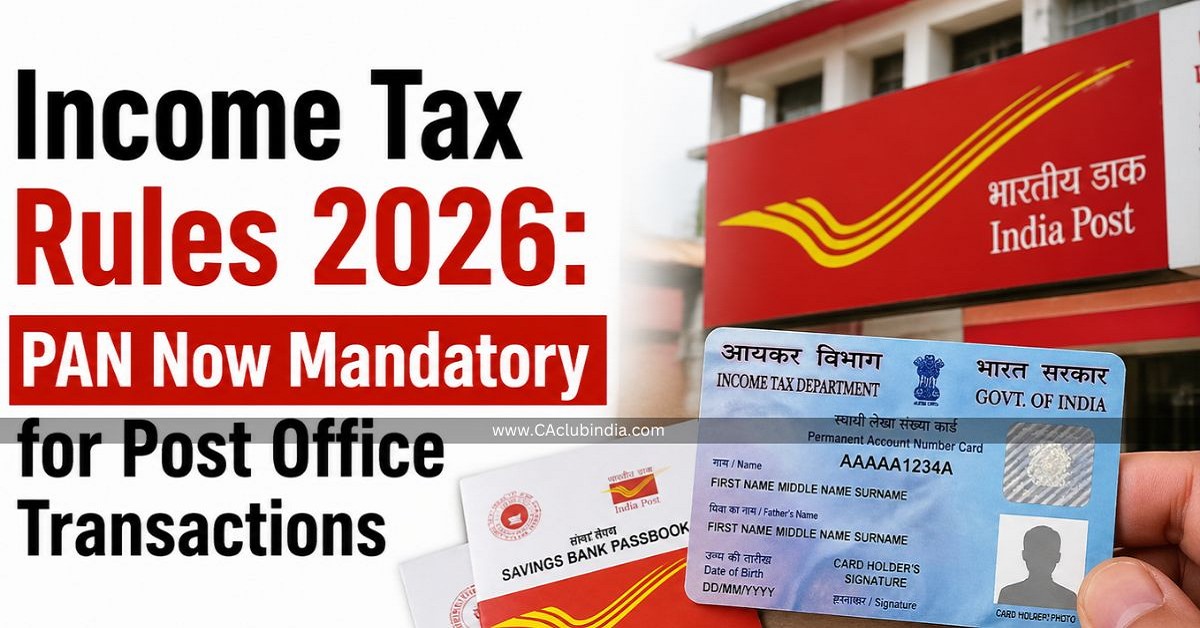
The Department of Posts has officially implemented the Income Tax Rules, 2026, bringing significant changes to how financial transactions are handled at post offices across India. The new framework, effective from April 1, 2026, introduces stricter reporting norms, mandatory PAN requirements and revamped declaration forms.
The move follows a notification issued by the Central Board of Direct Taxes (CBDT), aiming to align postal financial operations with the newly introduced Income-tax Act, 2025.
Key Highlight: Forms 15G & 15H Replaced by Form 121
One of the most notable changes is the merger of Forms 15G and 15H into a single unified Form No. 121.
- Form 121 will now be used to declare non-deduction of TDS on eligible incomes
- It applies to individuals, including senior citizens, provided their tax liability is nil
- This change simplifies compliance and reduces duplication in filing
Post offices must collect and verify this form and maintain records for seven years.
PAN Now Mandatory for High-Value Transactions
Under the new rules, quoting a Permanent Account Number (PAN) has become compulsory for specified transactions, including:
- Deposits and withdrawals
- Account opening
- Time deposit investments
If a customer does not have a PAN, they must submit Form No. 97, along with identity and transaction details.
New Forms Introduced: Form 97 & Form 98
The government has replaced the earlier Form 60 with:
- Form 97 - Declaration for individuals without PAN
- Form 98 - Reporting statement to be filed with the Income Tax Department
Post offices must:
- Verify Form 97 details
- Retain records for 6 years
- Submit Form 98 within prescribed timelines
Strict Reporting Deadlines Introduced
The new compliance framework mandates strict timelines:
- Declarations received till September 30 - Report by October 31
- Declarations received till March 31 - Report by April 30 (next FY)
Failure to comply may attract penalties under the Income-tax Act.
Introduction of Unique Identification Number (UIN)
Each Form 121 declaration must now be assigned a 26-character Unique Identification Number (UIN) by the concerned authority.
- Ensures tracking and transparency
- Mandatory for quarterly TDS reporting
- Must be generated even for manual submissions
This marks a major step toward digitized tax compliance.
Statement of Financial Transactions (SFT) Made Mandatory
The rules also require reporting of high-value transactions through:
- Form 165 (SFT Reporting)
- Submission within prescribed timelines
This enhances monitoring of large financial activities across postal networks.
Transition Phase: Existing Systems to Continue Temporarily
Until system upgrades (like Finacle integration) are completed:
- Existing processes for Form 60 and Forms 15G/15H will continue temporarily
- Manual registers will be used for UIN generation
Why This Matters for Customers and Taxpayers
These changes directly impact millions of India Post savings account holders and investors:
- Increased compliance requirements
- Mandatory documentation for transactions
- Reduced chances of tax disputes due to better reporting
Experts believe the move will improve transparency and align postal financial services with modern tax systems.
Conclusion
The implementation of Income-Tax Rules 2026 marks a significant transformation in India's postal financial ecosystem. With stricter documentation, unified forms, and digital tracking mechanisms, the government aims to create a more transparent and efficient tax compliance framework.
Customers are advised to ensure they have valid PAN details and understand the new form requirements to avoid disruptions in their financial transactions.
Click here to view/download the official copy of the order














 CAclubindia