A simple dhaba bill has sparked an important conversation about GST and consumer awareness.
CA Pratik Bharda recently shared his experience on Twitter/X after stopping at Hotel Jammu Himachal Dhaba in Cheerwa, Udaipur while travelling on the Jaipur highway.
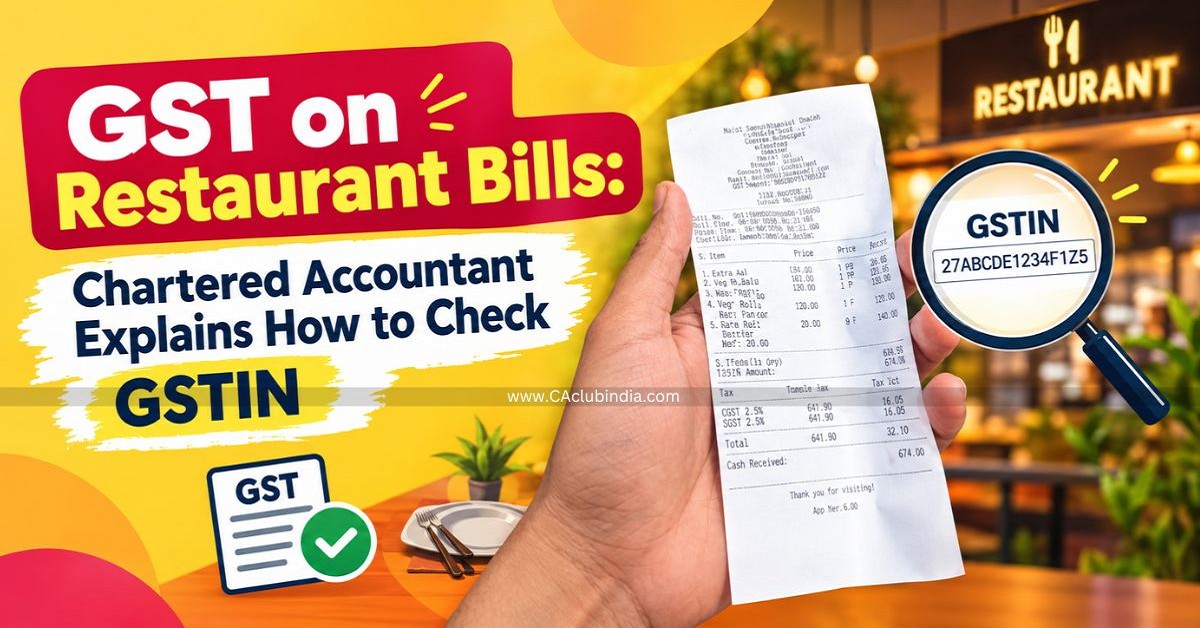
According to his post, the bill came to Rs 641.90 for food, along with Rs 32.10 GST, taking the total amount payable to Rs 674 .
The bill showed CGST at 2.5% and SGST at 2.5%, amounting to an effective GST rate of 5%.
But before making the payment, Bharda decided to do something that most customers may not think of doing - he checked the GSTIN printed on the bill.
CA Pratik Bharda Checks the Dhaba's GSTIN
As explained in his post, Bharda visited the GST portal, entered the GSTIN mentioned on the bill and checked the taxpayer's registration details.
The status appeared as "Regular Taxpayer."
That gave him confidence to proceed with the payment.
While sharing the incident, Bharda used it to highlight a broader issue that consumers should be aware of when paying GST at small restaurants, dhabas and other establishments.
Can a Composition Taxpayer Collect GST From Customers?
No.
A taxpayer registered under the GST Composition Scheme cannot collect GST separately from customers.
The composition scheme is designed as a simplified taxation mechanism for eligible small taxpayers. A composition taxpayer pays tax under the prescribed scheme but cannot collect GST from the customer in the manner a regular taxpayer does.
Instead, a composition taxpayer generally issues a Bill of Supply rather than a regular tax invoice.
This makes checking the GST registration status particularly useful when a customer sees GST separately added to a bill.
Regular vs Composition Taxpayer: Why It Matters
For consumers, the distinction is important.
A regular GST taxpayer can charge GST on taxable supplies at the applicable rate, subject to the relevant GST provisions and conditions.
On the other hand, a composition taxpayer cannot separately collect GST from customers.
Therefore, if a customer sees GST added to a restaurant or dhaba bill, checking the business's GSTIN can provide useful information about its registration status.
However, the mere presence of a GST amount on a bill does not automatically mean that the charge is incorrect. The taxpayer's registration, nature of supply and applicable GST provisions need to be considered.
How to Check a Restaurant's GSTIN
Bharda's post also offers a practical tip for consumers.
Before paying a GST-inclusive bill, customers can verify the GSTIN printed on the invoice through the GST portal.
The basic process is:
1. Find the GSTIN: Look for the GSTIN mentioned on the restaurant or dhaba bill.
2. Visit the GST portal: Go to the official GST website.
3. Select "Search Taxpayer": Use the taxpayer search facility.
4. Enter the GSTIN: Enter the number exactly as printed on the bill.
5. Check the registration details: Review whether the taxpayer is shown as a regular taxpayer, composition taxpayer or another status.
This quick verification can help consumers better understand the GST treatment appearing on their bills.
What Happened in This Case?
In the incident shared by CA Pratik Bharda, the dhaba's GSTIN showed it was registered as a Regular Taxpayer.
The bill therefore did not raise the particular concern associated with a composition taxpayer separately collecting GST.
The bigger lesson from his post is about consumer awareness.
Stopped at a dhaba on the Jaipur highway yesterday. Hotel Jammu Himachal Dhaba,
— 🎓 CA Pratik Bharda (@pratik0227) September 8, 2026
Cheerwa, Udaipur. Bill came: ₹641.90 food + ₹32.10 GST. CGST 2.5%, SGST 2.5%.
Before I paid, I did what I always do. Opened https://t.co/fcMXl5MVeJ. Typed in the GSTIN from the bill. Hit Search.… pic.twitter.com/hSC3u67Jbd
Many people simply look at the final amount on a restaurant bill and make the payment without checking the tax details. A GSTIN printed on the bill, however, provides an opportunity to verify the business's registration status.
A 30-Second Check Before Paying
The incident shared by CA Pratik Bharda is a reminder that customers do not necessarily have to accept every tax charge without understanding it.
The next time you stop at a dhaba, restaurant or small establishment and see GST added to your bill, take a few seconds to check the GSTIN and taxpayer status.
In Bharda's case, the verification confirmed that the establishment was a regular taxpayer.
The takeaway is simple: Check the GSTIN before you pay, especially when you're unsure about the GST charge.












 CAclubindia
