The Income Tax Department has released detailed FAQs on Form No. 126, providing much-needed clarity on its purpose, eligibility, and compliance requirements under the new Income Tax Act, 2025 and Income Tax Rules, 2026.
This move is part of the government's broader effort to streamline tax procedures and align withholding tax provisions with modern cross-border business practices.
What is Form 126?
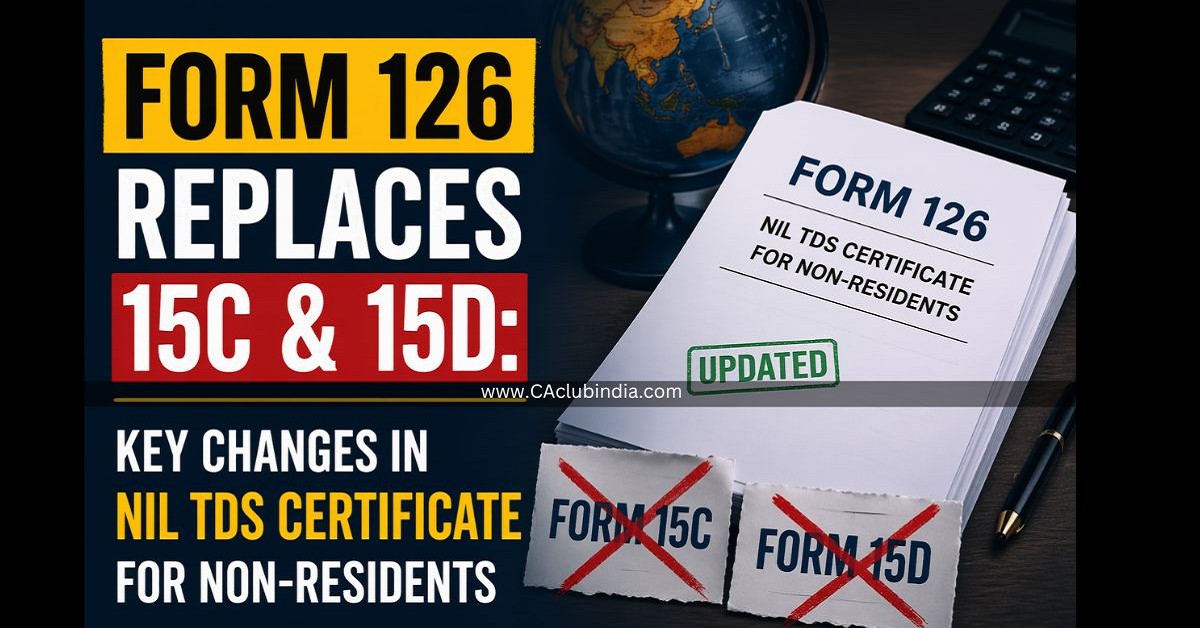
Form 126 is a newly introduced compliance form that replaces the earlier Forms 15C and 15D. It is designed for non-resident entities operating in India through branch offices to apply for a certificate allowing receipt of certain income without deduction of Tax Deducted at Source (TDS).
In simple terms, it enables eligible taxpayers to avoid excess TDS deductions where tax liability is lower or covered under tax treaties.
Who Can File Form 126?
As per the FAQs, the following entities are eligible:
- Foreign banking companies operating in India through branches
- Non-resident insurers
- Other non-resident persons carrying on business or profession in India via branch operations
However, strict conditions apply, including the nature of income and compliance with prescribed rules.
Key Conditions for Eligibility
To qualify for Form 126, entities must:
- Not be Indian companies
- Operate in India through a branch structure
- Earn specified income such as interest or other taxable sums (excluding certain categories like dividends in some cases)
- Meet conditions laid down under Rule 209 of the Income-tax Rules, 2026
This ensures only genuine cases benefit from reduced or nil TDS.
Legal Framework and Purpose
Form 126 is filed to obtain a certificate under Section 395(1) of the Income-tax Act, 2025.
The objective is to:
- Prevent excessive tax deduction at source
- Align TDS with actual tax liability
- Facilitate smoother cross-border transactions
- Improve transparency in tax compliance
Why This Update Matters
The introduction of Form 126 marks a significant shift in India’s tax compliance ecosystem:
- Unified Framework: Replaces multiple forms (15C & 15D) with a single streamlined process
- Better Compliance: Ensures accurate TDS based on real tax obligations
- Ease of Doing Business: Reduces cash flow issues for non-resident entities
- Global Alignment: Supports treaty-based taxation principles
Industry Impact
This update is particularly relevant for:
- Foreign banks and insurers operating in India
- Multinational companies with branch structures
- Tax professionals handling cross-border taxation
Businesses must review their TDS processes and ensure timely filing of Form 126 to avoid unnecessary deductions and compliance issues.
Conclusion
With the rollout of FAQs on Form 126, the Income Tax Department has taken a proactive step towards simplifying tax procedures under the new regime. As India transitions to the Income-tax Act, 2025, such clarifications will play a crucial role in helping taxpayers adapt to the evolving compliance landscape.












 CAclubindia
