The Employees' Provident Fund Organisation (EPFO), with the newly implemented Income Tax Act, 2025, has officially notified the transition from the existing Forms 15G and 15H to a unified declaration form, Form 121. This change is effective from April 1, 2026 and aims to streamline the process of claiming TDS exemption on eligible incomes.
As per the EPFO circular dated April 13, 2026, the move is part of a broader regulatory shift following the phase-out of the Income-tax Act, 1961 and the enforcement of the new tax framework.
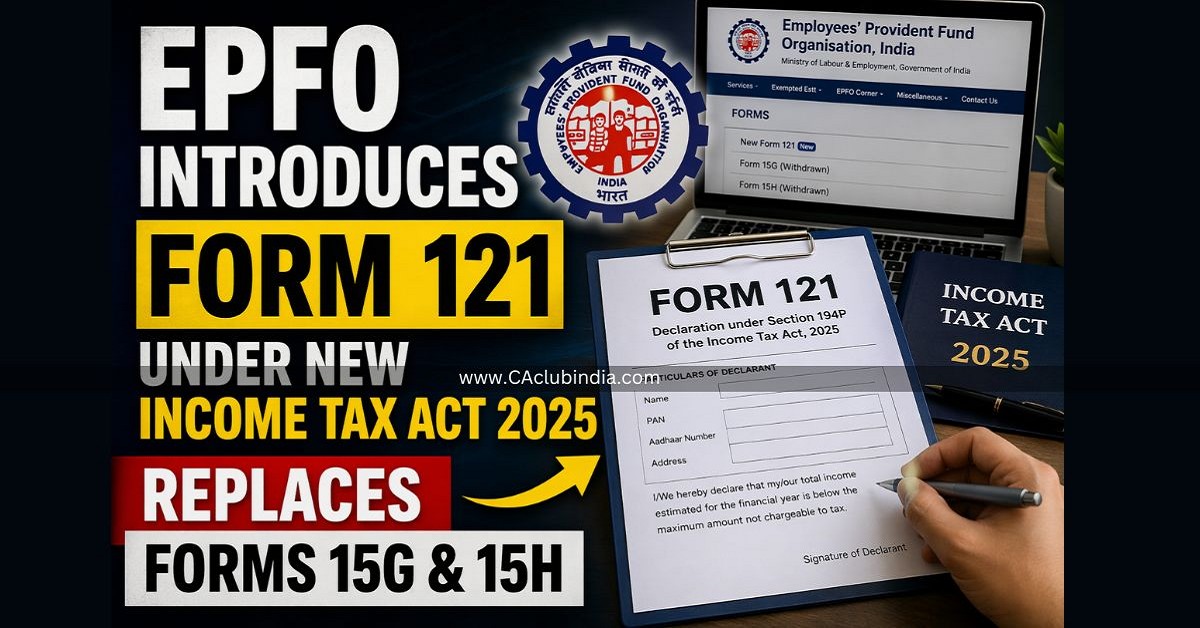
What is Form 121?
Form 121 is a consolidated self-declaration form under Section 393(6) of the Income Tax Act, 2025. It allows eligible taxpayers to declare that their estimated total income for the financial year is below the taxable limit, thereby ensuring that no Tax Deducted at Source (TDS) is applied to specified incomes.
Replacement of Forms 15G & 15H
Previously, taxpayers used:
- Form 15G (for individuals below 60 years and HUFs)
- Form 15H (for senior citizens)
Now, both have been merged into a single Form 121, simplifying compliance for all eligible taxpayers regardless of age.
Who Can File Form 121?
Form 121 can be filed by:
- Resident individuals (both below and above 60 years)
- Hindu Undivided Families (HUFs)
- Other eligible non-corporate entities
However, companies, firms, and non-residents are not eligible to use this form.
Types of Income Covered
The declaration applies to multiple income streams, including:
- EPF withdrawals
- Interest income (bank/post office deposits)
- Insurance commission
- Rent income
- Mutual fund income
- Dividends and life insurance payouts
Key Compliance Requirements for EPFO & Payers
EPFO and other deductors must adhere to strict compliance norms:
- Unique Identification Number (UIN): Each Form 121 must be assigned a UIN by the payer
- Monthly Reporting: A consolidated statement of all Form 121 submissions must be filed by the 7th of the following month
- Quarterly TDS Filing: UINs must be reported in Form 140 (TDS return)
- Digital Filing: Facility for e-sign and online submission is being developed
Failure to comply, such as missing UINs or incorrect reporting, may attract penalties under the new Act.
Important Timelines
- Effective Date: April 1, 2026
- Form Submission: Before income is credited or paid
- Monthly Statement Filing: By the 7th of next month
- Quarterly Reporting: Along with TDS returns (Form 140)
Not Mandatory, But Crucial for TDS Relief
Filing Form 121 is not mandatory. However, it is essential for taxpayers who wish to avoid TDS on eligible incomes, provided their total tax liability is nil.
Why This Change Matters
This reform is expected to:
- Reduce duplication and confusion between forms
- Improve digital compliance and automation
- Enhance accuracy with pre-filled and validated data
- Simplify TDS exemption claims for taxpayers
EPFO has also advised all regional offices to actively educate members about the new form and ensure smooth implementation.
Click here to view/download the official copy of the circular
Final Takeaway
The introduction of Form 121 marks a major shift in TDS compliance under the Income Tax Act, 2025. Taxpayers, employers, and financial institutions must quickly adapt to the new system to avoid penalties and ensure seamless tax reporting.












 CAclubindia
