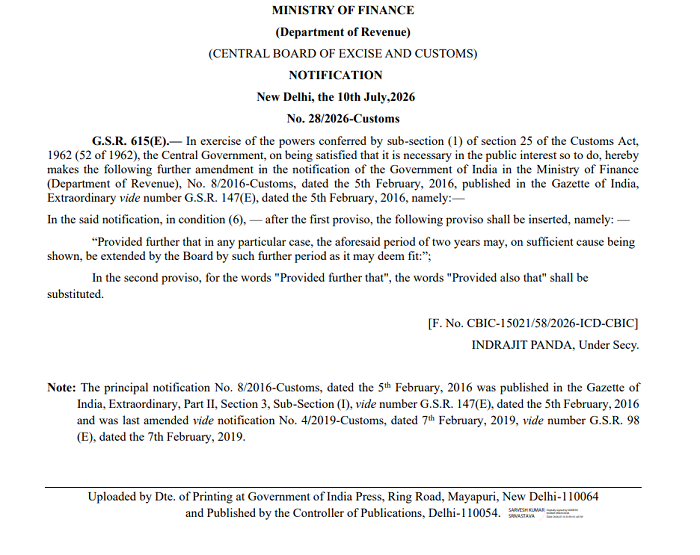
The Central Board of Indirect Taxes and Customs (CBIC) has issued Notification No. 28/2026-Customs dated 10 July 2026, introducing an important amendment to Notification No. 8/2016-Customs. The change provides greater flexibility by allowing the Board to extend the prescribed two-year period in deserving cases where sufficient cause is demonstrated.
The amendment has been issued under the powers conferred by Section 25(1) of the Customs Act, 1962, with the Government stating that the change has been made in the public interest.
What Has Changed?
Under the existing provisions of Notification No. 8/2016-Customs, certain benefits and conditions were linked to a specified period of two years. The latest notification inserts a new proviso empowering the Board to grant additional time beyond this period.
The newly inserted proviso states that:
Where sufficient cause is shown in a particular case, the Board may extend the prescribed two-year period by such further duration as it considers appropriate.
In simple terms, taxpayers, importers, exporters, or other eligible entities covered by the notification can now seek relief if they are unable to comply with the prescribed timeline due to genuine and justifiable reasons.
Significance of the Amendment
The amendment is expected to benefit stakeholders facing practical difficulties in meeting the two-year deadline because of circumstances beyond their control. Earlier, the absence of an explicit extension mechanism often created uncertainty and could result in the denial of benefits despite genuine hardships.
With the new provision:
- The Board now has discretionary powers to grant extensions on a case-by-case basis.
- Genuine cases can receive additional time upon demonstrating sufficient cause.
- Procedural compliance becomes more flexible without requiring a fresh amendment each time exceptional situations arise.
- Businesses may obtain relief in cases involving litigation, administrative delays, force majeure events, or other legitimate impediments.
Technical Amendment to Proviso Numbering
The notification also makes a consequential drafting change. Since a new proviso has been inserted after the first proviso, the wording in the existing second proviso has been modified.
Accordingly:
- The newly inserted provision becomes the second proviso.
- The earlier second proviso is redesignated through the substitution of the words "Provided further that" with "Provided also that".
This change is purely editorial and ensures proper sequencing of the provisos.
Background of Notification No. 8/2016-Customs
Notification No. 8/2016-Customs was originally issued on 5 February 2016 and has served as an important customs exemption notification. The notification was last amended in February 2019 before the present amendment.
The latest notification does not alter the substantive exemption itself but introduces an administrative relaxation mechanism that can help stakeholders avoid unintended hardship arising from strict adherence to the two-year limitation period.
Conclusion
Notification No. 28/2026-Customs introduces a pragmatic and taxpayer-friendly change by empowering the Board to extend the two-year period prescribed under Notification No. 8/2016-Customs where sufficient cause exists. The amendment recognizes that exceptional circumstances may prevent timely compliance and provides a formal mechanism for granting relief in deserving cases. Businesses and customs stakeholders should evaluate whether ongoing or future cases could benefit from this newly introduced extension power.












 CAclubindia
