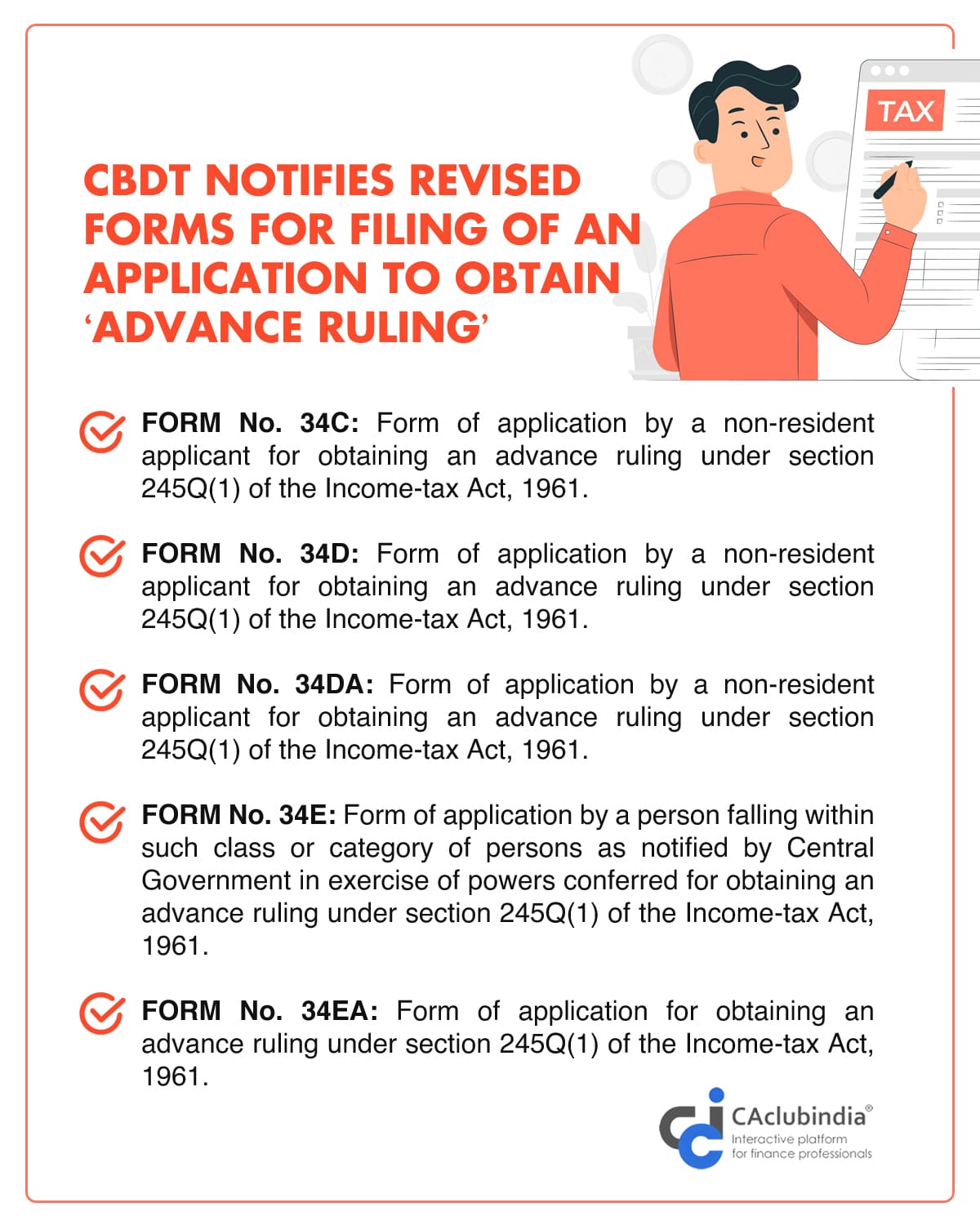
The Central Board of Direct Taxes (CBDT) on May 05, 2022 has issued the Income-tax (Twelfth Amendment) Rules, 2022 to further amend the Income-tax Rules, 1962. Official copy of the notification has been mentioned below
MINISTRY OF FINANCE
(Department of Revenue)
(CENTRAL BOARD OF DIRECT TAXES)
NOTIFICATION
New Delhi, the 5th May, 2022
G.S.R. 339(E).—In exercise of the powers conferred by the section 245Q read with section 295 of the Income-tax Act, 1961 (43 of 1961), the Central Board of Direct Taxes hereby makes the following rules further to amend Income-tax Rules, 1962, namely:
1. Short title and commencement. - (1) These rules may be called the Income-tax (Twelfth Amendment) Rules, 2022.
(2) They shall come into force from the date of their publication in the Official Gazette.
2. In the Income-tax Rules, 1962, (hereinafter referred to as the said rules), in rule 44E,––
(I) in sub-rule (1), the words "in quadruplicate" shall be omitted;
(II) for sub-rule (2), the following sub-rule shall be substituted, namely:–
"(2) The application referred to in sub-rule (1), the verification appended thereto, the annexures to the said application and the statements and documents accompanying the annexures, shall be,—
(a) in the case of an individual,—
(I) signed digitally, if he is required under these rules to furnish his return of income under digital signature,––
(i) by the individual himself; or
(ii) where, for any unavoidable reason, it is not possible for the individual to sign the application, by any person duly authorised by him in this behalf:
Provided that in a case referred to in sub-clause (ii), the person signing the application holds a valid power of attorney from the individual to do so, which shall be attached to the application ; or
(II) communicated through his registered e-mail address, in any other case;
(b) in the case of a Hindu undivided family,—
(I) signed digitally, if it is required under these rules to furnish his return of income under digital signature,––
(i) by the karta thereof; and
(ii) where, for any unavoidable reason, it is not possible for the karta to sign the application, by any other adult member of such family; or
(II) communicated through its registered e-mail address, in any other case;
(c) in the case of a company, digitally signed,—
(i) by the Managing Director thereof; or where for any unavoidable reason such Managing Director is not able to sign and verify the application, or where there is no Managing Director, by any Director thereof ;
(ii) where, for any unavoidable reason, it is not possible for the Managing Director or the Director to sign the application, by any person duly authorised by the company in this behalf :
Provided that in the case referred to in sub-clause (ii), the person signing the application holds a valid power of attorney from the company to do so, which shall be attached to the application ;
(d) in the case of a firm,
(I) signed digitally, if it is required under these rules to furnish his return of income under digital signature,––
(i) by the managing partner thereof; and
(ii) where for any unavoidable reason such managing partner is not able to sign and verify the application, or where there is no managing partner as such, by any partner thereof, not being a minor ;
(II) communicated through its registered e-mail address, in any other case;
(e) in the case of an association of persons,––
(I) signed digitally, if it is required under these rules to furnish his return of income under digital signature, by any member of the association or the principal officer thereof; or
(II) communicated through its registered e-mail address, in any other case;
(f) in the case of any other person,––
(I) signed digitally, if it is required under these rules to furnish his return of income under digital signature, by that person or by some other person competent to act on his behalf; or
(II) communicated through his registered e-mail address, in any other case.";
To view the full notification, Click Here












 CAclubindia
