Happy birthday to swami vivekananda

3247 views 30 replies
. . . . SWAMI VIVEKANANDA'S inspiring personality was well known both in India and in America during the last decade of the nineteenth century and the first decade of the twentieth. The unknown monkof India suddenly leapt into fame at the Parliament of Religions heldin Chicago in 1893, at which he represented Hinduism. His vast knowledge of Eastern and Western culture as well as his deep spiritual insight, fervid eloquence, brilliant conversation, broad human sympathy, colourful personality, and handsome figure made an irresistible appeal to themany types of Americans who came in contact with him. People who saw or heard Vivekananda even once still cherish his memoryafter a lapse of more than half a century. In America Vivekananda's mission was the interpretation of India's spiritual culture, especially in its Vedantic setting. He also tried to enrich the religious consciousness of the Americans through the rational and humanistic teachings of the Vedanta philosophy. In America he became India's spiritualambassador and pleaded eloquently for better understanding between India and the New World in order to create a healthy synthesis of East and West, of religion and science. In his own motherland Vivekananda is regarded as the patriot saint of modern India and an inspirer of her dormant national consciousness, To the Hindus he preached the ideal of a strength-giving and man-making religion. Service to man as the visible manifestation of the Godhead was the special form of worship he advocated for the Indians, devoted as they were to the rituals and myths of their ancient faith. Many political leaders of India have publicly acknowledged their indebtedness to Swami Vivekananda. The Swami's mission was both national and international. A loverof mankind, he strove to promotepeace and human brotherhood onthe spiritual foundation of the Vedantic Oneness of existence. A mystic of the highest order, Vivekananda had a direct and intuitive experience of Reality. He derived his ideas from that unfailing source of wisdom and often presented them in the soulstirring language of poetry. The natural tendency of Vivekananda's mind, like that of his Master, Ramakrishna, was to soar above the world and forget itself in contemplation of the Absolute. But another part of his personality bled at the sight of human suffering in East and West alike. It might appear that his mind seldom found a point of restin its oscillation between contemplation of God and service to man. Be that as it may, he chose, in obedience to a higher call, service to man as his mission on earth; and this choice has endeared him to people in the West, Americans in particular. In the course of a short life of thirty-nine years (1863-1902), of which only ten were devoted to public activities-and those, too, inthe midst of acute physical suffering-he left for posterity his four classics: Jnana-Yoga, Bhakti-Yoga, Karma-Yoga, and Raja-Yoga, all of which are outstanding treatises on Hindu philosophy. In addition, he delivered innumerable lectures, wrote inspired letters in his own hand to his many friends and disciples, composed numerous poems, and acted as spiritual guide to the many seekers, who came to him for instruction. He also organized the Ramakrishna Order of monks, which is the mostoutstanding religious organization of modern India. It is devoted to the propagation of the Hindu spiritual culture not only in the Swami's native land, but also in America and in other parts of theworld. Swami Vivekananda once spoke ofhimself as a "condensed India." His life and teachings are of inestimable value to the West for an understanding of the mind of Asia. William James, the Harvard philosopher, called the Swami the"paragon of Vedantists." Max Muller and Paul Deussen, the famous Orientalists of the nineteenth century, held him in genuine respect and affection."His words," writes Romain Rolland,"are great music, phrases in the style of Beethoven, stirring rhythms like the march of Handel choruses. I cannot touch these sayings of his, scattered as they are through the pages of books, at thirty years' distance, without receiving a thrill through my bodylike an electric shock. And what shocks, what transports, must have been produced when in burning words they issued from the lips of the hero!'' . . we should follow rules of swami vivekananda.smile.
Replies (30)

Yes Hardik i love swamivivekanada really very very veryy y THANKS for sharing this ..........................

Really i am glad to see this forum and


Ya Hardik,

I too respect to Swami Vivekananad.


Happy birthday to Swami Vivekananda

Happy Birthday. A very important day in the History of India. The birth of a Legend.

I would like to share some Quotes by Swami Vivekananda. Please see the attached file.

Also Must See Below Link.....


Swami Vivekananda

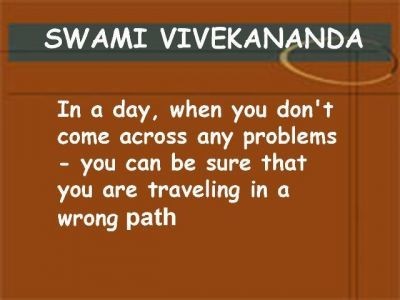
There is one thought of swami vivekananda is always on my mind .....

Thought reflect upon u smiley

Thanks a lot bro for this yes

Ap aise hi new new things batate rehna angel


Happy Birthday to Swami Vivekananda..............

Here i am attaching a biography of Swami Vivekananda....

Take a Look.....

Thankyou Hardik for opening a thread to remember Swami Vivekananda ji..

Swami Vivekananda was born in 3,  Shimla Pally, Calcutta (presently known as Kolkata) on 12 January 1863, Monday at 6:49 A.M., during the Makara Sankrantifestival in a traditional Kayastha family and was given the name Narendranath Dutta.

Narendranath's thinking and personality were influenced by his parents—the father by his rational mind and the mother by her religious temperament. From his mother he learnt the power of self-control. One of the sayings of his mother Narendranath quoted often in his later years was,

 "Remain pure all your life; guard your own honor and never transgress the honor of others. Be very tranquil, but when necessary, harden your heart."

He evinced much interest in the Hindu scriptttures like the Vedas, the Upanishads, the Bhagavad Gita, the Ramayana, the Mahabharata and the Puranas. He was also well versed in classical music, both vocal and instrumental and is said to have undergone training under two Ustads, Beni Gupta and Ahamad Khan.

Dr. William Hastie, the principal of Scottish Church College, where he studied during 1881-84, wrote,

"Narendra is really a genius. I have travelled far and wide but I have never come across a lad of his talents and possibilities, even in German universities, among philosophical students."

He was regarded as a Srutidhara—a man with prodigious memory. After a discussion with Narendranath, Dr. Mahendralal Sarkar reportedly said,

 "I could never have thought that such a young boy had read so much!"

His first introduction to Ramakrishna occurred in a literature class in General Assembly's Institution, when he heard Principal Reverend W. Hastie lecturing on William Wordsworth's poem The Excursion and the poet's nature-mysticism. In the course of explaining the word trance in the poem, Hastie told his students that if they wanted to know the real meaning of it, they should go to Ramakrishna of Dakshineswar. This prompted some of his students, including Narendranath to visit Ramakrishna.

Narendranath's meeting with Ramakrishna in November 1881 proved to be a turning point in his life. About this meeting, Narendranath said, "Ramakrishna looked just like an ordinary man, with nothing remarkable about him. He used the most simple language and I thought "Can this man be a great teacher?". I crept near to him and asked him the question which I had been asking others all my life: "Do you believe in God, Sir?"

 "Yes", he replied.

"Can you prove it, Sir?"

 "Yes".

"How?"

 "Because I see Him just as I see you here, only in a much intenser sense." That impressed me at once.  I began to go to that man, day after day, and I actually saw that religion could be given. One touch, one glance, can change a whole life."

Even though Narendra did not accept Ramakrishna as his guru initially and revolted against his ideas, he was attracted by his personality and visited him frequently. He initially looked upon Ramakrishna's ecstasies and visions as, "mere figments of imagination", "mere hallucinations". As a member of Brahmo samaj, he revolted against idol worship and polytheism, and Ramakrishna's worship of Kali.

Though at first Narendra could not accept Ramakrishna and his visions, he could not neglect him either. It had always been in Narendra's nature to test something thoroughly before he would accept it. He tested Ramakrishna, who never asked Narendra to abandon reason, and faced all of Narendra's arguments and examinations with patience—

"Try to see the truth from all angles" was his reply.

During the course of five years of his training under Ramakrishna, Narendra was transformed from a restless, puzzled, impatient youth to a mature man who was ready to renounce everything for the sake of God-realization. In time, Narendra accepted Ramakrishna as guru, and when he accepted, his acceptance was whole-hearted and with complete surrendering as disciple.

Later, In 1888, Vivekananda left the monastery as a Parivrâjaka—the Hindu religious life of a wandering monk, "without fixed abode, without ties, independent and strangers wherever they go."

His sole possessions were a kamandalu (water pot), staff, and his two favorite books—Bhagavad Gita and The Imitation of Christ.

He developed a sympathy for the suffering and poverty of the masses and resolved to uplift the nation. Living mainly on Bhiksha or alms, Narendranath traveled mostly on foot and railway tickets bought by his admirers whom he met during the travels.

At Bangalore, the Swami became acquainted with Sir K. Seshadri Iyer, the Dewan of Mysore state, and later he stayed at the palace as guest of the Maharaja of Mysore, Chamaraja Wodeyar. Regarding the Swami's learning, Sir Seshadri reportedly remarked,

"a magnetic personality and a divine force which were destined to leave their mark on the history of his country."

He had composed many songs including his favorite Kali the Mother. He used humour for his teachings and was also an excellent cook. His language is very free flowing. His own Bengali writings stand testimony to the fact that he believed that words - spoken or written - should be for making things easier to understand rather than show off the speaker or writer's knowledge.


Swami Vivekananda on the Platform of the Parliament of Religions


The Parliament of Religions opened on 11 September 1893 at the Art Institute of Chicago. On this day Vivekananda gave his first brief address. He represented India and Hinduism. Though initially nervous, he bowed to Saraswati, the goddess of learning and began his speech with,

"Sisters and brothers of America!". To these words he got a standing ovation from a crowd of seven thousand, which lasted for two minutes. When silence was restored he began his address. He greeted the youngest of the nations in the name of "the most ancient order of monks in the world, the Vedic order of sannyasins, a religion which has taught the world both tolerance and universal acceptance." And he quoted two illustrative passages in this relation, from the Bhagavad Gita—

"As the different streams having their sources in different places all mingle their water in the sea, so, O Lord, the different paths which men take, through different tendencies, various though they appear, crooked or straight, all lead to Thee!" and "Whosoever comes to Me, through whatsoever form, I reach him; all men are struggling through paths that in the end lead to Me."

Despite being a short speech, it voiced the spirit of the Parliament and its sense of universality.

Swami Vivekananda believed that the essence of Hinduism was best expressed in the Vedanta philosophy

Each soul is potentially divine.

The goal is to manifest this Divinity within by controlling nature, external and internal.

Do this either by work, or worship, or mental discipline, or philosophy—by one, or more, or all of these—and be free.

 This is the whole of religion. Doctrines, or dogmas, or rituals, or books, or temples, or forms, are but secondary details.

So long as even a single dog in my country is without food my whole religion is to feed it and serve it, anything excluding that is nonreligious.

The first governor general of independent India, Chakravarti Rajagopalachari, said "Vivekananda saved Hinduism, saved India."

According to Subhash Chandra Bose, Vivekananda "is the maker of modern India"

Mohandas Gandhi, Vivekananda's influence increased his "love for his country a thousandfold."

National Youth Day in India is held on his birthday, January 12.

Many years after Vivekananda's death, Rabindranath Tagore told Romain Rolland,

“ "If you want to know India, study Vivekananda. In him everything is positive and nothing negative."

Vivekananda inspired Jamshedji Tata to set up Indian Institute of Science, one of India's finest Institutions.

Scientist Nikola Tesla was one of those influenced by the Vedic philosophy teachings of the Swami Vivekananda. On November 11, 1995, a section of Michigan Avenue, one of the most prominent streets in Chicago, was formally renamed "Swami Vivekananda Way".

Vivekananda observed that the billions of people on the earth could be classified into four basic types- those who were in constant activity, or the worker;

those who were driven by their inner urge to achieve something in life, or the lover;

those who tended to analyze the working of their minds, or the mystic;

 and those who weighed everything with reason, or the philosopher.

He had composed many songs including his favorite Kali the Mother. He used humour for his teachings and was also an excellent cook. His language is very free flowing. His own Bengali writings stand testimony to the fact that he believed that words - spoken or written - should be for making things easier to understand rather than show off the speaker or writer's knowledge.

source: Wikipedia


"The greatest sin is think yourself weak"

“Always first learn to be a servant, and then you will be fit to be a master"

"“Your country requires heroes; be heroes; your duty is to go on working, and then everything will follow of itself.”

Thankyou sanjay bhaiah, for sharing great Quotes, Aaj tho  superb subah hein, no need to think ourself weak., we are the strongest.. as long as we are on the path of such great personalities...

@ Sanket, Thanks to you too for gifting us biography of Swami vivekanandaji..

You all made this morning as fantastic morning..Thanks to all...

HAppy Birthday to the great personality

HAppy Birthday to the great personality

Very lovely post....

Got to know many great aspects of this great man through coments of thie post.

Thanks a ton...

Keep Sharing.


Happy birthday to swami vivekananda

Happy Birthday to Swami Vivekananda..............


CCI Pro

Leave a Reply

Your are not logged in . Please login to post replies

Click here to Login / Register