The Income-tax Rules, 2026 continue to strengthen procedural clarity by expressly laying down the conditions under which a return of income shall be treated as a defective return. Rule 166, notified under the new rules, operationalises section 263(7) of the Income-tax Act by specifying clear, objective parameters for identifying defective returns.
What Does Rule 166 Deal With?
Rule 166 sets out the statutory conditions that render a return of income defective. If any of the prescribed conditions are satisfied, the return filed by the assessee may be treated as defective, triggering rectification requirements and possible compliance consequences.
Conditions for Treating a Return as Defective
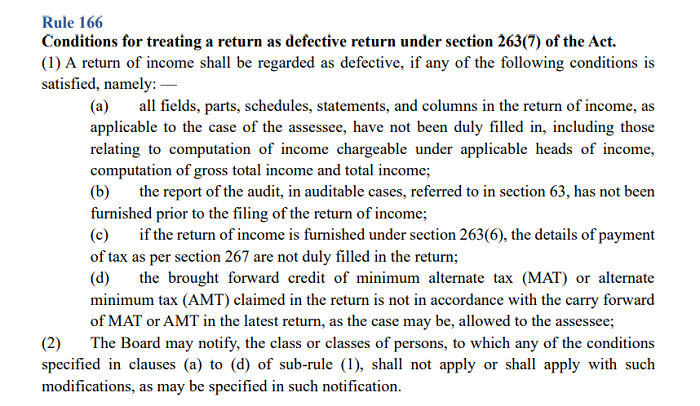
As per Rule 166(1), a return of income shall be regarded as defective if any one of the following conditions is fulfilled:
Incomplete or Improperly Filled Return
A return will be defective if all applicable fields, parts, schedules, statements or columns have not been duly filled in. This explicitly includes:
- Computation of income under applicable heads
- Computation of Gross Total Income
- Computation of Total Income
The rule reinforces that partial disclosure or missing computations are no longer treated as minor technical lapses.
Non-Furnishing of Audit Report Before Filing Return
In cases where an audit is mandatory under section 63, failure to furnish the audit report prior to filing the return of income will result in the return being treated as defective.
This provision underscores the importance of sequencing compliance - audit first, return filing thereafter.
Missing Tax Payment Details in Certain Returns
Where a return is furnished under section 263(6), the return shall be regarded as defective if details of tax payment as required under section 267 are not duly filled in.
This ensures accurate linkage between tax payments and the corresponding return, facilitating automated verification.
Incorrect Claim of MAT or AMT Credit
A return will also be defective if the brought forward credit of Minimum Alternate Tax (MAT) or Alternate Minimum Tax (AMT) claimed:
- Does not align with, or
- Exceeds the MAT/AMT credit allowed in the latest return
This provision prevents inconsistent or inflated carry-forward claims across assessment years.
Power of CBDT to Notify Exceptions
Rule 166(2) empowers the Central Board of Direct Taxes (CBDT) to notify:
- Specific classes of persons to whom any of the conditions may not apply, or
- Cases where the conditions may apply with suitable modifications
This enables administrative flexibility to address practical difficulties faced by certain categories of taxpayers.
Why Rule 166 Is Significant
By codifying defective return conditions within the Income-tax Rules, 2026, Rule 166:
- Brings greater certainty and uniformity
- Minimises discretionary interpretation
- Encourages accurate return filing at the first stage
- Reduces avoidable notices and delays in processing
For taxpayers and professionals, the rule serves as a clear compliance checklist at the time of filing returns.
Key Takeaway
Under the Income-tax Rules, 2026, accuracy, completeness and consistency are non-negotiable. Rule 166 makes it clear that incomplete disclosures, delayed audit reporting, missing tax payment details or incorrect MAT/AMT claims can render a return defective.
Taxpayers should therefore ensure meticulous compliance to avoid rectification proceedings and procedural setbacks.












 CAclubindia
