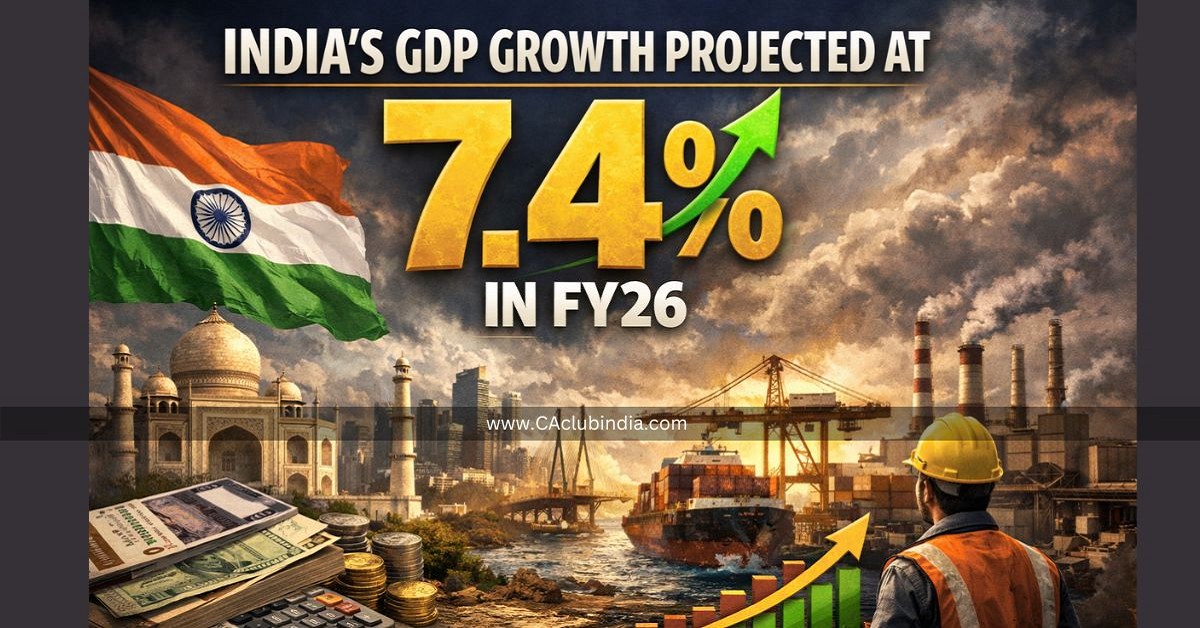
India's real gross domestic product (GDP) is estimated to grow by 7.4% in the current fiscal year, driven by robust performance in the services and manufacturing sectors, according to data released by the Ministry of Statistics and Programme Implementation on Wednesday.
The estimate marks an improvement over last year's growth of 6.5% , highlighting sustained momentum in domestic economic activity despite global headwinds.
Services, Manufacturing Lead Growth
Data from the National Statistics Office (NSO) shows the services sector emerging as the primary growth engine, with output expected to rise 9.1% in FY26, up from 7.2% in the previous year. Manufacturing activity is also projected to strengthen, with growth estimated at 7% , compared to 4.5% last fiscal.
Reflecting the overall economic expansion, per capita national income is projected to increase by Rs 16,025, reaching Rs 2,47,487 in FY26.
Nominal Growth Below Budget Target, Fiscal Deficit Stable
While real GDP growth remains strong, nominal GDP growth is estimated at 8% , falling short of the 10.1% assumed in the Union Budget. Economists, however, believe the lower nominal growth is unlikely to disrupt the government's fiscal deficit roadmap.
According to tax experts, the First Advance Estimate pegs nominal GDP at Rs 357.1 lakh crore. With the fiscal deficit targeted at 4.4% of GDP, the government remains on track as the base GDP for 2024-25 has been revised upward to Rs 330.7 lakh crore, compared to the budgeted Rs 324.1 lakh crore. The higher base has helped offset the impact of slower-than-expected growth.
Growth Outlook Supported by Policy Measures
Economists attribute the healthy growth outlook to a combination of GST rationalisation, lower personal income-tax burden, moderating inflation, interest rate cuts, and strong rural demand.
However, experts caution against complacency. "While domestic fundamentals remain supportive, heightened global uncertainties-especially trade barriers imposed by the US-could affect India's exports and capital flows," said the Chief Economist at CareEdge.
Tax Revenue Concerns Remain
Despite stability on the fiscal front, slower nominal growth could weigh on gross tax revenues (GTR). During the first eight months of the current fiscal year, GTR growth stood at 3.34% , significantly below expectations.
Experts warn that lower-than-budgeted nominal GDP growth, combined with modest tax buoyancy of 1.07 over revised estimates for FY25, could lead to downward revisions in tax revenue projections for FY26.
New GDP Series to Be Released in February
The latest estimates represent the final release under the 2011-12 base year series and are derived from high-frequency economic indicators available up to November. These figures may be revised in subsequent reports.
A new GDP series with a 2022-23 base year is scheduled for release on February 27, alongside the Second Advance Estimates for FY26 and revised annual and quarterly GDP numbers for the previous three years, aligned with the updated base year.











 CAclubindia
