The Government has proposed rationalisation of due dates for filing Income Tax Returns (ITR) under the Income-tax Act, 2025 ("the Act") to ease compliance for taxpayers in non-audit business cases and trusts. This amendment aims to facilitate timely filing, reduce grievances, and provide additional time for preparing accounts.

Key Provisions of Section 263 on Filing of Returns
Section 263 of the Income Tax Act, 2025 provides a comprehensive framework for filing returns, covering:
- Classes of persons required to file returns
- Due dates for different categories of taxpayers
- Types of returns, including original, belated, revised, and updated returns
Section 263(1)(c) defines the "due date" as the date in the financial year following the relevant tax year by which taxpayers must file their returns.
Proposed Rationalisation of Due Dates
To facilitate taxpayers engaged in business or profession and partners of firms whose accounts do not require audit, it has been proposed to extend the due date for filing returns:
- Non-audit businesses and partners of firms: Extended from 31st July to 31st August
- Individuals filing ITR-1 & ITR-2: Due date remains 31st July
This extension allows more time to prepare books of accounts and ensures compliance without undue pressure.
Amendments in Income Tax Act, 1961
A similar rationale has been applied to Explanation-2 to sub-section (1) of Section 139 of the Income-tax Act, 1961, extending due dates for non-audit business cases and trusts not requiring audits.
Effective Dates
- Income-tax Act, 2025: Amendments effective from 1st April 2026 for tax year 2026-27 and subsequent years.
- Income-tax Act, 1961: Amendments effective from 1st March 2026 for assessment year 2026-27 (previous year 2025-26).
Official copy of the Clause is as follows
Section 263 of the Income Tax Act, 2025 ("the Act") makes the provisions for filing of Income Tax Return by taxpayers. The said section deals with the comprehensive framework that lays down class of persons who are required to file a return, the due dates, and the different types of returns that may be furnished. It covers the original return, belated return, revised return and the updated return.
2. Section 263(1)(c) of the Act deals with “due date” means the date of the financial year succeeding the relevant tax year for filing the return of Income by different classes of assessee/person with different condition applied therein. In this regard, in order to facilitate the taxpayers who are engaged in business or profession and partners of a firm who do not require to get their books of account audited and trusts, it is proposed that more time should be made available to them to prepare their books of accounts to make the necessary compliances. Accordingly, rationalisation of due dates for filing of return of Income in such non audit business cases and trusts is envisaged to facilitate taxpayers and reduce grievances.
3. In this regard, assessee having income from profits and gains of business or profession whose accounts are not required to be audited under this Act or under any other law in force and partner of a firm whose accounts are not required to be audited under this Act or under any other law in force or the spouse of such partner (if section 10 applies to such spouse), their due date for filing of return is proposed to be extended from 31st July to 31st August. Further, individuals who files ITR-1 & ITR-2, their due date for filing return of Income shall remain 31st July. In this regard, amendments proposed in section 263(1)(c) of the Act are as under:
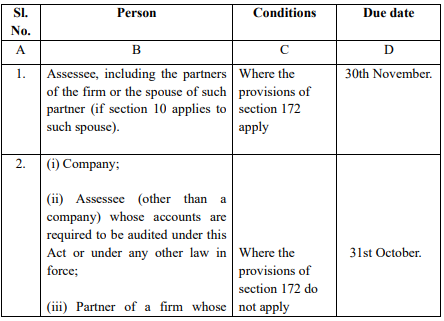
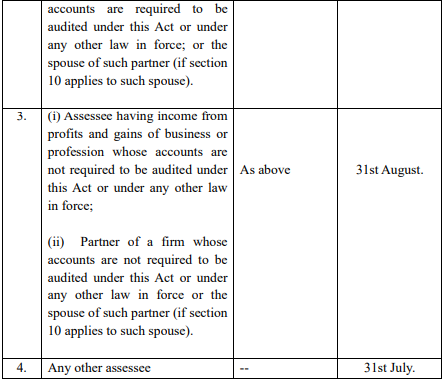
4. Similar rationale as referred in para 2 has been applied to make similar amendments in Explanation-2 to sub-section (1) of section 139 of Income-tax Act, 1961 to extend the due date of filing return of Income for non-audit business cases and Trusts requiring no audits.
5. It is proposed that the amendments made in Income-tax Act, 2025 shall come into force from the 1st day of April, 2026 for tax year 2026-27 and subsequent tax years.
6. It is proposed that the amendments made in Income-tax Act, 1961 shall come into force from the 1st day of March, 2026 for assessment year 2026-27(previous year 2025-26).











 CAclubindia
