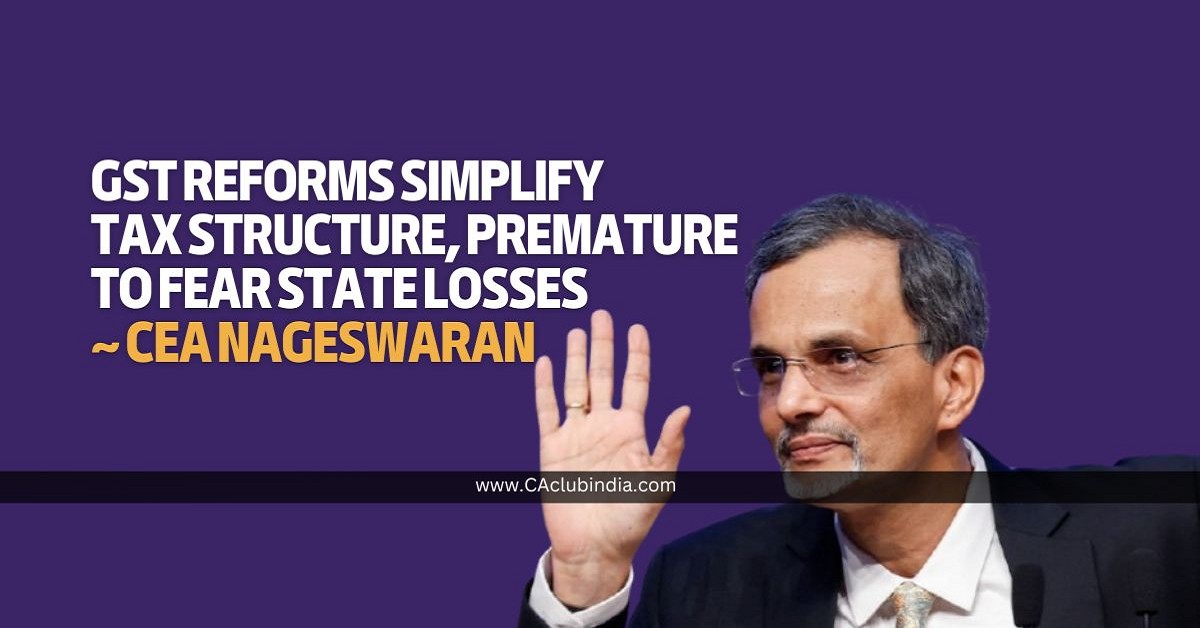
Chief Economic Advisor (CEA) V Anantha Nageswaran has expressed confidence that the Centre's newly approved GST reforms will stimulate consumption across India, even as some states remain worried about potential revenue losses.
Speaking at an event, Nageswaran said the GST Council's decision on September 3, 2025, to move from the existing four-slab structure to a two-tier system with rates of 5% and 18% along with a special 40% rate for luxury and sin goods was a landmark step in rationalising the tax regime.
While acknowledging that the revised GST rates may not fully offset the impact of the 50% tariffs imposed by US President Donald Trump, Nageswaran stressed that they "will definitely offset and compensate" losses for the Indian economy.
Premature to Assume States Will Lose Revenue
Responding to concerns voiced by states, the CEA said it would be "premature" to conclude that the rate cuts will erode state revenues. He pointed out that the pre-GST system offered no protection in times of economic downturns, unlike GST which guaranteed 14% annual revenue growth compensation to states in the initial years.
"In 2021, if we were in the old system, states would have had no cushion when revenues collapsed. With GST, they had protection," he said. Nageswaran added that states must also "do more on realising their own tax revenues," instead of relying solely on central compensation.
He explained that rate rationalisation could spur higher economic activity, increasing transaction volumes and balancing out revenue losses. "It's like a price versus volume framework. Lower rates may actually expand the tax base," he noted.
Revised GST Structure
Under the new framework:
- 5% slab - for essential goods and services.
- 18% slab - for most other products and services.
- 40% special rate - applicable only to luxury and sin goods such as private helicopters, tobacco products, and aerated drinks.
The move eliminates the earlier 12% and 28% slabs, simplifying compliance but sparking fears among some states of potential revenue losses amounting to Rs 48,000 crore.
Eight opposition-ruled states have already demanded the formation of a Group of Ministers (GoM) to study the revenue impact and suggest mechanisms for compensation.
Despite these concerns, Nageswaran maintained that the reforms were designed to strengthen consumption, create a fairer tax regime and reduce compliance complexities for both businesses and consumers.











 CAclubindia