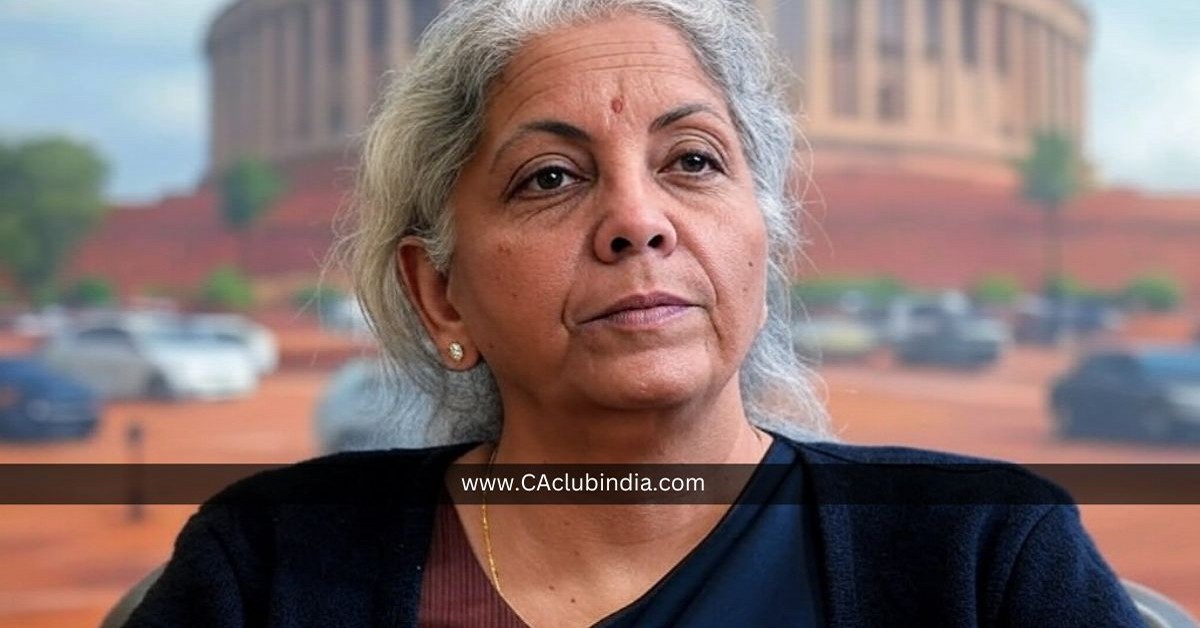
Finance Minister Nirmala Sitharaman has indicated that India is preparing for one of the most sweeping changes to its customs framework in decades, calling it her "next big cleaning up assignment" ahead of the upcoming Union Budget. She emphasised that customs administration must now match the efficiency, transparency and simplification achieved in income tax over the last ten years.
Industry bodies say the announcement has intensified expectations, with several proposals already under active discussion within the finance ministry. Businesses have long sought a customs system that lowers costs, reduces delays and aligns India's border procedures with global best practices.
Fixing Inverted Duty Structures a Top Industry Demand
A major priority for manufacturers is correcting inverted duty structures, where duties on raw materials remain higher than those on finished goods-particularly in sectors benefiting from Free Trade Agreements (FTAs).
Tax experts argue that this inversion depresses domestic competitiveness and makes finished imports artificially cheaper. Rationalising duty rates on inputs, they say, will restore tariff neutrality, boost Make in India, and encourage fresh investments in local manufacturing.
Push for Full Digitisation of Trade Schemes
Experts also highlight that compliance-heavy frameworks like AEO (Authorized Economic Operator) and MOOWR (Manufacture and Other Operations in Warehouse Regulations) need faster digitisation.
Despite earlier improvements, manual filings, inconsistent procedures and repetitive documentation continue to slow adoption. A fully digital, standardised, low-touch system covering online transfers, uniform return filing and automated approvals could significantly reduce transaction costs and improve processing timelines.
Unified Single Window Under Section 11(3)
Another major expectation is the operationalisation of Section 11(3) of the Customs Act, which would allow India to create a genuinely unified single-window system for import and export requirements.
Currently, compliance responsibilities are spread across DGFT, FSSAI, BIS, CDSCO and several other agencies, resulting in fragmented enforcement. A consolidated notification under Section 11(3) would centralise all requirements into a single, digitally accessible repository, improving regulatory certainty for both businesses and enforcement agencies.
Call for One-Time Amnesty for Legacy Customs Disputes
Industry stakeholders are urging the government to introduce a one-time amnesty scheme for old customs disputes, similar to Sabka Vishwas and Vivad se Vishwas. Such a move would help resolve pending litigations, especially for pre-GST levies such as Countervailing Duty (CVD) and Special Additional Duty (SAD), while providing immediate non-adversarial revenue to the government.
Need for Rational, Uniform Limitation Timelines
Another key area of reform is the rationalisation of limitation periods for issuing customs show-cause notices. While GST now follows a harmonised timeline under Section 74A, the Customs Act still uses different periods for normal and extended notices, often leading to prolonged litigation even in non-fraud cases. Experts say a uniform timeline would improve certainty and reduce disputes.
Several also recommend gradually phasing out the Special Valuation Branch (SVB), shifting its functions into an enhanced post-clearance audit framework to avoid duplication and expedite finalisation of Bills of Entry.
Recent Steps Show Momentum Toward Reform
Experts note that the government has already initiated consolidation by reducing tariff slabs, cutting duties on medicines, leather and raw materials, and removing the social welfare surcharge on 82 tariff items. Budget 2025-26 also unified 31 duty exemption notifications.
However, they stress the need for a sector-specific tariff restructuring strategy aligned with global value chains and clearer rules to resolve classification and valuation disputes.
Digitisation Must Anchor the Overhaul
Multiple experts underline that digital transformation should form the backbone of the upcoming reform. They propose an API-based architecture-similar to GST-covering customs filing, amendments, duty payment, refunds and post-clearance updates. Integrating Customs and DGFT systems to automatically release bonds and bank guarantees upon EODC issuance would further reduce delays.
Improving the advance ruling framework, streamlining MOOWR and SEZ rules, and harmonising valuation with transfer pricing principles are also seen as vital.
Some experts also recommend allowing consolidated appeals for multiple Bills of Entry involving the same issue, which would help reduce litigation volume. Greater awareness and clarity around AEO benefits could also speed up adoption among businesses.
A Strategic Reform for India's Position in Global Trade
Experts believe that the customs overhaul is not just a compliance reform; it is a strategic economic necessity. With global supply chains reorganising around a US-China-centric structure, India must position itself as the reliable "third pillar." A more stable, rules-based, digital customs system would support Make in India while attracting global manufacturers looking for alternative locations.
Simplified duty structures, clearer classification norms, faster dispute resolution and risk-based, paperless customs procedures could dramatically lower logistics and compliance costs, strengthening India's competitiveness.
Industry Awaits a Landmark Reform
As anticipation builds for Budget 2026, industry leaders agree that the proposed overhaul could define India's next phase of trade and manufacturing growth. If implemented comprehensively, the reforms could transform customs from a bottleneck into a strategic enabler of economic expansion, helping India integrate deeper into global value chains.











 CAclubindia