Know about........Gandhi ??

1295 views 11 replies

Gandhi's birthday, 2 October, is a national holiday in India, Gandhi Jayanti. On 15 June 2007, it was announced that the "United Nations General Assembly" has "unanimously adopted" a resolution declaring 2 October as "the International Day of Non-Violence."[63]

The word Mahatma, while often mistaken for Gandhi's given name in the West, is taken from the Sanskrit words maha meaning Great and atma meaning Soul. Most sources, such as Dutta and Robinson's Rabindranath Tagore: An Anthology, state that Rabindranath Tagore first accorded the title of Mahatma to Gandhi.Other sources state that Nautamlal Bhagavanji Mehta accorded him this title on 21 January 1915.In his autobiography, Gandhi nevertheless explains that he never felt worthy of the honour. According to the manpatra, the name Mahatma was given in response to Gandhi's admirable sacrifice in manifesting justice and truth.[67]

Momument of Gandhi in Moscow

Time magazine named Gandhi the Man of the Year in 1930. Gandhi was also the runner-up to Albert Einstein as "Person of the Century" at the end of 1999. Time Magazine named The Dalai Lama, Lech Wa³êsa, Dr. Martin Luther King, Jr., Cesar Chavez, Aung San Suu Kyi, Benigno Aquino, Jr., Desmond Tutu, and Nelson Mandela as Children of Gandhi and his spiritual heirs to non-violence.[68] The Government of India awards the annual Mahatma Gandhi Peace Prize to distinguished social workers, world leaders and citizens. Nelson Mandela, the leader of South Africa's struggle to eradicate racial discrimination and segregation, is a prominent non-Indian recipient.

In 1996, the Government of India introduced the Mahatma Gandhi series of currency notes in rupees 5, 10, 20, 50, 100, 500 and 1000 denomination. Today, all the currency notes in circulation in India contain a portrait of Mahatma Gandhi. In 1969, the United Kingdom issued a series of stamps commemorating the centenary of Mahatma Gandhi.

The Martyr's Column at the Gandhi Smriti in New Delhi, marks the spot where he was assassinated.

In the United Kingdom, there are several prominent statues of Gandhi, most notably in Tavistock Square, London near University College London where he studied law. 30 January is commemorated in the United Kingdom as the "National Gandhi Remembrance Day." In the United States, there are statues of Gandhi outside the Union Square Park in New York City, and the Martin Luther King, Jr. National Historic Site in Atlanta, and on Massachusetts Avenue in Washington, D.C., near the Indian Embassy. The city of Pietermaritzburg, South Africa—where Gandhi was ejected from a first-class train in 1893—now hosts a commemorative statue. There are wax statues of Gandhi at the Madame Tussaud's wax museums in London, New York, and other cities around the world.

Gandhi never received the Nobel Peace Prize, although he was nominated five times between 1937 and 1948, including the first-ever nomination by the American Friends Service Committee.[69] Decades later, the Nobel Committee publicly declared its regret for the omission, and admitted to deeply divided nationalistic opinion denying the award. Mahatma Gandhi was to receive the Prize in 1948, but his assassination prevented the award. The war breaking out between the newly created states of India and Pakistan could have been an additional complicating factor that year.[70] The Prize was not awarded in 1948, the year of Gandhi's death, on the grounds that "there was no suitable living candidate" that year, and when the Dalai Lama was awarded the Prize in 1989, the chairman of the committee said that this was "in part a tribute to the memory of Mahatma Gandhi."[71]

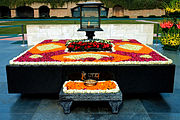
Rajghat in New Delhi, India marks the spot of Gandhi's cremation in 1948

In New Delhi, the Birla Bhavan (or Birla House), where Gandhi was assassinated on 30 January 1948, was acquired by the Government of India in 1971 and opened to the public in 1973 as the Gandhi Smriti or "Gandhi Remembrance". It preserves the room where Mahatma Gandhi lived the last four months of his life and the grounds where he was shot while holding his nightly public walk. A Martyr's Column now marks the place where Mohandas Gandhi was assassinated.

On 30 January every year, on the anniversary of the death of Mahatma Gandhi, in schools of many countries is observed the School Day of Non-violence and Peace (DENIP), founded in Spain in 1964. In countries with a Southern Hemisphere school calendar, it can be observed on 30 March or thereabouts.

Replies (11)

Many of us need to deeply think over and imbibe these in our daily lives...

" Dedi hame aajadi bina khadg bina dhaal sabarmati ke sant tune kar diya kamaal"

Excellent

Quick Facts

Mohandas Karamchand Gandhi


Mohandas Karamchand Gandhi, pictured in 1931
Born

2 October 1869


Porbandar, Kathiawar Agency, British India

Died

30 January 1948 (aged 78)


New Delhi, Union of India

Cause of death

Assassination


Nationality

Indian


Other names

Mahatma Gandhi


Education

University College London


Known for

Indian Independence Movement


Political party

Indian National Congress


Religious beliefs

Hinduism


Spouse(s)

Kasturba Gandhi


Children

Harilal


Manilal


Ramdas


Devdas

Signature


very inspiring .....

Mahatma Gandhi’s 5 Teachings To Bring About World Peace

“If humanity is to progress, Gandhi is inescapable. He lived, thought, acted and inspired by the vision of humanity evolving toward a world of peace and harmony.” - Dr. Martin Luther King, Jr.

Editor’s note: This post was written by Shilpan Patel of the Success Soul blog.

Have you ever dreamed about a joyful world with peace and prosperity for all Mankind – a world in which we respect and love each other despite the differences in our culture, religion and way of life?

I often feel helpless when I see the world in turmoil, a result of the differences between our ideals. This leads to grief and sorrow being inflicted on millions of innocent victims by a few who abuse the power of their convictions.

“How can I make difference so that I may bring peace to this world that I love and cherish so much? A name flickers instantly in my mind.”  - Mahatma Gandhi

Mahatma Gandhi inspired the world with his faith in truth and justice for all Mankind. He was a great soul who loved even those who fought against his ideals to bring about peace with non-violence.

How could a meek and fragile person of small physical stature inspire millions to bring about a profound change in a way the mightiest had never achieved before? His achievements were nothing less than miracles — his creed was to bring peace to not only those who suffered injustice and sorrow but to espouse a new way of life for Mankind, with peace and harmony. His life was a message — a message of peace over power, of finding ways to reconcile our differences, and of living in harmony with respect and love even for our enemy.

Teaching # 1: Power is of two kinds. One is obtained by the fear of punishment and the other by acts of love. Power based on love is a thousand times more effective and permanent then the one derived from fear of punishment. — Mahatma Gandhi

The force of power never wins against the power of love. At this hour of greatest unrest and turmoil in our world, the greatest force to be reckoned with lies within our hearts — a force of love and tolerance for all. Throughout his life, Mahatma Gandhi fought against the power of force during the heyday of British rein over the world. He transformed the minds of millions, including my father, to fight against injustice with peaceful means and non-violence. His message was as transparent to his enemy as it was to his followers. He believed that, if we fight for the cause of humanity and greater justice, it should include even those who do not conform to our cause. History attests to his power as he proved that we can bring about world peace by seeking and pursuing truth for the benefit of Mankind. We can resolve the greatest of our differences if we dare to have a constructive conversation with our enemy.

Teaching # 2: What difference does it make to the dead, the orphans, and the homeless, whether the mad destruction is wrought under the name of totalitarianism or the holy name of liberty and democracy?

A war always inflicts pain and sorrow on everyone. History has witnessed countless examples of dictators, including Hitler, Mussolini, and Stalin to name but a few, who inflicted sorrow and destruction on our world. A world of peace can be achieved if we learn the power of non-violence, as shown by the life of Mahatma Gandhi.

Mahatma Gandhi has proven that we can achieve the noble causes of liberty, justice and democracy for Mankind without killing anyone, without making a child an orphan, and without making anyone homeless with the damage caused by war.

Teaching # 3: There are many causes that I am prepared to die for but no cause that I am prepared to kill for. — Mahatma Gandhi

We live for our values and passion but at the core of our existence lies our innate desire to live a peaceful life. The greatest noble cause is to display our desire to bring about peace in this world by our own sacrifice and not that of those who oppose our views. The strength of cowardice is in using power to cause death and destruction for others. The strength of courage is in self-sacrifice for the benefit of all.

Mahatma Gandhi sacrificed his own lucrative law practice in Durban, South Africa to lead a simple life and to share the pain of the powerless and destitute. He won over the hearts of millions without ever reigning power over anyone — simply with the power of altruism. We too can bring peace to our world by showing our willingness to sacrifice our self-centered desires. Our utmost cause in life should be to win the hearts of others by showing our willingness to serve causes greater than ourselves.

Teaching # 4: An eye for an eye will only make the whole world blind — Mahatma Gandhi

History can attest to the fact that most human conflicts have been as a result of a stubborn approach by our leaders. Our history would turn out for the better if our leaders could just learn that most disputes can be resolved by showing a willingness to understand the issues of our opponents and by using diplomacy and compassion.

No matter where we live, what religion we practice or what culture we cultivate, at the heart of everything, we are all humans. We all have the same ambitions and aspirations to raise our family and to live life to its fullest. Our cultural, religious and political differences should not provide the backbone to invoke conflicts that can only bring sorrow and destruction to our world.

Teaching #5: We must become the change we want to see in the world. — Mahatma Gandhi

A great leader always leads with an exemplary life that echoes his ideals. Mahatma Gandhi sacrificed his thriving law practice and adopted a simple life to live among the millions who lived in poverty during his freedom struggle. Today, we see modern leaders cajoling the masses with promises that they never intend to keep - let alone practicing what they preach in their own lives. One cannot bring world peace to all unless a leader demonstrates peaceful acts of kindness daily. Mahatma Gandhi believed that we are all children of God. We should not discriminate amongst ourselves based on faith, caste, creed or any other differences.

An outstanding example of Mahatma Gandhi’s leadership was his famous Salt March, which brought about a profound change. On March 2nd 1930, as a protest at tax on salt, Gandhi wrote a remarkable letter to Lord Irwin, the Viceroy of India. He wrote, “Dear Friend, I cannot intentionally hurt anything that lives, much less fellow human beings, even though they may do the greatest wrong to me and mine. Whilst, therefore, I hold the British rule to be a curse, I do not intend to harm to a single Englishman or to any legitimate interest he may have in India…” With these words, he inspired millions to fight for this righteous cause and eventually forced the British to leave India without inflicting harm to any Englishman. Such were the quintessential qualities of justice and peace that made Mahatma Gandhi the man who changed our world for the better with his ideals of faith, love and tolerance.

“Generations to come, it may be, will scarce believe that such one as this ever in flesh and blood walked upon this earth.” - Albert Einstein on Gandhi

Mahatma Gandhi taught us that we can bring harmony to our world by becoming champions of love and peace for all. The task is daunting, but he has shown that a fragile, meekly man of small physical stature can achieve feats of incredible magnitude with a staunch belief to practice peace through non-violence. Will you make a pledge to become the change that you would like to see in this world? I have.

Let the first act of every morning be to make the following resolve for the day:

  • I shall not fear anyone on Earth.
  • I shall fear only God.
  • I shall not bear ill will toward anyone.
  • I shall not submit to injustice from anyone.
  • I shall conquer untruth by truth. And in resisting untruth, I shall put up with all suffering.

- Mahatma Gandhi

Good one

Truth (Meaning of Truth)

By M. K. Gandhi

I deal with truth first of all, as the Satyagraha Ashram owes its very existence to the pursuit and the attempted practice of truth.

The word satya (Truth) is derived from Sat which means 'being'. Nothing is or exists in reality except Truth. That is why Sat or Truth is perhaps the most important name of God, In fact it is more correct to say that Truth is God than to say God is truth. But as we cannot do without a ruler or a general, such names of God as 'King' or 'Kings' or ' The Almighty' are and will remain generally current. On deeper thinking, however it will be realized that Sat or Satya is the only correct and fully sign fact name for God.

And where there is Truth, there is also is knowledge which is true. Where there is no Truth, there also is knowledge which is true. Where there is no Truth, there can be no true knowledge. That is why the word Chit or knowledge is associated with the name of God. And where there is true knowledge, there is always bliss. (Ananda). There sorrow has no place. And even as Truth is eternal, so is the bliss derived from it. Hence we know God as Sat-Chit-ananda, one who combines in Himself Truth, Knowledge and Bliss.

Devotion to this Truth is the sole justification for our existence. All our activities should be centered in Truth. Truth should be the very breath of our life.

When once this stage in the pilgrim's progress is reached, all other rules of correct living will come without effort, and obedience to them will be instinctive. But without Truth it is impossible to observe any principles or rules in life.

Generally speaking observation of the law of Truth is understood merely to mean that we must speak the Truth. But we in the Ashram should understand the word Satya or Truth in a much wider sense. There should be truth in thought, truth in speech, and truth in action. To the man who has realized this truth in its fullness, nothing else remains to be known , because all knowledge is necessary included in it. What is not included in it is not truth, and so not true knowledge; and there can be no inward peace without true knowledge. If we once learn how to apply this never failing test of Truth, we will at once able to find out what is worth doing, what is worth seeing, what is worth reading.

But how is one to to realize this Truth, which may be likened to the philosophers stone or the cow of plenty? By single minded devotion (abhyasa  ) and indifference to all other interests in life (vairagya) replies the Bhagavadgita. In spite, however of such devotion, what may appear as Truth to one person will often appear as untruth to another person. But that need not worry the seeker. where there is honest effort, it will be realized that what appear to be different truths are like the countless and apparently different leaves of the same tree. Does not God himself appear to different individuals in different aspects? Yet we know that He is one. But Truth is the right designation of God. Hence there is nothing wrong in every man following Truth according to his lights. Indeed it is his duty to do so. Then if there is a mistake on the part of any one so following Truth it will be automatically set right. For the quest of Truth involves tapas self suffering, sometimes even unto death. There can be no place in it even a trace of self interest. In such selfless search for Truth nobody can lose his bearings for long. Directly he takes to the wrong path he stumbles, and is thus redirected to the right path. Therefore the pursuit of Truth is true bhakti (devotion). It is the path that leads to God. There is no place in it for cowardice, no place for defeat. It is the talisman by which death itself becomes the portal to life eternal.

In this connection it will be well to ponder over the lives and examples of Harishchandra, Prahlad, Ramchandra, Imam Hussain, the Christians saints, etc. How beautiful it would be if all of us, young and old, men and women devoted ourselves wholly to Truth in all that we might do in our walking hours, whether working, eating, drinking, or playing till dissolution of the body makes us one with Truth? God as Truth has been for me a treasure beyond price; may He be so to every one of us.

Source: The Mind of Mahatma Gandhi

Assorted Quotes of Mahatma Gandhi

Quotes of  Mahatma Gandhi

Collected from various sources.

I do not want my house to be walled in on all sides, and my windows to be closed. Instead, I want the cultures of all lands to be blown about my house as freely as possible. But I refuse to be blown off my feet by any.
I have nothing new to teach the world. Truth and non-violence are as old as the hills. All I have done is to try experiments in both on as vast a scale as I could.
To forgive and accept injustice is cowardice.
Prayer is not asking. It is a longing of the soul. It is daily admission of one's weakness... It is better in prayer to have a heart without words than words without a heart.
God is because Truth is.
One must be the change one wishes to see in the world.
Poverty is but the worst form of violence.
Untouchability is a crime against God and Mankind.


GooD.

Mahatma Gandhi, the Missing Laureate

by Øyvind Tønnesson
Nobelprize.org Peace Editor, 1998-2000
1 December 1999

introduction

Mohandas Gandhi (1869-1948) has become the strongest symbol of non-violence in the 20th century. It is widely held – in retrospect – that the Indian national leader should have been the very man to be selected for the Nobel Peace Prize. He was nominated several times, but was never awarded the prize. Why?

These questions have been asked frequently: Was the horizon of the Norwegian Nobel Committee too narrow? Were the committee members unable to appreciate the struggle for freedom among non-European peoples?" Or were the Norwegian committee members perhaps afraid to make a prize award which might be detrimental to the relationship between their own country and Great Britain?

Gandhi on stamp
When still alive, Mohandas Gandhi had many admirers, both in India and abroad. But his martyrdom in 1948 made him an even greater symbol of peace. Twenty-one years later, he was commemorated on this double-sized United Kingdom postage stamp.
Photo: Copyright © Scanpix   

Gandhi was nominated in 1937, 1938, 1939, 1947 and, finally, a few days before he was murdered in January 1948. The omission has been publicly regretted by later members of the Nobel Committee; when the Dalai Lama was awarded the Peace Prize in 1989, the chairman of the committee said that this was "in part a tribute to the memory of Mahatma Gandhi". However, the committee has never commented on the speculations as to why Gandhi was not awarded the prize, and until recently the sources which might shed some light on the matter were unavailable.


Mahatma Gandhi – Who Was He?

Mohandas Karamchand – known as Mahatma or "Great-Souled" – Gandhi was born in Porbandar, the capital of a small principality in what is today the state of Gujarat in Western India, where his father was prime minister. His mother was a profoundly religious Hindu. She and the rest of the Gandhi family belonged to a branch of Hinduism in which non-violence and tolerance between religious groups were considered very important. His family background has later been seen as a very important explanation of why Mohandas Gandhi was able to achieve the position he held in Indian society. In the second half of the 1880s, Mohandas went to London where he studied law. After having finished his studies, he first went back to India to work as a barrister, and then, in 1893, to Natal in South Africa, where he was employed by an Indian trading company.

In South Africa Gandhi worked to improve living conditions for the Indian minority. This work, which was especially directed against increasingly racist legislation, made him develop a strong Indian and religious commitment, and a will to self-sacrifice. With a great deal of success he introduced a method of non-violence in the Indian struggle for basic human rights. The method, satyagraha – "truth force" – was highly idealistic; without rejecting the rule of law as a principle, the Indians should break those laws which were unreasonable or suppressive. Each individual would have to accept punishment for having violated the law. However, he should, calmly, yet with determination, reject the legitimacy of the law in question. This would, hopefully, make the adversaries – first the South African authorities, later the British in India – recognise the unlawfulness of their legislation.

When Gandhi came back to India in 1915, news of his achievements in South Africa had already spread to his home country. In only a few years, during the First World War, he became a leading figure in the Indian National Congress. Through the interwar period he initiated a series of non-violent campaigns against the British authorities. At the same time he made strong efforts to unite the Indian Hindus, Muslims and Christians, and struggled for the emancipation of the 'untouchables' in Hindu society. While many of his fellow Indian nationalists preferred the use of non-violent methods against the British primarily for tactical reasons, Gandhi's non-violence was a matter of principle. His firmness on that point made people respect him regardless of their attitude towards Indian nationalism or religion. Even the British judges who sentenced him to imprisonment recognised Gandhi as an exceptional personality.


The First Nomination for the Nobel Peace Prize

Among those who strongly admired Gandhi were the members of a network of pro-Gandhi "Friends of India" associations which had been established in Europe and the USA in the early 1930s. The Friends of India represented different lines of thought. The religious among them admired Gandhi for his piety. Others, anti-militarists and political radicals, were sympathetic to his philosophy of non-violence and supported him as an opponent of imperialism.

In 1937 a member of the Norwegian Storting (Parliament), Ole Colbjørnsen (Labour Party), nominated Gandhi for that year's Nobel Peace Prize, and he was duly selected as one of thirteen candidates on the Norwegian Nobel Committee's short list. Colbjørnsen did not himself write the motivation for Gandhi’s nomination; it was written by leading women of the Norwegian branch of "Friends of India", and its wording was of course as positive as could be expected.

Gandhi
An ordinary politician or a Christ? In this photo Gandhi listens to Muslims during the height of the warfare which followed the partition of India in 1947.
Photo: Copyright © Scanpix

The committee's adviser, professor Jacob Worm-Müller, who wrote a report on Gandhi, was much more critical. On the one hand, he fully understood the general admiration for Gandhi as a person: "He is, undoubtedly, a good, noble and ascetic person – a prominent man who is deservedly honoured and loved by the masses of India." On the other hand, when considering Gandhi as a political leader, the Norwegian professor's descriptttion was less favourable. There are, he wrote, "sharp turns in his policies, which can hardly be satisfactorily explained by his followers. (...) He is a freedom fighter and a dictator, an idealist and a nationalist. He is frequently a Christ, but then, suddenly, an ordinary politician."

Gandhi had many critics in the international peace movement. The Nobel Committee adviser referred to these critics in maintaining that he was not consistently pacifist, that he should have known that some of his non-violent campaigns towards the British would degenerate into violence and terror. This was something that had happened during the first Non-Cooperation Campaign in 1920-1921, e.g. when a crowd in Chauri Chaura, the United Provinces, attacked a police station, killed many of the policemen and then set fire to the police station.

A frequent criticism from non-Indians was also that Gandhi was too much of an Indian nationalist. In his report, Professor Worm-Müller expressed his own doubts as to whether Gandhi's ideals were meant to be universal or primarily Indian: "One might say that it is significant that his well-known struggle in South Africa was on behalf of the Indians only, and not of the blacks whose living conditions were even worse."

The name of the 1937 Nobel Peace Prize Laureate was to be Lord Cecil of Chelwood. We do not know whether the Norwegian Nobel Committee seriously considered awarding the Peace Prize to Gandhi that year, but it seems rather unlikely. Ole Colbjørnsen renominated him both in 1938 and in 1939, but ten years were to pass before Gandhi made the committee's short list again.


1947: Victory and Defeat

In 1947 the nominations of Gandhi came by telegram from India, via the Norwegian Foreign Office. The nominators were B.G. Kher, Prime Minister of Bombay, Govindh Bhallabh Panth, Premier of United Provinces, and Mavalankar, the President of the Indian Legislative Assembly. Their arguments in support of his candidacy were written in telegram style, like the one from Govind Bhallabh Panth: "Recommend for this year Nobel Prize Mahatma Gandhi architect of the Indian nation the greatest living exponent of the moral order and the most effective champion of world peace today." There were to be six names on the Nobel Committee's short list, Mohandas Gandhi was one of them.

The Nobel Committee's adviser, the historian Jens Arup Seip, wrote a new report which is primarily an account of Gandhi's role in Indian political history after 1937. "The following ten years," Seip wrote, "from 1937 up to 1947, led to the event which for Gandhi and his movement was at the same time the greatest victory and the worst defeat – India's independence and India's partition." The report describes how Gandhi acted in the three different, but mutually related conflicts which the Indian National Congress had to handle in the last decade before independence: the struggle between the Indians and the British; the question of India's participation in the Second World War; and, finally, the conflict between Hindu and Muslim communities. In all these matters, Gandhi had consistently followed his own principles of non-violence.

The Seip report was not critical towards Gandhi in the same way as the report written by Worm-Müller ten years earlier. It was rather favourable, yet not explicitly supportive. Seip also wrote briefly on the ongoing separation of India and the new Muslim state, Pakistan, and concluded – rather prematurely it would seem today: "It is generally considered, as expressed for example in The Times of 15 August 1947, that if 'the gigantic surgical operation' constituted by the partition of India, has not led to bloodshed of much larger dimensions, Gandhi's teachings, the efforts of his followers and his own presence, should get a substantial part of the credit."

crowd
The partition of India in 1947 led to a process which we today probably would describe as "ethnic cleansing". Hundreds of thousands of people were massacred and millions had to move; Muslims from India to Pakistan, Hindus in the opposite direction. Photo shows part of the crowds of refugees which poured into the city of New Delhi.
Photo: Copyright © Scanpix

Having read the report, the members of the Norwegian Nobel Committee must have felt rather updated on the last phase of the Indian struggle for independence. However, the Nobel Peace Prize had never been awarded for that sort of struggle. The committee members also had to consider the following issues: Should Gandhi be selected for being a symbol of non-violence, and what political effects could be expected if the Peace Prize was awarded to the most prominent Indian leader – relations between India and Pakistan were far from developing peacefully during the autumn of 1947?

From the diary of committee chairman Gunnar Jahn, we now know that when the members were to make their decision on October 30, 1947, two acting committee members, the Christian conservative Herman Smitt Ingebretsen and the Christian liberal Christian Oftedal spoke in favour of Gandhi. One year earlier, they had strongly favoured John Mott, the YMCA leader. It seems that they generally preferred candidates who could serve as moral and religious symbols in a world threatened by social and ideological conflicts. However, in 1947 they were not able to convince the three other members. The Labour politician Martin Tranmæl was very reluctant to award the Prize to Gandhi in the midst of the Indian-Pakistani conflict, and former Foreign Minister Birger Braadland agreed with Tranmæl. Gandhi was, they thought, too strongly committed to one of the belligerents. In addition both Tranmæl and Jahn had learnt that, one month earlier, at a prayer-meeting, Gandhi had made a statement which indicated that he had given up his consistent rejection of war. Based on a telegram from Reuters, The Times, on September 27, 1947, under the headline "Mr. Gandhi on 'war' with Pakistan" reported:

"Mr. Gandhi told his prayer meeting to-night that, though he had always opposed all warfare, if there was no other way of securing justice from Pakistan and if Pakistan persistently refused to see its proved error and continued to minimise it, the Indian Union Government would have to go to war against it. No one wanted war, but he could never advise anyone to put up with injustice. If all Hindus were annihilated for a just cause he would not mind. If there was war, the Hindus in Pakistan could not be fifth columnists. If their loyalty lay not with Pakistan they should leave it. Similarly Muslims whose loyalty was with Pakistan should not stay in the Indian Union."

Nehru
Gandhi saw "no place for him in a new order where they wanted an army, a navy, an air force and what not". In the picture, Gandhi's spiritual heir, Prime Minister Pandit Nehru, Defense Minister Sardar Baldev Singh, and the Commanders-in-Chief of the three Services, are inspecting a Guard of Honour at the Red Fort, Delhi, in August, 1948. Fifty years later, both India and Pakistan had developed and tested their own nuclear weapons.
Photo: Copyright © Scanpix

Gandhi had immediately stated that the report was correct, but incomplete. At the meeting he had added that he himself had not changed his mind and that "he had no place in a new order where they wanted an army, a navy, an air force and what not".

Both Jahn and Tranmæl knew that the first report had not been complete, but they had become very doubtful. Jahn in his diary quoted himself as saying: "While it is true that he (Gandhi) is the greatest personality among the nominees – plenty of good things could be said about him – we should remember that he is not only an apostle for peace; he is first and foremost a patriot. (...) Moreover, we have to bear in mind that Gandhi is not naive. He is an excellent jurist and a lawyer." It seems that the Committee Chairman suspected Gandhi's statement one month earlier to be a deliberate step to deter Pakistani aggression. Three of five members thus being against awarding the 1947 Prize to Gandhi, the Committee unanimously decided to award it to the Quakers.


1948: A Posthumous Award Considered

Mahatma Gandhi was assassinated on 30 January 1948, two days before the closing date for that year's Nobel Peace Prize nominations. The Committee received six letters of nomination naming Gandhi; among the nominators were the Quakers and Emily Greene Balch, former Laureates. For the third time Gandhi came on the Committee's short list – this time the list only included three names – and Committee adviser Seip wrote a report on Gandhi's activities during the last five months of his life. He concluded that Gandhi, through his course of life, had put his profound mark on an ethical and political attitude which would prevail as a norm for a large number of people both inside and outside India: "In this respect Gandhi can only be compared to the founders of religions."

Nobody had ever been awarded the Nobel Peace Prize posthumously. But according to the statutes of the Nobel Foundation in force at that time, the Nobel Prizes could, under certain circumstances, be awarded posthumously. Thus it was possible to give Gandhi the prize. However, Gandhi did not belong to an organisation, he left no property behind and no will; who should receive the Prize money? The Director of the Norwegian Nobel Institute, August Schou, asked another of the Committee's advisers, lawyer Ole Torleif Røed, to consider the practical consequences if the Committee were to award the Prize posthumously. Røed suggested a number of possible solutions for general application. Subsequently, he asked the Swedish prize-awarding institutions for their opinion. The answers were negative; posthumous awards, they thought, should not take place unless the laureate died after the Committee's decision had been made.

On November 18, 1948, the Norwegian Nobel Committee decided to make no award that year on the grounds that "there was no suitable living candidate". Chairman Gunnar Jahn wrote in his diary: "To me it seems beyond doubt that a posthumous award would be contrary to the intentions of the testator." According to the chairman, three of his colleagues agreed in the end, only Mr. Oftedal was in favour of a posthumous award to Gandhi.

Later, there have been speculations that the committee members could have had another deceased peace worker than Gandhi in mind when they declared that there was "no suitable living candidate", namely the Swedish UN envoy to Palestine, Count Bernadotte, who was murdered in September 1948. Today, this can be ruled out; Bernadotte had not been nominated in 1948. Thus it seems reasonable to assume that Gandhi would have been invited to Oslo to receive the Nobel Peace Prize had he been alive one more year.


Why Was Gandhi Never Awarded the Nobel Peace Prize?

Up to 1960, the Nobel Peace Prize was awarded almost exclusively to Europeans and Americans. In retrospect, the horizon of the Norwegian Nobel Committee may seem too narrow. Gandhi was very different from earlier Laureates. He was no real politician or proponent of international law, not primarily a humanitarian relief worker and not an organiser of international peace congresses. He would have belonged to a new breed of Laureates.

There is no hint in the archives that the Norwegian Nobel Committee ever took into consideration the possibility of an adverse British reaction to an award to Gandhi. Thus it seems that the hypothesis that the Committee's omission of Gandhi was due to its members' not wanting to provoke British authorities, may be rejected.

In 1947 the conflict between India and Pakistan and Gandhi's prayer-meeting statement, which made people wonder whether he was about to abandon his consistent pacifism, seem to have been the primary reasons why he was not selected by the committee's majority. Unlike the situation today, there was no tradition for the Norwegian Nobel Committee to try to use the Peace Prize as a stimulus for peaceful settlement of regional conflicts.

During the last months of his life, Gandhi worked hard to end the violence between Hindus and Muslims which followed the partition of India. We know little about the Norwegian Nobel Committee's discussions on Gandhi's candidature in 1948 – other than the above quoted entry of November 18 in Gunnar Jahn's diary – but it seems clear that they seriously considered a posthumous award. When the committee, for formal reasons, ended up not making such an award, they decided to reserve the prize, and then, one year later, not to spend the prize money for 1948 at all. What many thought should have been Mahatma Gandhi's place on the list of Laureates was silently but respectfully left open.

 https://nobelprize.org/nobel_prizes/peace/articles/gandhi/index.html

very goood


CCI Pro

Leave a Reply

Your are not logged in . Please login to post replies

Click here to Login / Register