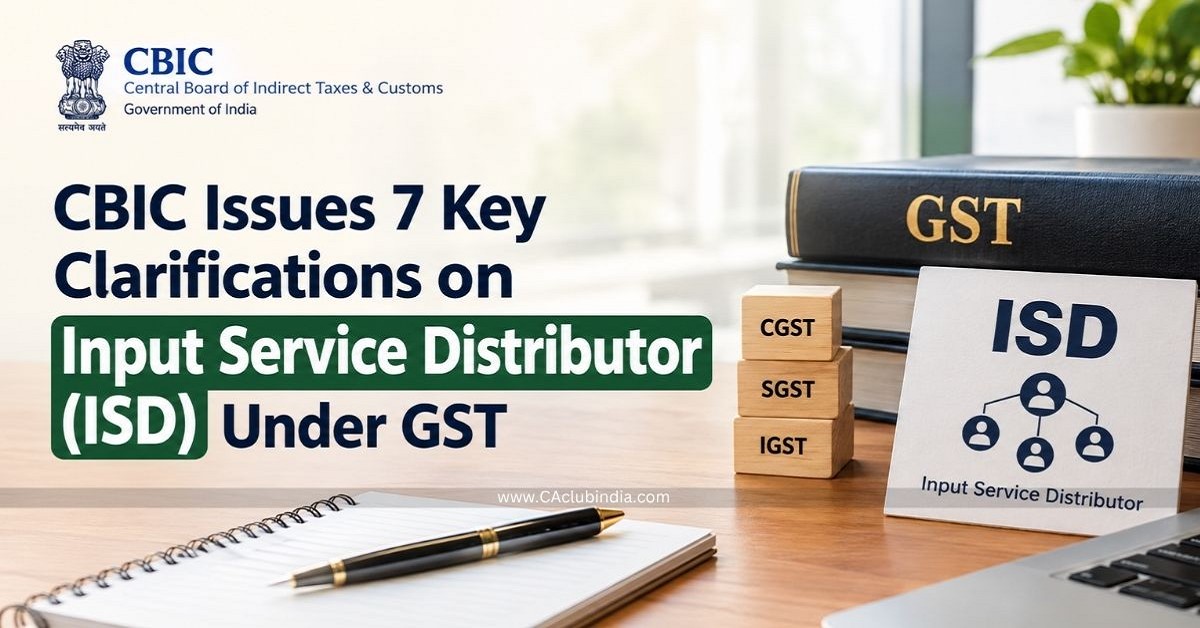
The Central Board of Indirect Taxes and Customs (CBIC) has issued Circular No. 260/06/2026-GST dated 26 October 2026, providing important clarifications on the Input Service Distributor (ISD) mechanism under the Goods and Services Tax (GST) framework.
The circular addresses seven issues raised by trade and industry concerning Sections 2(61), 20 and 21 of the Central Goods and Services Tax (CGST) Act, 2017, along with Rules 39 and 54(1A) of the CGST Rules, 2017.
The clarifications cover the requirement for separate ISD registrations, responsibility for input tax credit (ITC) eligibility, the timing of credit distribution, ITC reversals and the treatment of certain invoices while calculating turnover and refunds.
These clarifications are particularly relevant for businesses operating through multiple registrations, companies that centrally procure input services, and taxpayers distributing common service-related credit among different GST registrations.
1. Separate ISD Registrations May Be Required for Different Business Locations
CBIC has clarified that there is no restriction on obtaining more than one ISD registration for different business verticals or places of business within the same State or Union Territory.
Where separate registrations have been obtained for different business verticals or places of business, the respective registrants are treated as distinct persons under the CGST Act, subject to the applicable provisions.
Accordingly, each such registrant receiving input service invoices for or on behalf of distinct persons and required to distribute the related ITC under Section 20 must obtain an ISD registration.
However, the credit cannot be distributed arbitrarily. Under Rule 39(1), an ISD must distribute the credit only to the distinct person to whom it is attributable.
2. Responsibility for ITC Eligibility and Incorrect Distribution
The circular distinguishes between the responsibilities of the ISD and the recipient of the credit.
The ISD is responsible for distributing ITC in accordance with Section 20 of the CGST Act. The recipient, on the other hand, must satisfy the applicable conditions for claiming the credit, including those prescribed under Sections 16 and 17 of the CGST Act and the relevant rules.
CBIC has also clarified the consequences of irregular credit distribution.
Where an ISD distributes credit in contravention of Section 20, the ISD may be liable to a penalty under Section 122(1)(ix). The penalty prescribed under this provision is ₹10,000 or an amount equivalent to the tax evaded or ITC distributed irregularly, whichever is higher.
Further, if the incorrect distribution results in excess credit being transferred to one or more recipients, the excess credit is recoverable from those recipients along with applicable interest under Section 21. The relevant demand and recovery provisions apply as specified in the circular.
3. When Must an ISD Distribute ITC?
One of the important clarifications concerns the requirement to distribute ITC in the same month in which it becomes available for distribution.
Under Section 20(2) of the CGST Act read with Rule 39(1)(a) of the CGST Rules, credit available for distribution during a month must generally be distributed in that month, with the relevant details reported in Form GSTR-6.
CBIC has clarified that the mere receipt of invoice details in Form GSTR-6A does not automatically mean that the corresponding ITC is available for distribution.
The ISD must first ascertain whether the credit is prima facie eligible for availment. The credit becomes available for distribution when this assessment is made.
Consequently, the ISD must distribute the credit in the month in which it makes this ascertainment. It must also separately distribute eligible and ineligible ITC in accordance with Rule 39(1)(g), and report the relevant details in Form GSTR-6.
This clarification highlights the importance of timely invoice review and proper documentation before distributing credit among different GST registrations.
4. ITC Reversals Must Be Made by the Recipient of Credit
CBIC has clarified that an ISD should distribute the entire ITC available for distribution to the distinct persons to whom the credit is attributable.
The responsibility for making the applicable ITC reversals rests with the recipient of the credit.
Accordingly, recipients must make reversals, wherever applicable, under Section 17(1) or Section 17(2) read with Rules 42 and 43 of the CGST Rules, or under Section 17(4) read with Rule 38, as the case may be.
This distinction is important for businesses that centrally procure services but use those services across multiple registrations or business operations.
The ISD must distribute credit in accordance with the prescribed mechanism, while the recipient must evaluate the credit under the applicable eligibility and reversal provisions.
5. ISD-Related Invoices Will Not Count Towards Turnover in the State
Rule 54(1A) provides a mechanism through which a regular registered person having the same PAN and registered in the same State as the ISD can issue an invoice, credit note or debit note to transfer ITC relating to input services attributable to one or more distinct persons.
CBIC has clarified that such documents serve as a credit-transfer mechanism and do not represent an outward supply by the registered person issuing them.
Therefore, the amount reflected in these invoices, credit notes or debit notes must not be included in the computation of the issuing person's turnover in the State or turnover in the Union Territory under Section 2(112) of the CGST Act.
This exclusion applies even where the document is required to be reported in Form GSTR-1 to facilitate the transfer of credit to the ISD.
The circular further clarifies that these amounts should not be included when calculating the turnover-based distribution of ITC under Section 20 read with Rule 39 or the adjusted total turnover used for determining the maximum permissible refund under Section 54(3) read with Rule 89.
6. Credit Transferred to an ISD Is Not 'Net ITC' for Refund Calculation
The circular also addresses whether credit transferred under Rule 54(1A) can be treated as the issuing person's own ITC for refund purposes.
CBIC has clarified that credit relating to input services attributable to one or more distinct persons, when transferred to an ISD under Rule 54(1A), does not constitute ITC in respect of an inward supply of the transferring person.
The amount is transferred to the ISD for further distribution to the appropriate recipients.
Accordingly, such credit does not qualify as 'Net ITC' for calculating refunds under Rule 89(4) and Rule 89(5) of the CGST Rules.
This clarification is significant for taxpayers calculating refunds under the relevant provisions, as the credit transferred through this mechanism cannot be treated as the transferring registration's own eligible Net ITC merely because it appears in the relevant transfer document.
7. The Transferring Registration Need Not Reverse the Transferred ITC
CBIC has further clarified the treatment of ITC reversals where a registered person having the same PAN and State code as the ISD transfers credit under Rule 54(1A).
The transferring registration is not required to make ITC reversals under Section 17(1), Section 17(2) or Section 17(4) merely in respect of the credit transferred through this mechanism.
Instead, it must transfer the entire ITC available on account of tax paid by it under reverse charge to the ISD for further distribution to the eligible recipients.
The recipients of the credit are responsible for making the applicable reversals under the relevant provisions.
These recipients may also include the same registered person that initially transferred the credit to the ISD, where the credit is attributable to that registration.
What Should Businesses Do Next?
Following the clarification, businesses using the ISD mechanism should review their existing registration structures, invoice-processing procedures and ITC distribution practices.
The following checks can help improve compliance:
- Review ISD registrations: Identify separately registered business verticals and places of business receiving input service invoices for distribution to distinct persons.
- Verify credit eligibility: Assess invoice-level ITC eligibility before distributing credit, including the applicable restrictions under Section 17.
- Monitor monthly distribution: Ensure that credit is distributed in the month in which it is ascertained to be prima facie eligible and that the details are correctly reported in GSTR-6.
- Separate eligible and ineligible credit: Maintain appropriate classification in accordance with Rule 39(1)(g).
- Review ITC reversals: Confirm that the appropriate recipient makes reversals wherever required under the applicable provisions.
- Revisit turnover calculations: Exclude qualifying Rule 54(1A) transfer documents from turnover calculations specified in the circular.
- Reassess refund computations: Check whether credit transferred through the ISD mechanism has been incorrectly included in Net ITC or adjusted total turnover calculations.
Conclusion
CBIC Circular No. 260/06/2026-GST provides clarity on several practical aspects of the ISD mechanism, particularly the division of responsibilities between the distributor and the recipient of ITC.
The circular explains when multiple ISD registrations may be required, when credit becomes available for distribution, who must undertake ITC reversals, and how invoices issued for credit transfers should be treated for turnover and refund calculations.
Businesses operating multiple GST registrations should review their existing ISD processes in light of these clarifications to ensure that ITC distribution, reporting and refund claims are handled in accordance with the applicable provisions of the CGST Act and Rules.











 CAclubindia