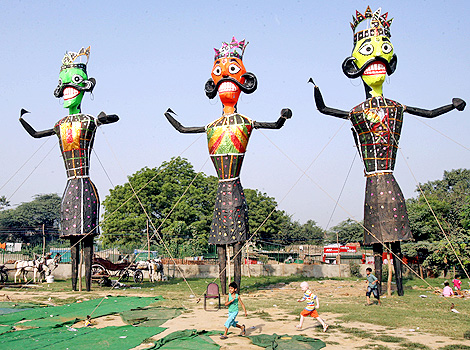
Dussehra is celebrated all over India to mark the homecoming of Lord Rama. This festival is celebrated as a triumph of the good over the evil. This festival is celebrated for nine consecutive days in praise of Lord Rama and his victory over the demon Ravana. During these nine days, the Ramlila, an enactment is made on the various episodes of the life of Lord Rama and there is continuous chanting from the great epic Ramayana. On the tenth day, the Lord Rama killed the demon Ravana, the abductor of his beloved Sita. On Dussehra, larger than life effigies of Ravana, his brothers Meghnath and Kumbhkarna filled with different fire crackers are set alight to celebrate the victory of good over evil. In Himachal Pradesh, a week long fair is held at Kullu during the Dussehra festival. From the little temples in the hills, the deity of Lord Raghunathji is brought in procession to the Kullu Maidan with lot of gaiety, music and colour.
On this day the Mysore Palace in Mysore is also illuminated with lights. Majestic processions, a torch lights parade and dance and musical events enliven the tranquil city. In south India during Dussehra, houses are decorated with displays of dolls, toys and idols. In West Bengal, the decorated idols of goddess Durga which were worshipped for nine days are taken out in huge procession and immersed in tanks, rivers or sea.
Guest
Posted on 25 September 2009
e
Guest
Posted on 25 September 2009
Ramlila, literally “Rama’s play”, is a performance of then Ramayana epic in a series of scenes that include song, narration, recital and dialogue. It is performed across northern India during the festival of Dussehra, held each year according to the ritual calendar in autumn. The most representative Ramlilas are those of Ayodhya, Ramnagar and Benares, Vrindavan, Almora, Sattna and Madhubani.
This staging of the Ramayana is based on the Ramacharitmanas, one of the most popular storytelling forms in the north of the country. This sacred text devoted to the glory of Rama, the hero of the Ramayana, was composed by Tulsidas in the sixteenth century in a form of Hindi in order to make the Sanskrit epic available to all. The majority of the Ramlilas recount episodes from the Ramacharitmanas through a series of performances lasting ten to twelve days, but some, such as Ramnagar’s, may last an entire month. Festivals are organized in hundreds of settlements, towns and villages during the Dussehra festival season celebrating Rama’s return from exile. Ramlila recalls the battle between Rama and Ravana and consists of a series of dialogues between gods, sages and the faithful. Ramlila’s dramatic force stems from the succession of icons representing the climax of each scene. The audience is invited to sing and take part in the narration. The Ramlila brings the whole population together, without distinction of caste, religion or age. All the villagers participate spontaneously, playing roles or taking part in a variety of related activities, such as mask- and costume making, and preparing make-up, effigies and lights. However, the development of mass media, particularly television soap operas, is leading to a reduction in the audience of the Ramlila plays, which are therefore losing their principal role of bringing people and communities together.
Guest
Posted on 25 September 2009
The festival of Dussera or Vijayadasham bright fortnight (Shukla Paksha) of the Hindu autumn month of Ashvin and as per the western calendar this period falls in October.
Dussehra celebrates the victory of Lord Ram over the demon king of Lanka, Ravana (Ravana was 10 headed). The sacred Indian epic 'Ramayana' mentions the birth of Lord
Ram, the seventh incarnation of Lord Vishnu,some ten thousand years ago in Ayodha that belongs to the present day state of Uttar Pradesh in India. Ramlila is generally held in almost every part of India to celebrate the return of Lord Rama from exile for 14 years. On a similar day as Dussehra in Satyug, Ram (the eighth incarnation of Lord Vishnu), is said to have killed Ravan, who had abducted his wife Sita. Ramlila, meaning “Rama’s play”, is a performance of the epic Ramayana in the form of a series of scenes that include song, narration, recital and dialogue. Seeing the Ramlila in open rural surroundings is an experience of a lifetime that cannot be replicated in a theatre even with the best of technology. It originated in Kashi modern day Benaras (Varanasi).It is believed that Ramlila was first staged in about 1625 AD and was based on Ramacharitamanas written by Goswami Tulsidas although some scholars believe Ramlila’s origin to be much older.
Most Ramlila’s in north India are based on the Avadhi version of Ramayana, Ramacharitamanas. The killing of Ravana by Lord Rama is enacted in a beautiful way by local actors, often amateur performers and drawn from the same social grouping as the audience. On the tenth day, the effigy of Ravana is burned, symbolizing the victory of good over evil. The Ramlila brings the whole population together, without distinction of caste, religion or age. Ramlila of Ramnagar is very famous is enacted almost two centuries. Ramnagar is just some kilometers from Varanasi. Other famous Ramlila’s in India are Ayodhya,Vrindavan, Almora, Satna and Madhubani,Chitrakoot and Delhi which is staged on Ramlila Ground outside the historic Red Fort.
Guest
Posted on 25 September 2009
Leave a Reply
Your are not logged in . Please login to post replies


 CCI
Pro
CCI
Pro


![[ramlila.JPG]](https://4.bp.blogspot.com/_MSZspNBhl7M/Spc1LFf22lI/AAAAAAAADAA/Ij9d_P3tmf0/s1600/ramlila.JPG)
![[ramlila_1.jpg]](https://4.bp.blogspot.com/_MSZspNBhl7M/Spc1Cs3gjJI/AAAAAAAAC_4/yFIv5t5HZh4/s1600/ramlila_1.jpg)


 CAclubindia
