if in original return refund has been claimed and received in assessee,' account and there is some other amount to b reported in revised return on the basis of which there is tax liability than is there liability to pay refund received earlier in original return ,? how to show it in revised return?
Menu
Forum Search
How to show refund to be deposit in revised return
Replies (11)

Only the additional tax liability with interest, if any, is to be paid as SAT, and the return should be revised when the credits of tax paid is available in 26AS. No need to pay back amount already refunded.
On 06 June 2017 at 20:13

@ Dhirajlal sir... But wouldn't the assessee also have to pay back the amount initially received as refund?
The thing is.. I had dealt with a similiar case (involving IT investigation) myself, where I had to manually add the refund amount to the revised tax computation and pay the total amount as SAT.
I will try to illustrate my point as follows:
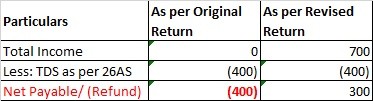
In above image, suppose we have already received Rs.400 as refund in our bank account. Subsequently, we notice an error in RoI and hence we draw up the revised return and the net liability turns out to be Rs. 300. Now if we were to pay only Rs. 300 as SAT without returning the initial refund, then wouldnt the department ultimately be at a loss of Rs. 100 (ie., Rs. 400 - Rs. 300). Another way to view this could be that TDS in 26AS has already been refunded initially. Claiming it again in the Revised Return, may result in Double Benefit.
The question is (in above example) shouldnt the assessee be paying Rs. 700 + Interest?(ie., Rs. 300 --SAT + Rs.400 --Refund wrongly recd).
Also if yes, then returning to Ms.Shivani's Qn.. how to treat this in the Revised ITR?
On 06 June 2017 at 22:51

Pay Rs.700+interest to save ourself from any inconvenience & notice from IT deptt. It deptt settled it self
Dear Sanjay S:
Simply to say, 2+3-4 = 2-4+3, that is just how one treats it.
At first, after clearing all tax liability, when you received refund, means earlier income totally assessed and old liability stand at NIL.
Now, when you detected additional income say 35K to be taxed at say 20%, your new tax liability arose is Rs. 700/- + cess+ interest till date of payment. (So, reducing TDS refund and again adding back for payment, that process not required).
Hope, it would be clear what I mean to say by "Only the additional tax liability with interest....."
Yes. I now understand. The thing is.. when u had mentioned "only the additional tax liability", I initially thought you were referring to revised total tax liability (Rs.300 in the above example).
So how can we show this in "Part B - TTI" of ITR?
I mean, in the above example, the net tax liability as per revised return is Rs. 300. Our TDS is Rs.400; SAT will be 700;
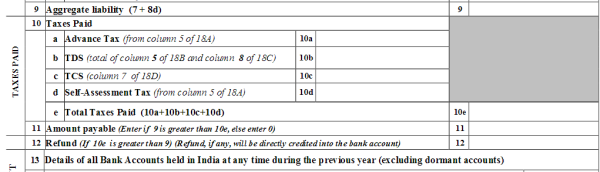
Hence where should we add the initial refund of Rs. 400 in the revised ITR so that the Net liability becomes NIL ?
(would the revised return be again subject to processing u/s 143(1)? If not, one could simply delete the TDS amount (under row 10(b)) and file the return.. right?)
Just fill Advance tax and SAT paid, and ask for refund as per ITR utility calculation. (There is no row to show any refund received, so don't show).
The (revised) return will be processed normally, and the refund will not be paid to you (again) as asked in revised return, as already paid earlier!! On the contrary some demand may arise because of additional interest calculation.
Thanks. Will try this next time.
On 07 June 2017 at 11:00

thanks all for their valuable comments...so should I just file the revise return and wait for demand if raise by department ??
On 07 June 2017 at 13:46
Pay the tax liability over the differential amount as Self Assessment Tax first, and revise the return.
On 07 June 2017 at 19:23

MOHANDAS T.R
22 Points
Posted on 05 January 2018
Sir
Is it necessary to pay interest u/s 234 D for the excess Refund Received?
On 05 January 2018 at 12:12
Yes, In the case referred above, interest liability will arise, which can be paid beforehand or as and when demand raised.
On 05 January 2018 at 12:20
Leave a Reply
Your are not logged in . Please login to post replies
Click here to Login / Register
Recent Topics :
- Does AIS GST Purchase aggregate GSTR-2B expenses?
- Form 26A - System has encountered some technical p
- Tool to convert GST invoice PDFs into Excel —
- Revised or rectification or leave it?
- Private limited tax audit
- LTCG - SEC54
- Foreign remittance from our client for Co Working
- UDIN generation
- Reply plz guys
- Tax Deduction and Collection Account Number
Related Topics :



 CAclubindia
