I had issued a FD of Rs. 1,00,000/- in State Bank of India, inspite of submitting 15G form to Bank, my TDS was deducted by bank. I want to know why TDS is deducted?
Menu
Forum Search
How my tds is deducted though form 15 g was submitted
3831 views
13 replies
Replies (13)

maybe the 15G is rejected, get in touch with your banker, with submission details

Conditions you must fulfill to submit Form 15G:
- You are an individual or HUF
- You must be a Resident Indian
- You should be less than 60 years old
- Tax calculated on your Total Income is nil
- The total interest income for the year is less than the minimum exemption limit of that year, which is Rs 2,50,000 for financial year 2014-15.

When should i submit 15G form to bank?
On 30 March 2016 at 11:06
Submitting them as soon as the financial year starts will ensure the banks don’t deduct any TDS on your interest income.............
On 30 March 2016 at 11:06
The forms 15G and 15H need to be submitted for tax exemptions on interest earned on bank deposits, preferably at the beginning of the new financial year but before June end
Many people prefer to keep their savings in bank fixed deposits (FDs), as such deposits earn higher rate of interest compared with savings account in the bank. However, many of them, especially senior citizens face harassment through tax deducted at source (TDS) by the bank even if they do not have any tax liability. The FD holder, (senior citizen) can be saved from this, if the interest earned on the FD in a financial year does not exceed Rs10,000 and she submits Form 15H to the bank in time, preferably before June end. Other individual depositors need to submit Form 15G and copy of their permanent account number (PAN) card.
Since these forms are applicable for a particular financial year, the FD holder will have to re-submit the form, in case, s/he continues with the same deposit in the same bank branch for next FY. This is applicable for renewal of the FD as well. This means, you need to submit the applicable form for renewal of the FD too. In short, even if you had submitted either Form15G or 15H for FY2014-15, you will have to re-submit the form for FY2015-16, for the same FD or renewed FD.
As per the Income Tax (I-T) rules in force, depositors who are not liable to pay any tax on their income can get their interest on bank deposits without any deduction of tax if they submit Form 15-G or 15-H, as appropriate, to the bank concerned in the beginning of every financial year.
However, it has been the experience of several depositors that even when you have submitted these forms; banks continue to deduct tax at source on such deposits putting depositors into considerable inconvenience.
To overcome this issue, the Reserve Bank of India (RBI) on 31 May 2013 came out with an advisory for banks. It says, "With a view to protect interest of the depositors and for rendering better customer service, banks are advised to give an acknowledgment at the time of receipt of Form 15-G/15-H. This will help in building a system of accountability and customers will not be put to inconvenience due to any omission on part of the banks.”
However, this advisory serves a very limited purpose and fails to deliver anything of value to the customers. This turns into harassment to customers, who despite submitting the form are subjected to a TDS of 20%, even if their total income falls within the exempted limit for I-T. In addition, to get back the excess deduction, the hapless customer will have to file an I-T return and claim refund.
Although, there has been a demand from FD holders to refund excess TDS collected by the bank, this appears to have met a deaf ear. The reason is that the banks are mandated to deposit the TDS amount to the revenues within the stipulated time. In such cases, banks can only issue TDS certificate to FD holders.
Earlier, there were views that if you split the FD amount, then you may not be subjected to TDS from the bank. However, the Budget 2015, makes banks, which are core banking solution (CBS) compliant, to aggregate all FDs by the customer across its several branches and deduct tax if the interest on all FDs exceed Rs10,000 in the FY.
Banks deduct TDS at a rate of 10% if the FD holder has submitted her PAN details for interest that exceeds Rs10,000. In case, neither the PAN nor the Forms are submitted and interest exceeds Rs10,000 on FDs, then the bank deducts TDS at a rate of 20%. In both cases, the banks are mandated to provide TDS certificate to the FD holder. The person, who does not have a PAN card, needs to make an application in Form 60.
On 30 March 2016 at 11:07

if the banki doesnt reverse TDS, then you can file ITR to get back the refund of TDS amount already deducted by the bank.
On 30 March 2016 at 11:10

your TDS was deducted before submissionform 15 G
plus check have you got unique code as per new system
for F.Y. 2016-17 SUBMIT your form 15G in first week of april
On 30 March 2016 at 12:18
how get unique code for Filing Form 15G
 |
On 30 March 2016 at 12:39
how to get unique code?
On 30 March 2016 at 12:47
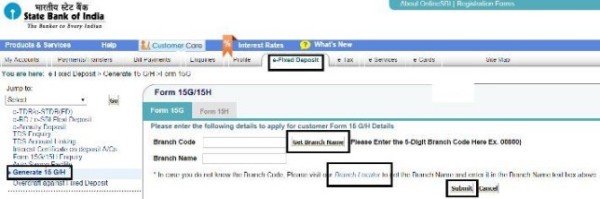
CBDT has made filing Form 15G and Form 15H lot simpler by putting it online. Assesse seeking non-deduction of TDS from certain incomes is required to file a self-declaration under Form 15G or Form 15H and submit it to the deductor which is now can be done either in paper form or electronically. Earlier the same was to be submitted only in paper form.
In line with simplifying the procedure of filing for form 15G and Form 15H, both the forms have also been modified reducing the compliances.
New Form 15G and Form 15H Procedure
Under New Form 15G and Form 15H filing procedure, tax payer need to submit online and deductor on receiving the same will assign a Unique Identification Number (UIN) to all self-declarations in accordance with a procedure by CBDT. Both the UIN and self-declarations details will have to be furnished by the deductor in the quarterly TDS statements. In addition, deductor will be required to retain Form 15G and 15H for seven years.
Online submission of form 15G and form 15H shall become effective from 1st October, 2015 and the requirement of submitting physical copy of Form 15G and 15H by the deductor to the income-tax authorities has been dispensed with.
On 30 March 2016 at 12:57

Interest accrued on an FD of 100000 is expected to be within 10000, thrash hold limit for TDS. Kindly check.
On 30 March 2016 at 21:21
Leave a Reply
Your are not logged in . Please login to post replies
Click here to Login / Register
Recent Topic
- Business income source for husband and wife
- Set off of LTCL against STCG under section 536(2n)
- Audit Workflow tool
- Is CA through direct entry easy for a commerce stu
- Dividend and withholding tax - DTAA- RSU
- NRI Query: Capital Gains Tax Exemption under Secti
- Royalty payment to UK
- Calculate ITR2 tax with equity and non equity prof
- LTCG on residential property sale - Rebate?
- TDS MISMATCH AND AIS
Related Topics


 CAclubindia
