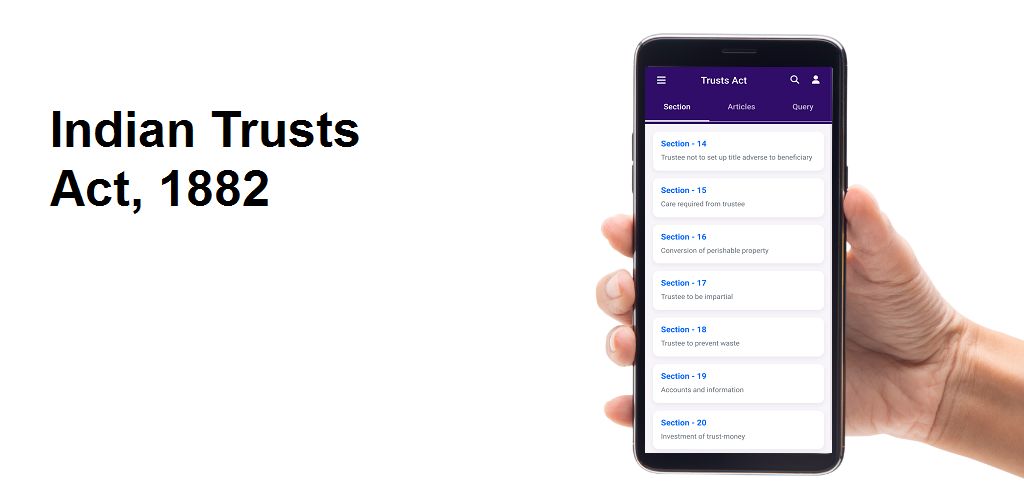
Indian Trusts Act, 1882
Section - 10 - Who may be trustee
Who may be trustee.
10. Every person capable of holding property may be a trustee; but, where the trust involves the exercise of discretion, he cannot execute it unless he is competent to contract.
No one bound to accept trust.
No one is bound to accept a trust.
Acceptance of trust.
A trust is accepted by any words or acts of the trustee indicating with reasonable certainty such acceptance.
Disclaimer of trust.
Instead of accepting a trust, the intended trustee may, within a reasonable period, disclaim it , and such disclaimer shall prevent the trust-property from vesting in him.
A disclaimer by one of two or more co-trustees vests the trust-property in the other or others, and makes him or them sole trustee or trustees from the date of the creation of the trust.
Illustrations
| (a) | - | A bequeaths certain property to B and C, his executors, as trustees for D. B and C prove A's will. This is in itself an acceptance of the trust, and B and C hold the property in trust for D. |
| (b) | - | A transfers certain property to B in trust to sell it and to pay out of the proceeds A's debts. B accepts the trust and sells the property. So far as regards B, a trust of the proceeds is created for A's creditors. |
.... To read the full section download the app from Google Play store

ARTICLESHIP
18 September 2026
Industrial TraineeTwenty Point Nine Five Ventures Private Limited Noida CA Inter View Details
22 September 2026
Account AssistantChirag P Shah & Co. Chartered Accountant Pune B.Com View Details
ARTICLESHIP
16 September 2026
Article AssistantMANUJ SHARMA AND COMPANY Noida CA Inter View Details
Featured
11 September 2026
Audit ExecutiveRBSM Corporate Advisors Private Limited Pune CA View Details
ARTICLESHIP
30 September 2026
CA Article AssistantCA Suraj Garg & Associates New Delhi CA Final View Details CCI
Pro
CCI
Pro
|

 CAclubindia
