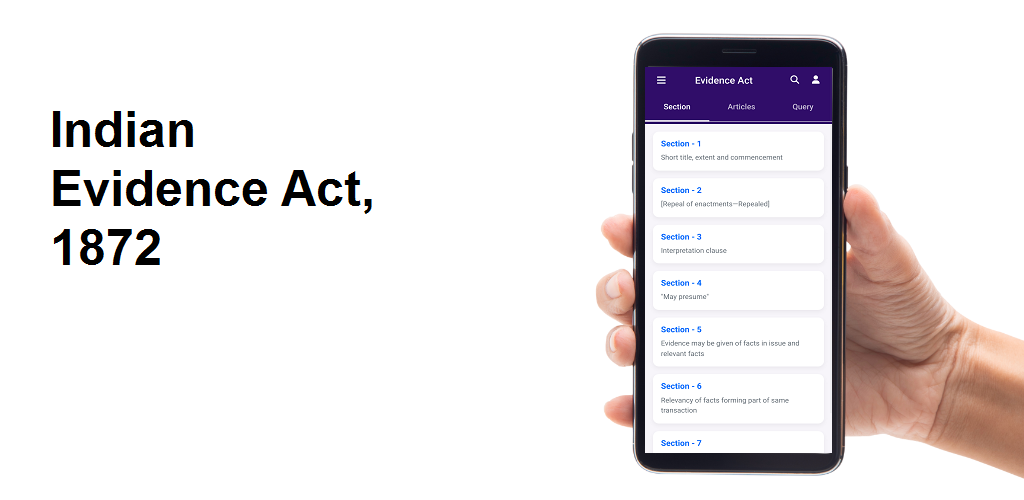
Indian Evidence Act, 1872
Section - 3 - Interpretation clause
Interpretation clause.
3. In this Act the following words and expressions are used in the following senses, unless a contrary intention appears from the context :-
"Court".
"Court" includes all Judges and Magistrates and all persons, except arbitrators, legally authorised to take evidence.
"Fact".
"Fact" means and includes-
Illustrations
(a) That there are certain objects arranged in a certain order in a certain place, is a fact.
(b) That a man heard or saw something, is a fact.
(c) That a man said certain words, is a fact.
(d) That a man holds a certain opinion, has a certain intention, acts in good faith, or fraudulently, or uses a particular word in a particular sense, or is or was at a specified time conscious of a particular sensation, is a fact.
(e) That a man has a certain reputation, is a fact.
"Relevant".
One fact is said to be relevant to another when the one is connected with the other in any of the ways referred to in the provisions of this Act relating to the releva .... To read the full section download the app from Google Play store
| (1) | - | any thing, state of things, or relation of things, capable of being perceived by the senses; |
| (2) | - | any mental condition of which any person is conscious. |

ARTICLESHIP
18 September 2026
Industrial Trainee
Twenty Point Nine Five Ventures Private Limited
Noida
CA Inter
View Details
22 September 2026
Account Assistant
Chirag P Shah & Co. Chartered Accountant
Pune
B.Com
View Details
ARTICLESHIP
16 September 2026
Article Assistant
MANUJ SHARMA AND COMPANY
Noida
CA Inter
View Details
Featured
11 September 2026
Audit Executive
RBSM Corporate Advisors Private Limited
Pune
CA
View Details
ARTICLESHIP
30 September 2026
CA Article Assistant
CA Suraj Garg & Associates
New Delhi
CA Final
View Details CCI
Pro
CCI
Pro
 CAclubindia
