Independence Day (India)

others 2471 views 5 replies

https://upload.wikimedia.org/wikipedia/commons/4/42/WavingIndianFlag.gif


India's Independence Day is celebrated on August 15 to commemorate its independence from British rule and its birth as a sovereign nation on that day in 1947. The day is a national holiday in India. All over the country, flag-hoisting ceremonies are conducted by the local administration in attendance. The main event takes place in New Delhi, where the Prime Minister hoists the National Flag at the Red Fort and delivers a nationally televised speech from its ramparts. In his speech, he highlights the achievements of his government during the past year, raises important issues and gives a call for further development. The Prime Minister also pays his tribute to leaders of the freedom struggle. A colourful pageant showcasing India’s cultural diversity, symbolic depictions of the country’s advances in science and technology, and a joint display of India’s military capabilities by the armed forces are an essential part of the Independence Day celebrations.

[edit]

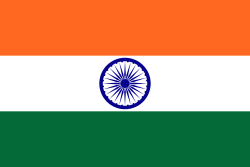
Flag of India
Emblem of India
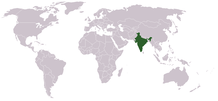
Location on the world map
Shortcut:
WP:PIN

The Republic of India is a country that occupies a greater part of Indian subcontinent. It borders Pakistan and Afghanistan in the northwest, the People's Republic of China, Nepal, and Bhutan in the north, and Bangladesh and Myanmar in the east. India's coastline stretches for over seven thousand kilometres. Its neighbours in the Indian Ocean are the island nations of the Maldives in the southwest, Sri Lanka in the south, and Indonesia in the southeast. India is the second most populous country in the world, with a population of over one billion and is the seventh largest country by geographical area. It is a constitutional republic consisting of twenty eight states and seven union territories. The word India derives from the Old Persian cognate for the Sanskrit word Sindhu, the Indus river. The Constitution of India also recognizes Bhārat listen (help·info) as an official name with equal status.

A centre of important historic trade routes, India is the home to some of the most ancient civilisations. India is the birthplace to four major world religions: Buddhism, Jainism, Sikhism and Hinduism. It also has the third largest Muslim population in the world after Indonesia and Pakistan. Hinduism is the major religion followed in India . India was a former colony of the British Empire under the British Raj before gaining independence on 15 August 1947. The country has witnessed significant economic and military growth after the liberalization of the Indian economy. India is also well-known for upholding the concept of peace, as was demonstrated by its peaceful method of freedom struggle.

Road to independence

[edit] Road to independence

File:Nehru Indian Independence speech.jpg
Jawaharlal Nehru being sworn in as India's first Prime Minister by Lord Mountbatten on August 15, 1947
Jawaharlal Nehru's tryst with destiny speech

On 3 June 1947, Viscount Lord Louis Mountbatten, the last British Governor-General of India, announced the partitioning of the British Indian Empire into India and Pakistan, under the provisions of the Indian Independence Act 1947. At the stroke of midnight, on 14 August 1947, India became an independent nation. This was preceded by Pandit Jawaharlal Nehru's famous speech titled Tryst with Destiny.

At the stroke of the midnight hour, when the world sleeps, India will awake to life and freedom. A moment comes, which comes but rarely in history, when we step out from the old to the new, when an age ends, and when the soul of a nation, long suppressed, finds utterance..... We end today a period of ill fortune, and India discovers herself again.

[edit] Celebrations

Prime Minister of India hoists the Indian flag on the ramparts of the this historical site, Red Fort, Delhi, On August 15th. 15th August is a national holiday in India. Government Offices are lit up. Flag hoisting ceremonies and cultural programs take place in all the state capitals. In the cities around the country the national flag is hoisted by politicians in their respective constituencies. In various private organisations the flag hoisting is carried out by a senior official of that organisation. Schools and colleges around the country organise flag hoisting ceremonies and various cultural events within their premises, where younger children in costume do impersonations of their favourite characters of the Independence era. Families and friends get together for lunch or dinner, or for an outing. Housing colonies, cultural centres, clubs and societies hold entertainment programmes and competitions, usually based on the Independence Day theme. Most national and regional television channels screen old and new film classis with patriotic themes on Independence Day.

Replies (5)

Flag of India

"Indian flag" redirects here. For flags used by Native American peoples, see the tribes' respective articles, for example the Navajo Nation.
Indian National Flag
Flag ratio: 2:3
Indian Flag, the first stamp of independent India, released on 21 Nov 1947, was meant for foreign correspondence.[1][2]

The National Flag of India was adopted in its present form during an ad hoc meeting of the Constituent Assembly held on the 22 July 1947, twenty-four days before India's independence from the British on 15 August 1947. It has served as the national flag of the Dominion of India between 15 August 1947 and 26 January 1950 and that of the Republic of India thereafter.[3] In India, the term "tricolour" (Hindi: तिरंगा, Tirangā) almost always refers to the Indian national flag.

The national flag, adopted in 1947, is based on the flag of the Indian National Congress, designed by Pingali Venkayya. The flag is a horizontal tricolour of "deep saffron" at the top, white in the middle, and green at the bottom. In the centre, there is a navy blue wheel with twenty-four spokes, known as the Ashoka Chakra, taken from the Lion Capital of Asoka erected atop Ashoka pillar at Sarnath. The diameter of this Chakra is three-fourths of the height of the white strip. The ratio of the width of the flag to its length is 2:3.[4] The flag is also the Indian Army's war flag, hoisted daily on military installations.

The official flag specifications require that the flag be made only of

khadi

, a special type of hand-spun cloth made popular by

Mahatma Gandhi

; while these specifications are widely respected within India, they are frequently ignored in the manufacture of Indian flags outside of the country. The display and use of the flag are strictly regulated by the

Indian Flag Code

.

[4]

A

heraldic

descripttion of the flag would be Party per fess Saffron and Vert on a fess Argent a "Chakra" Azure

Design

The following are the approximate colours of the Indian flag in different colour models. Saffron, green, white and blue are the colors of the flag. It is sorted into the HTMLRGBweb colours (hexadecimal notation); the CMYK equivalent; dye colours and the Pantone equivalent number.[3]

Scheme HTML CMYK Textile color Pantone
Orange #FF9933 0-50-90-0 Deep Saffron 1495c
White #FFFFFF 0-0-0-0 Dull White 1c
Green #138808 100-0-70-30 India green 362c
Blue #000080 100-98-26-48 Navy blue 2755c

The official (CMYK) value of the top band is (0,50,90,0)—closest to the colour pumpkin—with CMYK = (0,54,90,0); the CMYK value of true deep saffron being (4, 23, 81, 5)) and (0, 24, 85, 15)) respectively.[3] The flag was designed by Pingali Venkayya.[5]

[edit] Symbolism

The Ashoka Chakra, "the wheel of Righteousness" (Dharma)"

Originally, Gandhi was presented with a flag with two colors, red for the Hindus, and green for the Muslims. In the centre a traditional spinning wheel was suggested, which was associated with Gandhi's goal of making Indians self-reliant by fabricating their own clothing. Gandhi modified the flag by adding a white stripe in the center for other religious communities, and thus providing a background for the spinning wheel. Later on, to avoid sectarian associations with color, orange (having been changed from red), white and green were said to, respectively, represent courage and sacrifice, peace and truth, and faith and chivalry.[6]

A few days before India became independent on August 1947, the specially constituted Constituent Assembly decided that the flag of India must be acceptable to all parties and communities.[3] A flag with three colours, Saffron, White and Green with the Ashoka Chakra was selected. Sarvepalli Radhakrishnan, who later became India's first Vice President, clarified the adopted flag and described its significance as follows:

Bhagwa or the saffron colour denotes renunciation or disinterestedness. Our leaders must be indifferent to material gains and dedicate themselves to their work. The white in the centre is light, the path of truth to guide our conduct. The green shows our relation to (the) soil, our relation to the plant life here, on which all other life depends. The "Ashoka Chakra" in the centre of the white is the wheel of the law of dharma. Truth or satya, dharma or virtue ought to be the controlling principle of those who work under this flag. Again, the wheel denotes motion. There is death in stagnation. There is life in movement. India should no more resist change, it must move and go forward. The wheel represents the dynamism of a peaceful change.[4]


Emblem of India


Jump to: navigation, search

The Emblem of India
This is the famous original sandstone sculpted Lion Capital of Ashoka preserved at Sarnath Museum which was originally erected around 250 BCE atop an Ashoka Pillar at Sarnath.

The emblem of India is an adaptation from the SarnathLion Capital of Ashoka.

Emperor Ashoka the Great erected the capital atop an Ashoka Pillar to mark the spot where Gautama Buddha first taught the Dharma and where the Buddhist Sangha was founded. In the original there are four Asiatic lions, standing back to back, mounted on a circular abacus with a frieze carrying sculptures in high relief of an elephant, a galloping horse, a bull and a lion separated by intervening Dharmachakra or Ashoka Chakra wheels over a bell-shaped lotus. It was carved out of a single block of polished sandstone.

The version used as the emblem does not include the fourth lion (since it is hidden from view at the rear) or the bell-shaped lotus flower beneath. The frieze beneath the lions is shown with the Dharma Chakra in the center, a bull on the right and a galloping horse on the left, and outlines of Dharma Chakras on the extreme right and left.[1]

Forming an integral part of the emblem is the motto inscribed below the abacus in Devanagari scriptt: Satyameva Jayate सत्यमेव जयते (English: Truth Alone Triumphs).[1] This is a quote from MundakaUpanishad[2], the concluding part of the sacred HinduVedas.

It was adopted as the National Emblem of India on 26 January 1950, the day that India became a republic[3].

The emblem forms a part of the official letterhead of the Government of India, and appears on all Indian currency as well. It also sometimes functions as the national emblem of India in many places and appears prominently on the diplomatic and national Passport of the Republic of India. The wheel "Ashoka Chakra" from its base has been placed onto the center of the National Flag of India

Chak De India

Jai Hind


CCI Pro

Leave a Reply

Your are not logged in . Please login to post replies

Click here to Login / Register