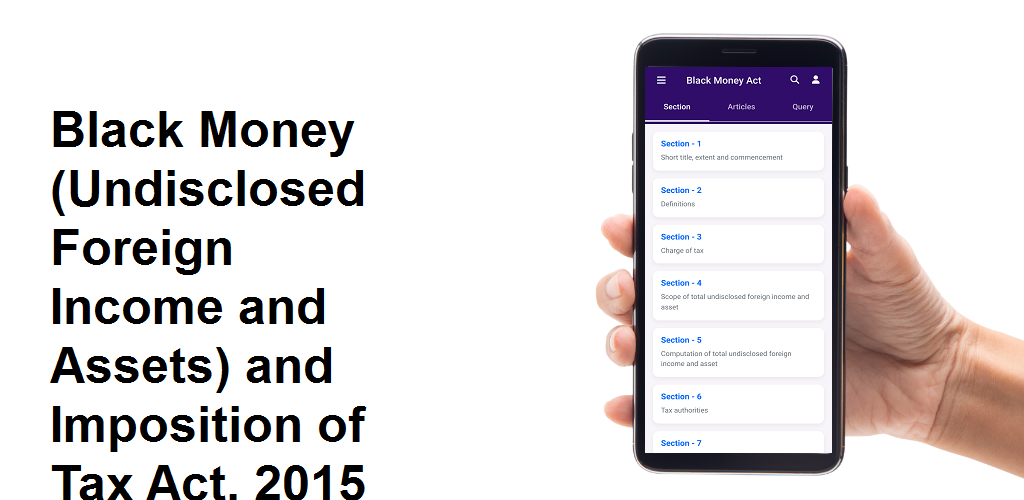
Black Money (Undisclosed Foreign Income and Assets) and Imposition of Tax Act, 2015
Section - 32 - Modes of recovery of tax dues
Modes of recovery of tax dues.32. (1) The Assessing Officer or the Tax Recovery Officer may require the employer of the assessee to deduct from any payment to the assessee such amount as is sufficient to meet the tax arrear from the assessee.(2) Upon requisition under sub-section (1), the employer shall comply with the requisition and shall pay the sum so deducted to the credit of the Central Government in such manner as may be prescribed.(3) Any part of the salary, exempt from attachment in execution of a decree of a civil court under section 60 of the Code of Civil Procedure, 1908 (5 of 1908), shall be exempt from any requisition made under sub-section (1).(4) The Assessing Officer or the Tax Recovery Officer may, by notice in writing, require any debtor of the assessee to pay such amount, not exceeding the amount of debt, as is sufficient to meet the tax arrear of the assessee.(5) Upon receipt of the notice under sub-section (4), the debtor shall comply with the requisition and shall pay the sum to the credit of the Central Government in such manner as may be prescribed within the time (not being before the debt becomes due to the assessee) specified in the notice.(6) A copy of the notice issued under sub-section (4) shall be forwarded to the assessee at his last address known to the Assessing Officer or the Tax Recovery Officer and in the case of a joint account, to all the joint holders at their last addresses known to the Assessing Officer or the Tax Recovery Officer.(7) It shall not be necessary for any pass book, deposit receipt, policy or any other document to be produced for the purpose of any entry, endorsement or the like being made before payment is made, notwithstanding any rule, practice or requirement to the contrary if the notice under sub-section (4) is issued to a post office, banking company, insurer or any other person.(8) Any claim in respect of any property, in relation to which a notic .... To read the full section download the app from Google Play store

09 September 2026
SENIOR AUDITOR & ACCOUNTS MANAGER
Anupam Parashar & Co.
Ghaziabad
CA Final
View Details
ARTICLESHIP
18 September 2026
Industrial Trainee
Twenty Point Nine Five Ventures Private Limited
Noida
CA Inter
View Details
ARTICLESHIP
07 September 2026
Article/ Paid Assistant
Murali and Sumeet Chartered Accountant
Bengaluru
CA Foundation
View Details

08 September 2026
Semi-Qualified Assitant
Subrahmanyam & Sivudu CA Firm
Hyderabad
CA Inter
View Details
 CCI
Pro
CCI
Pro
 CAclubindia
