
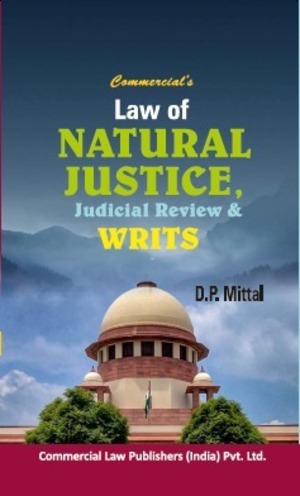
Law of Natural Justice - Judicial Review & Writs
by D.P. MittalBook Currently Unavailable
This book is no longer available and has been discontinued
Browse Other BooksCONTENTS
Chapter 1—Introduction
| 1.1 Constitution is the supreme law | 1 |
| 1.2 Law – Meaning and concept | 1 |
| 1.3 Law – Functions | 2 |
| 1.4 Sources of law | 3 |
| 1.5 Law cannot stand still | 4 |
| 1.6 Doctrine of laissez faire yielding to welfare state | 6 |
| 1.7 Law-Recent trends | 7 |
| 1.8 Public and private law | 7 |
|
8 |
|
9 |
|
10 |
|
11 |
|
12 |
|
12 |
| 1.9 Administration of law governed by fundamental policy of law | 13 |
| 1.10 Administrative law | 13 |
| 1.11 Administrative procedure to be fair, just and reasonable | 16 |
Chapter 2—Rule of Law
| 2.1 Introduction | 17 |
| 2.2 Concept and meaning | 18 |
| 2.3 Dicey Three Principles | 19 |
|
20 |
|
21 |
|
22 |
| 2.4 Rule of law - Differently described | 23 |
|
24 |
|
24 |
|
24 |
|
25 |
| 2.5 Rule of law- Indian Constitution | 25 |
| 2.6 Rule of law - Characteristics | 28 |
|
28 |
|
29 |
|
31 |
|
31 |
|
32 |
Chapter 3—Judicial and Administrative Functions of the State
| 3.1 Introduction | 38 |
| 3.2 Legislative, executive and the judicial functions of the State | 38 |
| 3.3 Legislature power to make law is not absolute | 40 |
| 3.4 Executive power is not absolute | 40 |
| 3.5 Executive functions of the State | 41 |
| 3.6 Administration of law | 41 |
| 3.7 Administrative law - relationship between government and the people | 41 |
|
42 |
|
43 |
| 3.8 Administrative law - Scope | 44 |
| 3.9 Administrative law and principle of governance | 45 |
|
45 |
|
46 |
|
47 |
|
47 |
|
48 |
| 3.10 Judicial act | 48 |
|
48 |
|
50 |
| 3.11 Judicial decisions made according to law | 51 |
| 3.12 Administration of justice is the State function - Courts | 52 |
| 3.13 Judicial power divided between courts and tribunals | 53 |
| 3.14 Court – meaning | 54 |
|
56 |
|
58 |
| 3.15 Tribunal – meaning | 59 |
|
62 |
|
62 |
|
65 |
|
66 |
|
70 |
| 3.16 Tribunal - Evidence Act not applicable | 71 |
|
72 |
|
73 |
|
73 |
|
74 |
|
75 |
| 3.17 Tribunal set up under different Acts- not court | 76 |
|
76 |
|
76 |
|
77 |
|
77 |
|
78 |
|
78 |
|
78 |
|
79 |
|
79 |
Chapter 4—Judicial Review - General Principles
| 4.1 Introduction | 80 |
|
80 |
|
82 |
| 4.2 Judicial review – meaning and concept | 82 |
|
83 |
| 4.3 Judicial review integral part of the Constitution | 84 |
| 4.4 Judicial review and justiciability – distinction | 86 |
| 4.5 Judicial review and appeal | 86 |
| 4.6 Judicial decision not subject to judicial review | 89 |
| 4.7 Judicial review- purpose | 89 |
| 4.8 Judicial review- Functions | 90 |
| 4.9 Judicial review- Scope | 92 |
| 4.10 Sovereign and some other certain acts outside the scope of Judicial review | 94 |
|
95 |
|
96 |
|
98 |
|
100 |
|
102 |
|
103 |
|
104 |
|
105 |
|
106 |
|
107 |
| 4.11 Judicial review - State actions if they relate to public law domain | 108 |
|
108 |
| 4.12 Judicial review- Judicial activism | 109 |
| 4.13 Judicial review – Limitation | 111 |
|
111 |
|
111 |
|
115 |
| 4.14 Judicial Review -Broad principles | 115 |
Chapter 5—Jurisdiction-Lack of, Nullity, Illegality Irregularity
| 5.1 Introduction | 118 |
| 5.2 Jurisdiction – meaning | 118 |
|
120 |
| 5.3 Nullity, illegality and irregularity are the various consequences of error | 121 |
| 5.4 Nullity, meaning of | 122 |
|
122 |
|
122 |
| 5.5 Illegality, meaning of | 124 |
|
124 |
| 5.6 Irregularity, meaning of | 125 |
|
125 |
| 5.7 Illegality and irregularity, distinction | 125 |
| 5.8 Nullity and irregularity, distinction | 125 |
| 5.9 Jurisdiction- Inherent, exercise and invoking of | 126 |
| 5.10 Inherent lack of jurisdiction | 127 |
|
130 |
| 5.11 Jurisdiction – Ultra vires statute | 130 |
| 5.12 Jurisdiction – Improper constitution of Tribunal | 130 |
| 5.13 Jurisdiction - Subject-matter | 130 |
| 5.14 Jurisdiction - Lack of During the course of proceedings | 131 |
| 5.15 Jurisdictional facts and conditions first determined before determining the actual issue | 132 |
|
132 |
| 5.16 Jurisdiction – Error of jurisdiction and error in the exercise | 132 |
|
133 |
|
134 |
| 5.17 Jurisdiction - An order without, is a nullity | 134 |
| 5.18 A null and void order is operative till it is declared void | 135 |
| 5.19 Jurisdiction - Not affected by repeal or amendment of a provision | 136 |
| 5.20 Nullity, illegality and irregularity Income-tax Act, 1961 | 137 |
| 5.21 Illegality, irrationality and procedural impropriety [Council of Civil Service Unions] | 138 |
| 5.22 Illegality – Decision contravening or exceeding the terms of the power | 140 |
| 5.23 According to law | 142 |
|
144 |
| 5.24 Flagrant violation of natural justice | 145 |
| 5.25 Perversity | 146 |
| 5.26 Irrationality | 147 |
|
150 |
|
151 |
|
152 |
|
154 |
|
156 |
|
156 |
|
158 |
|
159 |
| 5.27 Procedural Impropriety | 159 |
|
160 |
|
161 |
|
162 |
|
163 |
|
163 |
|
164 |
|
164 |
Chapter 6—Judicial Review - Judicial Control of Administrative Discretion
| 6.1 Introduction | 165 |
| 6.2 Judicial review - A mode for the court to exercise control on proper exercise of discretionary powers | 166 |
| 6.3 Judicial review - Directed against the decision-making process and not against the decision | 167 |
| 6.4 Discretion – some concepts | 168 |
|
168 |
| 6.5 Discretion – meaning | 169 |
| 6.6 Discretion coupled with duty | 171 |
| 6.7 Discretion-capable of abuse and not immune from judicial reviewability | 172 |
| 6.8 Judicial review - Scope and parameters of | 174 |
|
175 |
| 6.9 Judicial review - Failure to exercise discretion | 175 |
| 6.10 Judicial review – Excess or abuse of discretionary power | 176 |
|
177 |
|
178 |
|
178 |
|
179 |
|
180 |
| 6.11 Exercise of discretion - grounds for challenge of | 181 |
| 6.12 Misuse in bad faith | 181 |
| 6.13 Excess or abuse of power – Overstepping limits or defeating the provisions of the Act | 182 |
|
183 |
| 6.14 Excess or abuse of power- Situations giving rise to | 183 |
|
183 |
|
186 |
| 6.15 Summing up | 187 |
Chapter 7—Natural Justice - Concept and Features
| 7.1 Natural justice- A concept | 189 |
| 7.2 Participatory justice | 191 |
| 7.3 Not justice natural among men | 191 |
| 7.4 In aid of Legal justice | 192 |
| 7.5 Not statutory rules | 192 |
| 7.6 ‘Natural justice’ not capable of static and precise definition | 193 |
| 7.7 Not imprisoned in the straight-jacket or a cast-iron formula | 194 |
| 7.8 Not embodied rules | 195 |
| 7.9 Operates in area not covered by law validly made | 196 |
| 7.10 Natural justice - Aims | 198 |
|
199 |
|
200 |
| 7.11 Natural justice- Ingredients | 200 |
| 7.12 Features | 201 |
| 7.13 Limitations | 202 |
| 7.14 Non-application to legislative act | 202 |
| 7.15 Exceptions | 203 |
| 7.16 Presumptive implications - Implicit in every decision making function | 204 |
| 7.17 Branch of public law | 205 |
| 7.18 Guiding factor in administrative law | 206 |
| 7.19 Administrative law-Quasi-judicial and administrative enquiries | 206 |
Chapter 8 Natural Justice - Fair play and Fair hearing
| 8.1 What is natural justice | 208 |
| 8.2 Natural justice means fairness | 209 |
| 8.3 What constitutes fairness | 210 |
| 8.4 What fairness achieves | 211 |
| 8.5 Fair play and fair hearing | 211 |
|
212 |
| 8.6 Fair play means acting fairly | 213 |
|
215 |
| 8.7 Fair hearing-Procedural fairness | 216 |
|
217 |
| 8.8 Fairness in decision making | 218 |
|
218 |
| 8.9 Fair hearing necessary even if something obvious | 220 |
|
220 |
| 8.10 Fair hearing denied at initial stage not cured at appellate stage | 225 |
| 8.11 Fair hearing – Departmental proceedings | 225 |
|
227 |
Chapter 9—Audi Alteram Partem
| 9.1 Introduction | 230 |
| 9.2 Audi alterampaterm-Hear the other side | 230 |
| 9.3 Various aspects | 233 |
| 9.4 Compliance- categories | 234 |
| 9.5 Injects justice into law | 234 |
| 9.6 Constitutionally protected right | 235 |
| 9.7 Two facets -intrinsic and institutional (constitutional) | 237 |
| 9.8 Right of hearing, even if not provided | 238 |
| 9.9 Exception - No hearing | 239 |
|
243 |
| 9.10 Post decisional hearing | 243 |
| 9.11 Summary judgment | 245 |
| 9.12 audi alteram partem - Principles | 245 |
| 9.13 Notice | 246 |
|
248 |
|
248 |
|
248 |
|
249 |
|
249 |
|
250 |
| 9.14 Adequate notice | 250 |
|
250 |
| 9.15 Appropriate opportunity | 251 |
|
253 |
|
254 |
|
255 |
|
255 |
|
256 |
|
256 |
|
257 |
|
258 |
|
259 |
| 9.16 Personal (oral) hearing | 259 |
| 9.17 Audi alteram partem - effect of non observance | 260 |
|
260 |
|
262 |
|
262 |
Chapter 10—Bias - Nemo Debet Esse Judex in Propria Causa
| 10.1 Introduction | 264 |
| 10.2 Fair hearing by an impartial tribunal – A right | 264 |
| 10.3 ‘nemojudex in causasua’ | 265 |
|
266 |
|
266 |
| 10.4 Bias | 266 |
|
267 |
|
267 |
|
268 |
|
268 |
|
268 |
|
269 |
|
270 |
| 10.5 No man shall be a judge in his own cause | 271 |
|
272 |
|
272 |
|
273 |
|
273 |
|
274 |
|
275 |
|
276 |
|
277 |
|
278 |
| 10.6 Justice not only be done, but manifestly seen to be done | 280 |
|
282 |
|
283 |
|
285 |
|
287 |
|
288 |
|
289 |
|
290 |
|
293 |
|
293 |
|
296 |
| 10.7 Existence of bias – Situations | 297 |
| 10.8 Duty to disclosure | 299 |
| 10.9 Waiver | 300 |
| 10.10 Doctrine of necessity | 302 |
| 10.11 Bias - Opinion or reports | 303 |
Chapter 11—Speaking Order
| 11.1 Introduction | 304 |
| 11.2 Speaking order | 304 |
|
305 |
| 11.3 Speaking order - An ingredient of audi alteram partem | 306 |
| 11.4 Order of administrative or quasi-judicial authority must speak | 306 |
| 11.5 Requisites of decisions | 307 |
| 11.6 Duty to record reasons | 308 |
|
308 |
|
310 |
|
310 |
| 11.7 Transparency - ensures people knowing how, why and what for the decision taken | 310 |
| 11.8 Rationale - Failure to give reasons amounts to denial of justice | 311 |
| 11.9 Speaking order – why necessary | 313 |
|
314 |
|
315 |
|
316 |
|
317 |
|
317 |
|
317 |
|
318 |
|
318 |
| 11.10 Reasons to be proper and adequate | 321 |
| 11.11 Non-recording of reasons- Court Martial cases | 322 |
| 11.12 Summing up | 322 |
Chapter 12—Legitimate Expectation
| 12.1 Introduction | 324 |
| 12.2 Historical development | 325 |
| 12.3 Concept | 326 |
|
328 |
|
330 |
|
331 |
|
332 |
|
333 |
|
334 |
|
335 |
|
336 |
|
336 |
|
336 |
|
337 |
|
338 |
|
338 |
|
339 |
| 12.4 Two aspects | 340 |
|
341 |
|
342 |
|
343 |
|
343 |
|
344 |
| 12.5 Right of Fair hearing | 344 |
|
344 |
|
345 |
|
346 |
| 12.6 Judicial review | 346 |
|
348 |
Chapter 13—Promissory Estoppel
| 13.1 Introduction | 350 |
| 13.2 Aims to secure justice and equity | 350 |
| 13.3 Historical development - England | 351 |
| 13.4 Historical development - India | 356 |
| 13.5 Estoppel | 360 |
| 13.6 Equitable estoppel | 361 |
| 13.7 Promissory estoppel | 361 |
|
362 |
|
367 |
|
369 |
|
369 |
|
369 |
|
370 |
| 13.8 Ingredients | 371 |
| 13.9 Promise for the future (promissory statement) | 371 |
|
372 |
| 13.10 Altering position | 372 |
|
372 |
|
373 |
|
373 |
|
374 |
|
374 |
| 13.11 Legal right | 374 |
| 13.12A Legal relationship | 375 |
| 13.13 Promissory estoppel and Service laws | 376 |
Chapter 14—Burden of Proof
| 14.1 Introduction | 377 |
| 14.2 Burden of proof-meaning | 377 |
| 14.3 Evidence | 377 |
|
378 |
|
378 |
|
379 |
|
379 |
|
379 |
| 14.4 Fact | 381 |
| 14.5 Proof | 381 |
|
382 |
| 14.6 Presumption - Meaning of | 382 |
| 14.7 Presumption - A rule of evidence | 382 |
|
383 |
| 14.8 Burden of proof - Aspects | 383 |
| 14.9 Burden of proof - As a matter of law | 383 |
| 14.10 Presumption of fact | 383 |
| 14.11 Presumption of law | 384 |
|
384 |
|
385 |
| 14.12 Burden of proof in civil cases - Preponderance of probabilities | 385 |
| 14.13 Burden of proof - Mala fide acts | 386 |
| 14.14 Burden of proof - Income-tax Act | 390 |
Chapter 15—Review and Rectification
| 15.1 Introduction | 392 |
| 15.2 Review | 392 |
|
393 |
| 15.3 Procedural review | 393 |
| 15.4 Review under Civil Procedure Code | 394 |
|
395 |
|
395 |
|
396 |
|
397 |
|
397 |
| 15.5 Error apparent from record | 398 |
|
398 |
|
399 |
|
400 |
| 15.6 Power mandatory | 401 |
| 15.7 ex debito justitiae | 401 |
| 15.8 Recalling order | 402 |
|
404 |
|
404 |
|
405 |
|
405 |
Chapter 16—Revision
| 16.1 Introduction | 408 |
| 16.2 Review and Revision- distinction | 408 |
| 16.3 Revision and appeal - Distinction | 408 |
| 16.4 Revisional power | 409 |
| 16.5 Parameters | 410 |
|
412 |
|
413 |
| 16.6 Revision under the Income-tax Act | 413 |
Chapter 17—Appeal
| 17.1 Introduction | 415 |
| 17.2 Appeal – meaning | 415 |
|
417 |
|
418 |
|
418 |
|
419 |
|
419 |
|
419 |
|
420 |
|
420 |
|
421 |
| 17.3 Appeal from any order | 422 |
|
422 |
|
422 |
|
423 |
| 17.4 Right to appeal | 424 |
|
426 |
|
427 |
|
427 |
|
429 |
|
430 |
|
431 |
|
432 |
| 17.5 First appeal | 432 |
|
433 |
|
433 |
|
434 |
|
435 |
|
436 |
| 17.6 Second Appeal | 436 |
|
438 |
|
439 |
|
440 |
|
440 |
|
441 |
|
442 |
|
444 |
|
445 |
|
445 |
|
446 |
|
447 |
| 17.7 Appeal to Supreme Court | 449 |
|
450 |
|
451 |
|
452 |
|
452 |
|
453 |
| 17.8 Doctrine of merger | 455 |
|
456 |
|
457 |
|
458 |
|
459 |
|
460 |
Chapter 18—Writs
| 18.1 Introduction | 463 |
| 18.2 Writs - High Court power | 463 |
| 18.3 Historical background | 465 |
| 18.4 Writ - meaning | 467 |
| 18.5 Writs and Judicial review | 467 |
| 18.6 Writs Public law remedy | 469 |
|
469 |
|
470 |
|
471 |
|
472 |
| 18.7 Writs - scope | 473 |
|
475 |
| 18.8 Power of writ and of superintendence | 475 |
|
476 |
| 18.9 Power of superintendence - Article 227 | 477 |
|
477 |
| 18.10 Power of writ - Article 226 | 480 |
|
481 |
|
483 |
| 18.11 Writs in the nature of | 484 |
| 18.12 Limitations | 484 |
| 18.13 Writs – Kinds | 487 |
|
488 |
|
488 |
|
489 |
|
490 |
Chapter 19—Writ of Mandamus
| 19.1 Mandamus - To command and execute | 491 |
| 19.2 Mandamus – Scope | 492 |
|
494 |
| 19.3 Mandamus not taken away by finality of order | 495 |
| 19.4 Mandamus not a substitute for regular trial | 490 |
| 19.5 Mandamus not applicable to contractual rights | 490 |
|
490 |
|
496 |
|
496 |
|
496 |
|
496 |
| 19.7 Mandamus - Cannot be denied | 497 |
| 19.8 Mandamus - Admissibility | 497 |
| 19.9 Alternative remedies | 498 |
|
500 |
|
501 |
|
502 |
|
502 |
|
504 |
|
504 |
| 19.10 Conduct of parties | 505 |
| 19.11 Laches (inordinate delay) | 505 |
| 19.12 Mandamus –Subordinate Legislation | 507 |
| 19.13 Circumstances – summing up | 508 |
Chapter 20—Writs - Certiorari and Prohibition
| 20.1 Introduction | 509 |
| 20.2 Historical development | 509 |
| 20.3 Writ Prohibition | 509 |
| 20.4 Certiorari-Object | 510 |
| 20.5 Certiorari - Judicial superintendence, in the nature of revisional jurisdiction | 511 |
| 20.6 Certiorari - Alternative remedy | 511 |
| 20.7 Certiorari and Prohibition - Scope | 511 |
| 20.8 Summing up | 515 |
| 20.9 Jurisdictional error and want of jurisdiction | 516 |
|
517 |
| 20.10 Show cause notice | 518 |
| 20.11 Certiorari and appeal | 519 |
Chapter 21—Judicial Review and Ousting of Civil Court Jurisdiction
| 21.1 Introduction | 520 |
| 21.2 Exclusionary clause - Justification | 520 |
| 21.3 Exclusion not readily inferred | 522 |
| 21.4 Tests for intended exclusion - Adequacy and sufficiency of remedies | 522 |
| 21.5 Principles for exclusion | 524 |
| 21.6 Limitations | 525 |
| 21.7 Civil court jurisdiction not completely ousted- order subject to judicial review under article 226 or 227 | 525 |
Chapter 22—High Court Inherent Powers
| 22.1 Introduction | 528 |
| 22.2 Inherent power - Meaning and necessity | 528 |
| 22.3 Inherent power - And ex debito justitiae | 528 |
| 22.4 Inherent power and implied power - Distinction | 528 |
| 22.5 Inherent and revisional power - Distinction | 529 |
| 22.6 Inherent power - Scope of | 529 |
| 22.7 Inherent powers - Restrictions and conditionalities | 530 |
| 22.8 Power of the High Court under section 151 of the Civil Procedure Code | 530 |
| 22.9 Inherent power of the court to review its own decision | 532 |
| 22.10 Inherent power Under section 482 of the Code of Criminal Procedure | 532 |
| 22.11 Inherent power under section 482 - Scope | 532 |
| 22.12 Inherent power - Quashing of proceeding to prevent manifest injustice | 533 |
| 22.13 Inherent power to quash proceeding - If ingredients of offence are absent | 533 |
|
534 |
|
534 |
Chapter 23—Interpretative Principles
| 23.1 Introduction | 535 |
| 23.2 Interpretation of statute, meaning of | 535 |
| 23.3 Interpretation- General principles | 535 |
| 23.4 Statute not a divine revelation | 537 |
|
537 |
| 23.5 Intention of Legislature | 537 |
| 23.6 Statutory text and intention of the Parliament | 538 |
| 23.7 Statutory construction is regarded an exercise in legal reasoning | 539 |
| 23.8 Rules of interpretation | 539 |
| 23.9 Purposive Interpretation | 542 |
|
545 |
| 23.10 Principle of Interpretation, summing up | 546 |
| 23.11 Updating construction | 547 |
| 23.12 Constitutionality of law - Principles | 547 |
| 23.13 Presumption in favour of constitutionality | 549 |
| 23.14 Casus omissus and ex visceribus actus | 550 |
| 23.15 Strict interpretation | 551 |
|
551 |
|
551 |
|
552 |
|
553 |
|
553 |
|
554 |
|
554 |
| 23.16 Liberal Interpretation | 555 |
|
555 |
|
555 |
|
556 |
|
556 |
|
556 |
| 23.17 Interpretation - Internal aids | 557 |
| 23.18 Preamble | 557 |
| 23.19 Definition | 558 |
|
558 |
|
559 |
|
559 |
| 23.20 Means | 559 |
| 23.21 Includes | 559 |
|
560 |
| 23.22 “Means and includes� | 560 |
|
561 |
| 23.23 Unless the context otherwise requires | 561 |
| 23.24 Referential definition | 562 |
| 23.25 Proviso | 563 |
|
563 |
|
564 |
|
565 |
| 23.26 Explanation | 565 |
|
566 |
| 23.27 Exception | 567 |
| 23.28 Legal fiction and deeming provisions | 567 |
| 23.29 Marginal notes and headings | 568 |
| 23.30 Setting of the Act | 568 |
|
568 |
| 23.31 Other expressions | 569 |
| 23.32 Notwithstanding | 569 |
| 23.33 Subject to | 570 |
| 23.34 In accordance with | 570 |
| 23.35 In addition to | 570 |
| 23.36 In derogation of | 570 |
| 23.37 In connection with | 570 |
| 23.38 In (by) writing | 570 |
| 23.39 In relation to | 571 |
| 23.40 Pertaining to | 571 |
| 23.41 Incidental | 571 |
| 23.42 Incident | 572 |
| 23.43 In respect of - With respect to | 572 |
| 23.44 Within | 572 |
| 23.45 In and within | 572 |
| 23.46 Namely, or that is to say | 572 |
| 23.47 Liable | 572 |
| 23.48 Under the Act | 573 |
| 23.49 Otherwise | 573 |
| 23.50 Without prejudice | 573 |
| 23.51 As the case may be | 574 |
| 23.52 So far as may be | 574 |
| 23.53 Similar | 574 |
| 23.54 Like | 574 |
| 23.55 Having regard to | 574 |
| 23.56 Or | 575 |
| 23.57 “And� and “Or� | 575 |
| 23.58 At any time | 575 |
| 23.59 “During� and “In all� | 575 |
| 23.60 “A� | 575 |
| 23.61 “An� | 575 |
| 23.62 “The� | 575 |
| 23.63 “Any� | 575 |
| 23.64 Where, when if, | 576 |
| 23.65 Etc. | 576 |
| 23.66 After | 576 |
| 23.67 Hereafter | 577 |
| 23.68 Mandatory or directory/Meaning | 577 |
|
577 |
|
577 |
|
578 |
|
578 |
|
578 |
|
578 |
|
579 |
|
579 |
|
579 |
|
579 |
|
580 |
|
580 |
|
580 |
| 23.69 Guidelines | 581 |
| 23.70 Schedule | 581 |
| 23.71 External aids | 582 |
| 23.72 Dictionary | 583 |
|
583 |
|
584 |
|
584 |
|
585 |
| 23.73 Process of legislation | 585 |
|
586 |
|
586 |
|
586 |
|
587 |
| 23.74 Contemporanea expositio (Administrative instructions) | 588 |
| 23.75 Special law v. General law | 590 |
|
590 |
About the Author

D.P. Mittal
D.P. Mittal-D.P. Mittal is an advocate, tax and business law consultant. He has authored about two hundred articles in Indian and foreign magazines and journals and also books on various law subjects; some of them are as follows: Interpretation of Taxing Statutes, Wills, Deeds and Documents; Laws relating to Copyrights, Patents, Trade Marks and GATT; Business and Commercial Laws; Law of Arbitration, ADR and Contract in India; Indian Patents Law; Natural Justice, Judicial Review & Administrative Law; Law of Trade Marks; Law of Information Technology (Cyber Law); Law of Arbitration (2002); Indian Patents Law and Procedure (2002); Trade Marks Passing off and Geographical Indications of Goods - Law and Procedure (2002); Competition Law; Law relating to Sick Industries; Interpretation of Statutes; Law Dictionary
FREE Shipping
Have Questions About This Book?
Our course advisors are here to help you make the right decision for your career growth.
Other books
Taxation MCQ Booklet For CA Inter
Taxation For CA Inter - Module 4 Practice Manual

GST (IDT) Book - 4th Edition | May, Sept 2026 & Jan 2027 Attempt

Strategic Management (SM) Book May 26 & Sept 26 onwards

AUDIT INSIGHTS BOOK May 26 & Sept 26 onwards
List your Books
Share your knowledge and help shape the next generation of tech-savvy CA & Tax professionals while building a rewarding career in education.
Get Started CAclubindia
