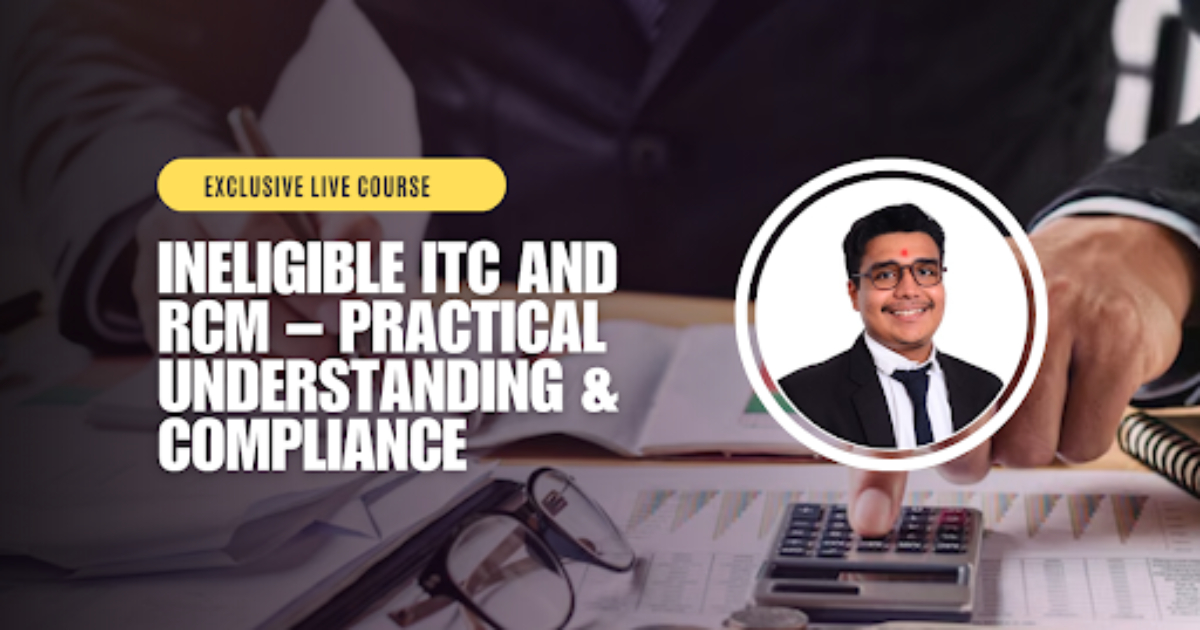
Ineligible Input Tax Credit (ITC) and Reverse Charge Mechanism (RCM) – Practical Understanding & Compliance(Recorded Course)
Course Description
Session Objective
To help participants clearly understand:
- Which expenses block ITC under GST,
- When and how RCM applies, and
- How to avoid inadvertent ineligible‑ITC claims and RCM‑related disputes.
A. Introduction to ITC and RCM
- Brief refresher on Input Tax Credit under Section 16 of CGST Act.
- Concept of Reverse Charge Mechanism under Sections 9(3)/5(3) CGST/IGST.
- Why ITC and RCM matter for working‑capital, cash‑flow, and audits.
B. Cases of Ineligible / Blocked ITC
(Under Section 17(5) + related rules)**
Explain common categories where ITC is disallowed, with practical examples:
- Motor vehicles (small passenger vehicles, aircraft, vessels)
- Goods / services used for personal use, exempt supplies, or non‑business purposes
- Food & beverages, club / health‑club memberships, life / health insurance (where not obligatory)
- Construction of immovable property (except plant & machinery)
- Goods lost / stolen / destroyed without valid reason
- Interest, penalty, late‑fee, fines, taxes paid under compounding / penalty proceedings
Emphasis:
- How to identify blocked‑ITC at invoice level.
- Impact on GSTR‑3B, GSTR‑9/9C, and ITC reversals.
C. Reverse Charge Mechanism (RCM) - Applicability
Define RCM and then cover:
- When RCM applies:
- Notified goods and services (e.g., GTA, advocate, insurance agent, etc.)
- Unregistered suppliers to registered persons (B2B)
- Imports of services
- Calculation of liability under RCM (value + GST + cess, if any).
- Time of liability and due dates for payment (current month vs delay).
Mention:
- Conditions for availment of ITC on RCM‑paid tax (usage for business, valid invoice, etc.).
D. ITC and RCM - Practical Pitfalls
Discuss common errors seen in practice:
- Wrong assumption that all RCM‑paid GST is automatically eligible as ITC.
- Claiming ITC on expenses that fall under Section 17(5) blocks.
- Non‑reconciliation of GSTR‑2B / GSTR‑3B with books leading to ineligible‑ITC discovery at audit stage.
- Delayed RCM payment and interest consequences.
Illustrate each with a short example (e.g., GTA services, car hire, office‑party food, etc.).
E. Record‑Keeping & Compliance Tips
- Proper invoicing and documentation for RCM transactions (self‑invoice, copy of supplier invoice, etc.).
- Maintenance of separate registers for blocked‑ITC and RCM‑payable supplies.
- How to show RCM liability and ineligible‑ITC in GSTR‑3B, GSTR‑9, and GSTR‑9C.
- Quick checklist for in‑house finance teams / tax consultants.
F. Doubt‑Solving & Discussion (if extended)
- Open‑floor discussion on participants - real‑life scenarios.
- Typical doubts:
- Can ITC be claimed on RCM if the supplier is registered later?
- How to treat RCM where part of services are for exempt supplies?
- Reversal entries for ineligible‑ITC and interest implications.
Meet Your Instructor

CA Varun Parmar
I am a Chartered Accountant specializing at the intersection of Taxation and Technology, with strong expertise in GST audits, compliance management, and end-to-end indirect tax processes.
My work focuses on delivering accurate, efficient, and insight-driven solutions in indirect taxation. I have developed strong capabilities in data reconciliation, statutory compliance reviews, and identifying tax optimization opportunities that add real value to businesses.
With hands-on experience in Excel automation and process design, I build practical tools that streamline workflows, improve reporting accuracy, and reduce manual intervention. I strongly believe that the future of tax lies in integrating domain knowledge with smart technology.
I am passionate about creating scalable, user-friendly solutions that simplify complex GST processes for professionals and businesses. My goal is to drive efficiency through automation while strengthening compliance systems.
I continue to grow with a vision of becoming a trusted advisor in Tax, Technology, and Process Transformation, helping organizations move towards smarter and more structured financial ecosystems.
Have Questions About This Course?
Our course advisors are here to help you make the right decision for your career growth.
Other Courses
Practical Course on Income Tax Audit(Recorded Course)
Tally with Tax Pro
Tally with Tax Course
Tally with Tax Advance
List your Class
Share your knowledge and help shape the next generation of tech-savvy CA & Tax professionals while building a rewarding career in education.
Get Started CCI
Pro
CCI
Pro
 CAclubindia
