Start-up Reckoner 2 - Turnover-limit linked compliances/ exemptions for a start-up which is private company
I-54
Start-up Reckoner 3 - Turnover-limit linked compliances/exemptions for start-up which is a limited liability partnership
I-59
Start-up Reckoner 4 - Turnover-limit linked compliances/exemptions for start-up which is a traditional/general partnership firm
I-64
Start-up Reckoner 5 - Tax Benefits Available to DPIIT - Recognised Start-up Private Limited Companies based on their Turnover
I-70
1
WHAT IS A START-UP
1.1 Backdrop
1
1.2 Start-up
2
1.3 Distinction between 'entrepreneurships' and start-ups
2
1.4 Definition of 'start-up' for the purposes of DPIIT - Recognition for obtaining income-tax benefits and benefits under start-up India scheme
3
1.5 Start-up India scheme
3
1.6 Benefits to recognised start-ups under 'start-up India scheme'
4
1.7 What benefits are available for irrespective of DPIIT recognition
7
2
DISTINCTION BETWEEN START-UPS AND MSMEs
2.1Whether start- ups can register as MSMEs to avail benefits under the MSMED Act, 2006?
8
2.1-1 Whether start-ups will be regarded as MSMEs as per the revised definition in NMN?
8
2.2What is the legal difference between an MSME and a start-up?
11
2.3Can an enterprise satisfy the definition of MSME and start-up and get the best of both the worlds i.e benefits under MSMED Act as well as LSN?
13
2.4 What benefits are available under the MSMED Act to a micro enterprise start-up filing Udyam Registration?
14
2.5 What benefits are available under the MSME Act to a small enterprise start-up filing Udyam Registration?
14
2.6 What benefits are available under the MSME Act to a medium enterprise start-up filing Udyam Registration?
15
2.7 For availing tax holiday under section 80-IAC of the Income-tax Act, will it be necessary for start-up to file Udyam Registration?
15
2.8 What Income-tax benefits are applicable to start-ups regardless of whether they satisfy the MSME definition or not?
16
3
WHAT IS THE CRITERIA FOR RECOGNITION OF START-UPS BY DPIIT
3.1 What criteria must be met by start-up to obtain DPIIT recognition and to obtain various income-tax benefits?
17
3.2 What is the definition of 'start-up' in the ISN
18
3.3 What are the Revised Guidelines as to Recognition of start-up?
20
3.4 Whether an entity incorporated outside India is eligible for DPIIT recognition as a start-up?
22
4
START-UPS ELIGIBLE FOR DPIIT - RECOGNITION
4.1 What are the start-up entities eligible for recognition by DPIIT?
23
4.1-1 Registered Partnership Firm
23
4.1-2 Limited Liability Partnership
24
4.1-3 Private Limited Company
24
4.2 Which form of entity is most efficient from income-tax point of view: RPF or LLP or PLC?
25
5
OPC AS A START-UP ENTITY
5.1 What is a One Person Company?
27
5.2 Is One Person Company (OPC) a private limited company and eligible to be considered a 'start-up'?
27
5.3 Is the OPC a Private Company?
28
5.4 What are the features of an OPC?
28
5.5 What were the announcements regarding One Person Companies in Finance Minister's Budget Speech on Feb.1, 2021?
31
5.6 Can an NRI incorporate an OPC start-up entity today if he so wishes?
32
5.7 Can a foreigner (citizen of any foreign country) incorporate an OPC start-up entity today if he so wishes?
33
5.8 I incorporated my OPC on 1-1-2020. When can I convert my OPC into private company or public company?
33
5.9 What is the procedure applicable with effect from 1-4-2021 for voluntary conversion of OPC into private company or public company?
33
5.10 Whether a private company can convert itself into OPC if its paid-up capital exceeds 50 lakhs and/or its average annual turnover exceeds 2 crores?
34
5.11 Have any OPCs been approved as *start-up" for start-up India and for section 80-IAC tax holiday purposes in the past years?
35
5.12 Is there any provision which bars OPCs from Section SO-IAC Tax Holiday?
35
5.13 If an NRI incorporates an OPC on or after 1-4-2021, can he be allotted shares at a premium by the OPC? Will "angel tax" apply? Will OPC have to obtain valuation reports to justify premium/FMV of shares?
35
5.14 If an NRI incorporates an OPC on or after 1-4-2021, will the first proviso to section 68 of the Income-tax Act, 1961 apply as regards share capital/ share application money contributed by him?
36
5.15 What will be the tax implications for OPC start-up?
36
5.16 Can OPC float subsidiary OPCs?
36
5.17 Can OPC float subsidiary Public Co. or Private Co.?
36
5.18 Can an NRI floating an OPC sell his flat in India and invest in OPC? Is there any exemption for him from capital gain
36
5.19 Whether a DPIIT-Recognised OPC start-up entity is permitted to convert itself into a private limited company or public limited company?
36
5.20 Whether a DPIIT-Recognised private limited start-up entity can convert itself into an OPC?
37
6
INNOVATIONISCALABLE BUSINESS MODEL
6.1 Entity is working towards innovation, development or improvement or is a scalable business model
38
6.2 Innovation
38
6.3 Scalable busines.s model
41
6.4 Examples of start-up entities working towards innovation/innovativeness (as certified for section 80-IAC tax holiday by IMB)
45
6.5 Examples of start-up entities working towards improvement in products or services (as certified for section SO-IAC tax holiday by IMB)
68
6.6 Examples of start-up entities as scalable business models(as certified for section 80-IAC tax holiday by IMB)
88
6.7 Examples of start-up entities with high employment generation m»tential (as certified for section 80-IAC tax holiday by IMB)
142
6.8 Examples of start-up entities with wealth creation potential (as certified for section 80-IAC tax holiday by IMB)
151
7
START-UP ENTITIES NOT ELIGIBLE FOR DPIIT RECOGNITION
7.1 Entities not eligible for recognition by DPIIT
152
8
SOLE PROPRIETORSHIPS - WHETHER ELIGIBLE FOR DPIIT RECOGNITION
8.1 Whether sole proprietorship is eligible to apply for DPIIT recognition as a start-up?
153
8.2 Whether a One Person Company (OPC) start-up entity is eligible to be recognised by DPIIT?
153
8.3 Whether a sole proprietorship can seamlessly convert itself into OPC?
153
8.3-1 Transfer of proprietorship to a private limited company / OPC
154
8.3-2 Sole propfietorship is converted into a partnership firm/ LLP by admitting a partner and then the firm is converted into a private limited company under Chapter XXI of Companies Act. 2013
155
8.3-3 Sole proprietorship is converted into partnership firm and firm is then seamlessly converted into LLP
156
9
ENTITIES FORMED AS A RESULT OF AMALGAMATIONS/MERGERS/DEMERGERS/ABSORPTION WHETHER ELIGIBLE FOR DPIIT RECOGNITION
9.1 What is meant by the terms "amalgamation", "merger","absorption" & "acquisition"?
157
9.1-1 Merger by absorption
158
9.1-2 Merger by formation of a new company
158
9.2 What is meant by the term "demerger"?
158
9.2-1 Division 159
9.3 Whether DPIIT - Recognition is available to resultant entities formed due to merger/demerger/acquisition/amalgamation/ absorption
159
9.3-1 Definition of 'start-up company'
160
9.3-2 Definition of 'small company'
160
10
ENTITIES FORMED AS A RESULT OF COMPROMISE/ARRANGEMENT - WHETHER ELIGIBLE FOR DPIIT RECOGNITION
10.1 Whether any entity formed due to compromise/ arrangement is eligible for DPIIT Recognition?
162
10.2 What is *compromise" / "arrangement"?
162
11
HOLDING & SUBSIDIARY COMPANIES - WHETHER ELIGIBLE FOR DPIIT RECOGNITION
11.1 Whether a holding company or subsidiary company is eligible for DPIIT recognition as a start-up?
164
11.2 What if a DPIIT recognised start-up becomes holding co./subsidiary co. of any company after its recognition?
164
11.3 What is the definition of "holding company"?
164
11.4 What is the definition of "subsidiary company"? 165
165
11.4-1 Control
166
11.4-2 Control of compusition of BOD of subsidiary by holding company
166
11.4-3 One-half of total voting power
168
11.4-4 "Subsidiary" or "Subsidiary Company" must be a body corporate
169
11.4-5 Layers of subsidiaries 2
172
11.5 Whether a start-up private limited company will treated as subsidiary company if more than of its share capital is held by a partnership firm?
173
11.6 Whether a start-up private limited company will treated as subsidiary company if more than of its share capital is held by a LLP?
173
11.7 Whether a Private Limited company which has more than stake in a LLP will be treated as holding company?
173
11.8 Whether a Private Limited company which has more than 5096 stake in a partnership firm will be treated as holding company?
174
11.9 Whether common directors is the test for holding co. - Subsidiary relationship
174
12
JOINT VENTURES - WHETHER ELIGIBLE FOR DPIIT RECOGNITION
12.1 Whether a JV (Joint Venture) is eligible for DPIIT recognition as a start-up?
175
12.2 What if a start-up enters into a JV after its recognition?
175
12.3 What is a "joint venture"?
175
13
ENTITIES INCORPORATED OUTSIDE INDIA -WHETHER ELIGIBLE FOR DPIIT RECOGNITION
13.1 Whether an entity incorporated outside India is eligible for DPIIT recognition as a start-up?
179
14
ENTITIES WITH FOREIGN SHAREHOLDING/STAKE -WHETHER ELIGIBLE FOR DPIIT RECOGNITION
14.1 Whether entity with foreign equity/foreign partner/ foreign shareholder is eligible to be recognised by DPIIT?
181
15
ENTITIES FORMED BY SPLITTING-UP/RECONSTRUCTION OF EXISTING BUSINESS - WHETHER ELIGIBLE FOR DPIIT RECOGNITION
15.1 Entity formed by splitting uporreconstruction of existing business is not eligible for DPIIT recognition
184
15.2 Instances where section 80-IAC certification of start-up entity rejected by IMB and DPIIT recognition revoked for violation of "not formed by splitting up or reconstruction" of existing business
185
15.3 How to stay clear of the teeth of "not formed by splitting- up or reconstruction of existing business" clause
193
15.4 Whether conversion of a start-up entity which is a firm or LLP partnership into a private limited company under Chapter XXI of the Companies Act, 2013 (the 2013 Act) amounts to splitting-up or reconstruction of a business already in existence? Will new converted entity lose benefits available to a start-up under the Notification?
194
16
ENTITIES INCORPORATED WITH COMMON DIRECTOR/DP/PARTNER - WHETHER ELIGIBLE FOR DPIIT RECOGNITION
16.1 Whether additional entity inconxjrated with one common Director/DP/Partner will be eligible for DPIIT - Recognition?
197
16.2 Concept of "arm's length"
197
17
PROCEDURE FOR DPIIT - RECOGNITION OF START-UP
17.1 What is the process for recognition of a start-up by DPIIT
200
17.2 What is the procedure for applying for DPIIT Recognition
201
17.3 Whether a start-up LLP with foreigner as a partner can get recognition by DPIIT?
205
17.4 What if start-up application for DPIIT - Recognition is rejected or marked incomplete?
206
17.5 Is there any appeal against order rejecting the application for recognition?
206
17.6 Whether recognition by DPIIT essential for claiming tax benefits under the Income-tax Act, 1961 ?
206
17.7 Whether fresh recognition to be obtained by a DPIIT -Recognised start-up firm on conversion to LLP/private limited company or by a DPIIT - Recognised LLP on conversion to private limited company?
207
18
NAME CHANGE BY DPIIT - RECOGNISED START-UP ENTITY - WHETHER PERMITTED
18.1 Whether name change by a start-up entity disqualifies a start-up from DPIIT - Recognition?
19.1 Whether CIN/LLPIN change by a DPIIT - Recognised start-up entity is permitted ?
211
20
CONVERSION BY A DPIIT - RECOGNISED ENTITY FROM ONE FORM TO ANOTHER - WHETHER PERMISSIBLE
20.1 Whether conversion by a DPIIT - Recognised start-up entity from one form to another is permissible?
212
20.2 Conversion from general partnership to LLP - Whether gives rise to taxable capital gains?
212
20.3 Conversion of firm/ LLP into a company
215
20.3-1 Where firm converted into company according to Part IX of the Companies Act, 1956 [now Chapter XXI of the Companies Act, 20131, is section 47(xiit) required to be complied with for claiming exemption from capital gains tax?
215
20.3-2 Where it was held that conditions imposed by proviso to section 47(xiit) have been violated triggering section 47A(3)
219
20.4 Conversion of private company /unlisted public company into LLP [Section 47(xiiib)]
221
21
AUTOMATICALLY CEASING TO BE A 'START-UP' UNDER THE LSN
21.1 Entity hasn't completed 10 years from the date of its incorporation/ registration
230
21.2 Turnover of entity shall not exceed INR I(Ã…) crores
231
21.2-1 Definition of 'turnover'
232
22
APPROVALS NEEDED BY START-UP ENTITY FOR CLAIMING TAX BENEFITS
22.1 No tax incentives under section 80-IAC if start-up entity is a partnership firm
234
22.2 Merely satisfying the definition of start-up is not enough to claim tax benefits under the Income-tax Act
234
22.3 Approvals needed by start-up to claim tax benefits under the Income-tax Act
235
23
TAX EFFICACY OF DIFFERENT START-UP ENTITY FORMS - FIRMS, LLPs & PVT. COS.
23.1 What are the tax consequences under the Act for a RPF start-up entity ?
237
23.2 What are the tax consequences for a start-up LLP under the Income-tax Act?
239
23.3 Tax consequences for a start-up entity which is a private limited company
241
23.4 Summary
446
24
TAX HOLIDAY TO START-UPS UNDER SECTION BO-IAC
24.1 Tax holiday to start-ups under section 80-IAC
248
24.2 Eligible start-up 249
24.2-1 Start-up entity must be a private limited company or LLP
250
24.2-2 Engaged in eligible business 250
24.2-3 Instances of start-ups certified as 'eligible business' by IMB as per Start-up India website
251
24.2-4 Instances of Applications rejected by IMB
321
24.2-5/6 It is incorporated on or after 1-4-2016 but before 1-4-2024
338
24.2-7 Total turnover not to exceed Rs 100 crores
339
24.2-8 It holds a certificate of eligible business from the Inter-Ministerial Board of Certification
340
24.2-9 Board'/1MB
344
24.2-10 Whether start-ups existing as on 19-2-2019 whose turnover is more than 25 cr. and less than Rs. 1OO cr. can apply to IMB for certification for section 80-IAC purposes?
344
24.2-11 Does a start-up have to separately apply to IMB for certification every assessment year?
346
24.2-12 Is it essential to obtain DPIIT recognition before applying to IMB for certification for section 80-IAC under Para 3 of the latest start-up Notification?
346
24.2-13 What are the common reasons for which IMB rejects applications for certification under section 80-1AC?
348
24.2-14 What are common reasons why applications are regarded as incomplete and deferred for seeking additional information
349
24.2-15 Can the IMB revoke certification for section 80-1AC?
362
24.2-16 What is the time-limit within which IMB has to revoke certification?
362
24.2-17 What is the effect of revocation of certificate by IMB?
362
24.3 Start-up not formed by splitting up, or the reconstruction,of a business already in existence
362
24.4 Start-up not formed by the transfer to a new business of machinery or plant previously used for any purpose
363
24.5 Additional conditions applicable
364
24.6 Deduction is subject to sections 80A and 80AB
364
24.7 Deduction not available if ITR not filed within due date
365
24.8 Simultaneous deduction under section 80JJAA and section 80-IAC is available
365
24.9 Minimum alternate tax
366
24.10 Alternate minimum tax applicable to LLP negates section 80-IAC and renders tax holiday illusory 366
366
24.11 Start-ups may forego tax holiday under section SO-IAC and opt for lower tax rates under section 115BAA and section 115BAB
368
25
FUNDING BLUES OF PRIVATE LIMITED START-UP COMPANIES
25.1 Additional Onus on start-up private limited co. to explain'source of the source' of share capital/share premium raised
374
25.1-1 Can the AO demand the startup furnish documents like bank statements/ITRs of reputed non-resident marquee investors?
376
25.1-2 Seamless e-verification by Department for the purposes of 2nd proviso to section 68
378
25.2 Angel tax u/s 56(2)(viib) - Share premium received by closely held companies in excess of FMV taxable
379
25.2-1 Section 56(2Xviib) is attracted on conversion of CCPS into equity shares at premium, as there is constructive receipt of money during the year
389
25.2-2 Exemption of from angel tax
390
25.2-3 Consequences of non-compliance with startups with conditions for exemption from angel tax specified in LSN
391
25.2-4 Where first proviso to section 68 attracted,will there be double taxation - Taxation under section 56(2Xviib) as well as section 68?
235
25.2-5 Implications of amendments by Finance Act, 2023
296
25.3 Mode of acceptance of share capital monies - Section 269ST
397
25.4/5 Filing of statement of financial transaction by startup company for share issue and dividends payment
399
25.6 Raising borrowings or deposits
400
25.7 Taxpayer required to prove source of the source in respect of borrowings/ loans [Finance Act, 2022 amendmen t] 410
410
25.7-1 Amendment made by Finance Act, 2022 : New First proviso
411
25.7-2 Objective of the amendment
413
25.7-3 Scope of the amendment (new first proviso)is much wider than the pre-amendment first proviso (now second proviso)
415
25.7-4 Scope of applicability of the first proviso
415
25.7-5 Scope of 'loan or borrowings or any such amount'
420
25.7-6 Applicability of the new first proviso to non-resident assessees
421
25.7-7 Applicability of the new first proviso to banking concerns
422
25.7-8 Whether new first proviso would apply to bogus or fake entries of loans or borrowings?
422
25.7-9 Additional onus is cast on the assessee, not on his legal heirs or any other person
423
25.7-10 Definition of a loan
423
25.7-11 Definition of 'borrowing'
431
25.7-12 Application of the new first proviso to'deposits'
432
25.7-13 Application of new first proviso to 'share application money' received by widely-held companies
433
25.7-14 Application of the new first proviso to 'advances'
433
25.7-15 Application of the new first proviso to 'hundi borrowings'
435
25.7-16 Application of the new first proviso to 'Debentures'
435
25.7-17 How to satisfy the additional onus under the first proviso?
437
25.7-18 Deemed dividend and first proviso
438
25.7-19 Share capital round-tripped as loans
438
25.7-20 Addition by AO is discretionary and not mandatory
439
25.7-21 Period from when the provisions shall apply
440
26
EXEMPTION FROM 'ANGEL TAX' TO PRIVATE LIMITED COMPANIES START-UPS
26.1 Exemption from angel tax as per paras 4 to 7 of latest start-up notification
441
26.2 Start-up should be a private limited company recognised by DPIIT
445
26.3 Aggregate paid-up share capital and share premium should not exceed INR 25 crores
445
26.3-1 Is the limit of aggregate of paid-up share capital and share premium of INR 25 crore for angel tax exemption applicable financial year-wish
447
26.3-2 Promoter sells his residential property and invests in equity shares of his start-up private co. for 25% stake and claimed section 54GB exemption for capital gains from property in his ITR. Will this amount count for limit of INR25 cr. for angel tax exemption 44
448
26.3-3 Will preference shares issued count for the limit of INR 25 cr.?
448
26.3-4 Illustration on angel tax exemption
448
26.3-5 Is consideration received on shares issued to employees to be excluded for reckoning the Rs. 25 crore limit for exemption from angel tax?
450
26.3-6 Does the limit of Rs. 25 crore mean exemption from scrutiny under section 68 also?
450
26.3-7 Does limit of aggregate of paid up sharecapital and share premium of Rs. 25 crores not being exceeded exempt a company from filing SFT in respect of any shares issued to a resident?
450
26.3-8 Where the aggregate of paid up share capital and share premium of a DPIIT recognised startup Pvt. Ltd. Co. does not exceed Rs. 25 crores, can the AO insist on examination/determination of fair market value of shares of the co.?
450
26.4 Start-up has not invested in specified assets for pericxl of 7 years from end of latest FY in which shares are issued for premium
451
26.4-1 Declaration in Form 2 to be filed for availing exemption from Angel Tax
452
26.5 Declaration in Form 2 to be submitted by start-up fulfilling conditions
453
26.6 Consequences of non-compliance with startups with conditions for exemption from angel tax specified in LSN
453
26.6-1 What if conditions of exemption from angel tax are violated and FMV of shares exceeds consideration received on them? Will start-up PLC be able to claim any deduction as negative income or loss?
454
26.6-2 Company fails to comply with any of those conditions'
454
26.6-3 If company ceases to be 'start-up' as defined in LSN by reason of crossing INR 100 crores turnover limit or by reason of expiry of 10 years from the date of incorporation, will tax and penalty as per new second proviso apply to past issues of shares for which exemption from angel tax under ISN was claimed?
458
26.7 What about pending assessments of DPIIT - Recognised start-up companies based on notices issued prior to 19-2-2019? How should deal with these?
458
26.8 When to file declaration in Form 2? Can it be filed after issue of notice under section 143(2)/147 when assessment prcReeding is pending?
460
26.9 Whether DPIIT - Recognition can be obtained after issue of notice under section 147 when assessment proceeding is pending?
460
26.10 What if assessment was made before 19-2-2019 and demand raised in of angel tax i.e. Additions u/s 56(2)(viib)? Can exemption be obtained by filing Form No. 2 in such cases?
460
26.11 What about demands raised on start-up company in orders passed before 19-2-2019?
461
26.12 What haplk:ns if matter as in FAQ 27.10 above is pending in appeal?
461
27
COMPUTATION ON FMV OF SHARES ISSUED WHEN ANGEL TAX EXEMPTION IS NOT APPLICABLE
27.1 Determination of fair market value of start-up company's equity shares
463
27.1-1 Substantiation by the company of FMV of shares based on the value of its assets including intangible assets
464
27.1-2 Determination of FMV based on the method/ s prescribed by Rule 11 UA
466
27.1-3Where genuineness of valuation or price at which shares are allotted are self-evident
471
27.2 Break-up value method (also known as 'net assets value method'/ 'NAV method')
471
27.2-1 Balance sheet as on valuation date
472
27.2-2 Book value'
474
27.2-3 Book value of assets'
474
27.2-4 Amount paid as advance tax under the Income-tax Act
475
27.2-5 Fictitious assets
475
27.2-6 Book value of liabilities
475
27.2-7 The paid-up capital in respect of equity shares[Sub-cluse (i) of Rule 11UA(2)(a)]
476
27.2-8 The amount set apart for payment of dividends on preference shares and equity shares[Sub-clause(ii) of Rule 11UA(2)(a)]
476
27.2-9 Reserves, by whatever name called, other than those set apart towards depreciation [Sub-clause (iii) of Rule 11UA(2)(a)]
476
27.2-10 Any amount representing provision for taxation [Sub-clause (iv) of Rule 11UA(2)(a)]
477
27.2-11 Any amount representing provisions made for meeting liabilities, other than ascertained liabilities [Sub-clause (vi) of Rule 11UA(2)(a)]
478
27.2-12 Any amount representing contingent liabilities other than arrears of dividends payable in respect of cumulative preference shares[Clause(vi) of Rule 11UA(2)(a)]
483
27.3 Discounted free cash flow methcxl of valuation
484
27.3-1 Fair Market value determined by discounting estimated post-tax cash flows
486
27.3-2 Cash Flow Projections
487
27.3-3 Discount Rate
489
27.3-4 Terminal Value
490
27.3-5 When AO justified in rejecting DCF method and report of the Merchant Banker and adopting Net Asset Value method
490
27.3-6 Where assessee-company had been consistently determining FMV of shares as per DCF method which was accepted by revenue
492
28
CONDITIONS FOR CARRY FORWARD OR SET OFF OF LOSSES OF START-UP PLC UIS 79
28.1 Carry forward and set off of losses of start-up PLC under section 79 - Pre-amendment position
493
28.2 If turnover of start-up PLC exceeds the turnover limit in section 80-IAC, will it also luse tax benefits under section 79?
495
29
DEFERRING TDS OR TAX PAYMENT IN RESPECT OF ESOP INCOME OF EMPLOYEES OF ELIGIBLE START-UPS
29.1 Deferring TDS or tax payment in respect of income pertaining to Employee Stock Option Plan (ESOP) of start-ups
497
29.2 FAQs on deferral of TDS on ESOPs/Sweat Equity perquisite under section 192(lC)
500
30
TAX & TDS ON WINNING FROM ONLINE GAMES
30.1 Overview
504
30.2 Introduction to online gaming and extant tax framework
504
30.2-1 Types of Online Games
505
30.2-2 Operating model of online games
506
30.2-3 History of taxation of winnings from games, etc.
507
30.2-4 Position Ik•fore Finance Act, 2023
508
30.2-5 Game of Skill v. Game of Chance
513
30.3 Tax on winnings from online games [Section 115BBJ]
515
30.3-1 Overriding effect of the provision
516
30.3-2 Winnings from online games
516
30.3-3 Online games should be offered on the internet and accessed through a computer resource including any telecommunication device
518
30.3-4 Chargeability of winnings from online games
519
30.3-5 Computation of net winning from online games
526
30.3-6 Taxes to be levied at 30%
529
30.3-7 No power to CBDT to issue removal of difficulties guidelines
530
30.3-8 Other Issues 531
30.4 Deduction of tax at source under section 194BA 534
30.4-1 Overriding effect of the provision
535
30.4-2 Obligation is on any person for paying winning from online games (deductor)
536
30.4-3 Winning from online games may be provided to any person (deductee)
537
30.4-4 Tax shall be deducted from the net winnings in the user's account
537
30.4-5 Deduction of tax at source at the rate specified
538
30.4-6 Time of deduction of tax
539
30.4-7 No threshold limit for the deduction of tax
540
30.4-8 Obligation to ensure that the tax required to be deducted has been paid if the net winnings is in kind
540
30.4-9 Power of CBDT to issue guidelines for removing any difficulty that arises in giving effect to the provisions of section 194BA
545
30.4-10 Case Studies
546
30.5 Consequential amendment to section 115BB
547
30.6 Consequential amendment to section 194B
548
30.7 Change in the threshold limit for deduction of tax under section 194B and section 194BB
549
30.8 Overview
550
31
MANDATORY ACCEPTANCE OF PAYMENTS THROUGH PRESCRIBED ELECTRONIC MODES IF TURNOVER EXCEEDS RS. 50 CRORES - SECTION 269SU
31.1 Mandatory acceptance of payments through prescribed electronic mcxles if business entitv's turnover exceeds 50 crores [Sections 269SU and 271DB]
552
31.2 Conditions to be fulfilled for applicability of section 269SU
554
31.3 Is section 269SU applicable to DPIIT - Recognised startups?
556
31.4 'Total sales, turnover or gross receipts'
556
31.5 Distinction between 'turnover' and 'total sales'
557
31.6 ICAI's views on 'turnover'
557
31.6-1 Whether GST collected is to be included in turnover
558
31.7 Items to be excluded/ deducted from 'turnover'
558
31.8 Items to be included/not to be deducted from 'turnover'
559
31.9 Gross Receipts' of business - ICAI's Views
560
31.10 Items to be included in 'gross receipts'
560
31.11 Items not to be included in 'gross receipts'
561
32
TAXATION OF INVESTORS EXITING STARTUPS
32.1 Transfer of shares of startup private limited Co. by exiting investor will result in capital gains income
563
32.2 Special provision for full value of consideration for transfer of unquoted share - Section 50CA
564
32.2-1 Quoted Share
564
32.2-2 Fair Market value
564
32.3 Taxation of short-term capital gains resulting from transfer of unlisted equity shares
564
32.4 Taxation oflong-term capital gains resulting from transfer of unlisted equity shares
565
32.5 Where individual/ HUF investor had claimed section 54GB benefits
567
APPENDICES
APPENDIX 1 : NEW DEFINITION OF 'START.UPS'
571
APPENDIX 2 : REPEALED DEFINITIONS OF 'START-UP'
578
APPENDIX 3 : RELEVANT SECTIONS OF INCOME-TAX ACT, 1961
589
APPENDIX 4 : RELEVANT RULES OF INCOME-TAX RULES, 1962 6
614
APPENDIX 5 : NOTIFIED CLASS OF PERSONS UNDER CLAUSE (ii) OF PROVISO TO SECTION 56(2)(viib)
621
APPENDIX 6 : SECTION OF THE INCOME-TAX ACT,1961 • INCOME FROM OTHER SOURCES •CHARGEABLE AS • STARTUPS • CONSOLIDATED CIRCULAR FOR ASSESSMENT OF START UPS
APPENDIX 9 : GUIDELINES FOR RECOGNITION OF START-UPS
634
About the Author
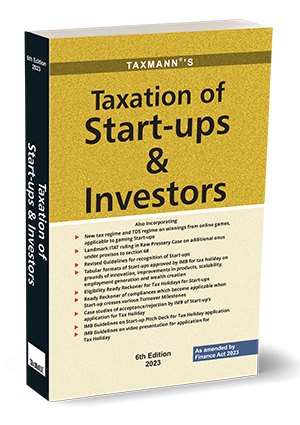
Taxmann
Taxmann Publications has a dedicated in-house Research & Editorial Team. This team consists of Chartered Accountants, Company Secretaries, and Lawyers. This team works under the guidance and supervision of Editor-In-Chief Mr Rakesh Bhargava.
The Research and Editorial Team is responsible for developing reliable and accurate content for the readers. The team follows the six-sigma approach to achieve the benchmark of zero error in our publications and research platform. The team ensures that the following publication guidelines are thoroughly followed while developing the content:
The statutory material is obtained only from the authorized and reliable sources
Keep the readers abreast with the latest developments in the judicial and legislative fields
Prepare the analytical write-ups on recent, controversial, and contagious issues to help the readers to understand the event and its implications
Every content published by Taxmann should be complete, accurate and lucid
All evidence-based statements must be supported with proper reference to Section, Circular No., Notification No., or citations
The golden rules of grammar, style and consistency are thoroughly followed
Choose a font and size that s easy to read, and remain consistent across all imprint and digital publications




 CAclubindia
