
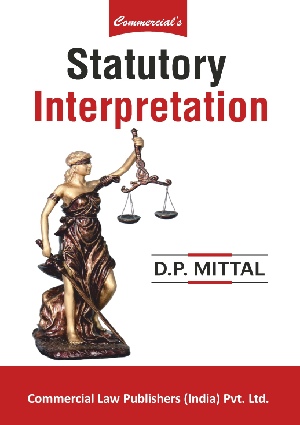
Statutory Interpretation
by D.P. MittalBook Currently Unavailable
This book is no longer available and has been discontinued
Browse Other BooksContents
CHAPTER 1
�
Law - Introduction
| 1.1 Law - Meaning | 1 |
| 1.2 Kinds of law | 2 |
| 1.3 Supreme legislation | 2 |
| 1.4 Subordinate legislation | 2 |
| 1.5 Referential legislation | 2 |
| 1.6 Judge-made law | 2 |
CHAPTER 2
�
Statutory Law - Supreme Legislation
| 2.1 Supremacy of Parliament | 4 |
| 2.2 Power of legislature subject to constitutional limits | 4 |
| 2.3 Taxation, a prerogative of legislature | 4 |
SUBORDINATE LEGISL
| 2.4 Subordinate legislation - Necessity | 5 |
|
6 |
|
6 |
|
8 |
| 2.5 Subordinate legislation - Extent and limits of delegation | 11 |
| 2.6 Subordinate legislation - Powers of rule making authorities | 12 |
| 2.7 Rules have effect as if enacted in the Act | 13 |
| 2.8 Rules are mandatory | 13 |
| 2.9 Rules interpretation | 14 |
REFERENTIAL LEGISL
| 2.10 Referential legislation - Convenient legislative device | 15 |
| 2.11 Referential legislation - Kinds of | 16 |
| 2.12 Referential legislation - Effect of repeal, modification or amendment of | 18 |
RAG-BAG LEGISLATION OR COMPOSITE LEGISLATION
| 2.13 Rag-Bag Legislation - Legislative competence | 19 |
CHAPTER 3
Judge-Made Law Rule of Precedents
| 3.1 Legislature - Delegation of responsibility to courts to make law through interpretative process | 21 |
| 3.1.1 Judges not only declare but also make laws | 22 |
| 3.1.2 Supreme Court and High Courts’ decisions - As important as statutes | 24 |
| 3.2 Interpretation is fundamental role of a Judge | 25 |
| 3.3 Judicial Interpretation to Adapt Law to Suit the Needs of Society | 25 |
PRECEDENTS - MEANING AND SCOPE
| 3.4 Doctrine of Precedent | 27 |
| 3.4.1 Ratio Decidendi | 28 |
| 3.4.2 Obiter Dicta | 31 |
| 3.4.3 Judicial Dicta | 32 |
RULES OF PRECEDENTS
| 3.5 Precedent provides a Guide as to Future Course of Law | 32 |
| 3.6 Precedents binding - Reasons | 33 |
| 3.6.1 Stare decisis- Long Standing precedents | 33 |
| 3.7 Precedents – Guidelines | 34 |
EXCEPTIONS TO RULE OF PRECEDENT
| 3.8 Precedent - Decision given in per incuriam not binding | 36 |
| 3.9 Precedent - followed not mechanically | 39 |
| 3.10 Every observation not to be followed | 40 |
| 3.11 Precedent - Sub Silentio | 41 |
CHAPTER 4
�
Law - Constitutional Validity
| 4.1 All laws flow from Constitution | 44 |
| 4.2 Constitutionality of provisions - Principles of interpretation | 45 |
| 4.2.1 Constitution - Interpretation | 45 |
| 4.2.2 Aspect doctrine | 49 |
| 4.3 Reading down an enactment | 51 |
|
52 |
|
53 |
|
54 |
| 4.4 Constitutionality - Subordinate legislations | 55 |
CONSTITUTIONALITY - COMPETENCE OF PARLIAMENT TO ENACT LAWS
| 4.5 Legislative competence to enact laws - Articles 245 and 246 of the Constitution | 56 |
| 4.6 Power of legislation and list of legislation | 56 |
| 4.7 Power of Parliament to enact laws - Limitations | 58 |
| 4.9 Judicial review | 59 |
| 4.10 Legislative competence - Pith and substance of a statute | 59 |
| 4.11 Colourable Legislation - Constitutionality | 61 |
| 4.12 Competence of Parliament to impose taxes | 62 |
CHAPTER 5
�
Interpretation - General Principles
| 5.1 Interpretation/Construction - Meaning | 63 |
| 5.2 Statute not drafted with divine prescience | 63 |
| 5.3 Statutory construction - an exercise in legal reasoning | 64 |
| 5.4 Interpretation - General observations | 64 |
| 5.5 Three rules for interpretation | 67 |
| 5.6 Rules of construction not the rules of law | 69 |
| 5.7 Ascertainment of Legislative Intention - Sources | 71 |
CONSTRUCTION - SCOPE AND EFFECT OF STATUTE
| 5.8 Rules of construction - Scope and Effect of the statute | 73 |
| 5.9 Construction - Internal and external aids | 75 |
CONSTRUCTION - STATUTE READ AS A WHOLE
| 5.10 ex visceribus actus - Within the four corners of the statute | 76 |
|
78 |
|
79 |
|
80 |
|
81 |
| 5.11 Summing up - Rules of interpretation (construction) of statute | 82 |
| 5.12 Statutory text and intention of the Parliament | 84 |
CHAPTER 6
�
Interpretation of Words - Contextual
| 6.1 Contextual interpretation of words | 86 |
| 6.2 Meaning of words be derived from the context | 87 |
| 6.3 Shorn of context - Words are slippery customers | 89 |
| 6.4 Context - which it means | 90 |
| 6.5 Same word in different enactment | 91 |
| 6.6 Same words in different places in the same section or statute | 92 |
| 6.7 Words in social welfare legislation | 93 |
| 6.8 Words have not only meaning but also contents | 93 |
| 6.9 No word has absolute meaning and defined without reference to context | 94 |
| 6.10 Words speak for themselves concept has been exploded | 96 |
| 6.11 Meaning of sentence may be more than of the separate words | 97 |
CHAPTER 7
�
Interpretation - Sententia legis
| 7.1 Sententia legis - The intention of the Legislative statute repository of legislative will | 98 |
| 7.2 Intention of the legislation a slippery phrase | 99 |
| 7.3 Actual and implied intention of parliament - ascertainment of | 101 |
| 7.4 Intention gathered from social conditions and the mischief to be remedied | 102 |
| 7.5 Primary and secondary statutory intention | 104 |
CHAPTER 8
�
Interpretation - Casus Omissus
| 8.1 Casus omissus | 107 |
| 8.2 Casus omissus supplied in case of necessity | 108 |
| 8.3 Judges to expound and not legislate in providing casus omissus | 109 |
CHAPTER 9
�
Interpretation - Ongoing Act
| 9.1 Interpretation of Ongoing Act | 111 |
| 9.2 Law never reaches consistency as man’s concept of state changes over years | 115 |
| 9.3 Law cannot remain immutable as society changes | 116 |
| 9.4 Laws used as an instrument of distributive justice | 117 |
CHAPTER 10
�
Interpretation - Literal rule
| 10.1 Literal rule | 119 |
| 10.2 Literal construction - when words are plain and unambiguous | 121 |
|
122 |
|
122 |
|
123 |
|
123 |
| 10.3 Literal construction — Corollary to the general rule - Nothing added or taken from and nothing surplusage | 124 |
| 10.4 Literal rule deviated - in case of ambiguity, absurdity and injustice | 125 |
| 10.5 Ambiguity - Meaning and scope | 125 |
| 10.6 Absurd result | 126 |
| 10.7 Ridiculous and harsh is not the legislative purpose | 127 |
| 10.8 Literal rule—Summing up | 128 |
| 10.9 Literal interpretation - Not to be followed slavishly as to stultify the manifest purpose | 129 |
LITERAL INTERPRETATION - TERMS, EXPRESSIONS AND TECHNICAL WORDS
| 10.10 Literal interpretation - Terms and expressions | 129 |
| 10.11 Words of legal import | 131 |
| 10.12 Words in a general statute - popular meaning | 131 |
| 10.13 Ordinary and natural meaning of words | 132 |
| 10.14 Standard test for ascertaining meaning of words in common parlance | 133 |
| 10.15 Expressions used in trade and industries | 133 |
| 10.16 Expressions in popular sense and not in technical sense | 134 |
| 10.17 Literal or dictionary meaning | 136 |
| 10.18 Composite expressions are not to be interpreted with the aid of dictionary | 138 |
| 10.19 Dictionaries meaning may sometimes be diffused | 139 |
| 10.20 ejusdem generis | 140 |
| 10.21 Distributive construction (plurals are broken into component singulars) | 140 |
CHAPTER 11
�
Purposive Interpretation vis-à-vis Literal Interpretation
| 11.1 Introduction | 142 |
| 11.2 Purposive and mischief rule | 143 |
| 11.3 Purposive interpretation | 144 |
| 11.4 Purposive interpretation to resolve ambiguity - Parliament never intends to enact ambiguity | 145 |
| 11.5 Purposive interpretation - Essence | 146 |
| 11.6 Purposive approach means purposive construction of statute | 147 |
| 11.7 Purposive interpretation - Undue importance not given | 149 |
| 11.8 Purposive interpretation not applied when the Act has been amended from time to time | 149 |
| 11.9 Purposive and literal approach combined | 149 |
| 11.10 Reading down meaning of words | 150 |
| 11.11 Purposive interpretation and tax laws | 150 |
|
153 |
CHAPTER 12
�
Interpretation - Golden rule (Meaning modified)
| 12.1 Golden Rule - Literal meaning modified | 155 |
| 12.2 Words presumed to be correctly and exactly used and interpreted contextually | 155 |
| 12.3 Violence to the language used | 157 |
| 12.4 Omissions and gaps supplied | 158 |
| 12.5 Meaning of the word may be extended | 158 |
| 12.6 Arm Chair Rule - Judges stepping into shoes of legislatures | 159 |
| 12.7 Judicial legislation | 160 |
| 12.8 Court’s competence in supplying omissions | 161 |
CHAPTER 13
�
Interpretation – Mischief Rule (Heydon’s case)
| 13.1 Mischief Rule - Heydon’s case | 164 |
| 13.2 Ironing out the creases | 168 |
CHAPTER 14
�
Interpretation - noscitur a sociis and ejusdem generis
| 14.1 noscitur a sociis - a word is judged by the company it keeps | 170 |
| 14.2 ejusdem generis | 173 |
| 14.3 Genus - Narrower than the words it regulates | 174 |
| 14.4 Ejusdem generis - Aid to construction | 174 |
| 14.5 ejusdem generis - Non-application if defeats the intention of legislature | 175 |
CHAPTER 15
�
Interpretation - Taxing statute
| 15.1 Interpretation - Taxing Statutes General Observations | 176 |
| 15.2 Interpretation of taxing provisions - Principle | 178 |
| 15.3 Taxing statutes - Strict Interpretation | 179 |
| 15.4 Taxing statutes - Doctrine of equity | 180 |
| 15.5 Strict interpretation does not rule out reasonable construction | 181 |
| 15.6 Strict interpretation charging section of income-tax Act | 182 |
| 15.6.1 Tax not to be charged by inference or analogy | 184 |
| 15.6.2 Taxing provision - Construction in favour of the subject in case of ambiguity | 185 |
| 15.7 Tax Avoidance - Strict interpretation | 186 |
| 15.8 Penal provisions - Strict interpretation | 187 |
| 15.9 Limitation provisions - Strict interpretation | 192 |
|
194 |
|
195 |
|
196 |
| 15.10 Exception clause - Strict interpretation | 196 |
| 15.11 Form or substance of a transaction - Strict interpretation | 198 |
| 15.12 Doctrine of substance of the transaction - meaning and scope | 200 |
| 15.13 Form or legality of the transaction | 203 |
| 15.14 Doctrine of ‘fiscal nullity’ | 206 |
CHAPTER 16
�
Interpretation - Liberal
| 16.1 Liberal interpretation | 208 |
| 16.2 Liberal construction - welfare legislation | 208 |
| 16.3 Liberal interpretation - Beneficial provisions | 21 |
| 16.4 Liberal construction - Exemption provisions | 212 |
| 16.5 Liberal versus literal construction | 214 |
|
214 |
| 16.6 Liberal construction - to make a provision effective and operative | 217 |
CHAPTER 17
�
Interpretation - Internal Aidse
| 17.1 Internal aids | 222 |
INTERPRETATION - PREAMBLE AND TITLE
| 17.2 Preamble | 222 |
|
222 |
|
224 |
|
224 |
|
224 |
INTERPRETATION - MARGINAL NOTES FOR HEADINGS
| 17.3 Marginal notes not referred for construction | 224 |
|
225 |
|
225 |
DEFINITION - PURPOSE AND FUNCTIONS
| 17.4 Definition | 226 |
| 17.5 Definition - Types | 226 |
| 17.6 Definition - function | 227 |
| 17.7 Definition clause - Ordinary meaning not taken away | 228 |
| 17.8 Definition clause - Interpretation | 228 |
| 17.9 Referential definition | 230 |
| 17.10 Referential provision - Interpretation | 231 |
| 17.11 “So far as may be, apply�, “as far as applicable� | 233 |
| 17.12 Definition clause - Some qualifying expressions | 233 |
|
234 |
|
235 |
|
236 |
|
239 |
|
240 |
|
240 |
|
241 |
|
241 |
|
242 |
|
242 |
|
243 |
|
243 |
|
243 |
|
243 |
|
243 |
|
243 |
|
243 |
|
244 |
|
244 |
|
247 |
|
250 |
|
250 |
|
251 |
|
251 |
|
252 |
|
252 |
CHAPTER 18
�
Interpretation – Internal aids Setting of the Act
| 18.1 Interpretation - Sections and sub-sections | 254 |
PROVISO—FUNCTION AND INTERPRETATION
| 18.2 Proviso - Function | 255 |
|
256 |
|
257 |
|
258 |
|
259 |
EXPLANATION - FUNCTIONS AND INTERPRETATION
| 18.3 Explanation — Function | 259 |
|
260 |
|
260 |
|
261 |
|
262 |
EXCEPTION - INTERPRETATION
| 18.4 Exception | 263 |
SCHEDULE INTERPRETATION
| 18.5 Schedule | 263 |
PUNCTUATION - PURPOSE AND FUNCTION
| 18.6 Punctuation | 266 |
|
267 |
|
268 |
|
269 |
|
270 |
|
270 |
CHAPTER 19
�
Interpretation - Rule of Language
| 19.1 Rules of Language | 271 |
RULE OF LANGUAGE - MANDATORY OR DIRECTORY
| 19.2 ‘May’ and ‘shall’ directory or mandatory | 271 |
|
274 |
| 19.3 Mandatory or directory depends on intention of legislature | 274 |
| 19.4 Mandatory - Use of word ‘shall’ not conclusive | 275 |
| 19.5 “Shall� and “may� - Inter-changeable | 275 |
| 19.6 Factors other than use of “shall� or “May� taken into account | 276 |
| 19.7 Negative or prohibitive word mandatory | 277 |
| 19.8 Provisions for performance of a duty - rarely mandatory | 278 |
| 19.9 Provision pertaining to avoidance of public mischief not mandatory | 279 |
| 19.10 Procedural rule not mandatory | 279 |
| 19.11 Mode of performing a duty has to be mandatorily followed | 282 |
| 19.12 Conditions of a provision should be mandatorily followed | 282 |
| 19.13 Whether all conditions mandatory | 283 |
| 19.14 Prescription of time-frame for the act to be done not mandatory | 284 |
| 19.15 Requirement of filing declaration or audit report along with return of income-tax directory | 285 |
| 19.16 Rules are mandatory | 286 |
| 19.17 Non-compliance of mandatory provisions - Consequence of | 286 |
RULE OF LANGUAGE - LEGAL FICTION
| 19.18 Legal fiction | 287 |
| 19.19 Legal fiction - strictly construed | 289 |
| 19.20 Legal fiction - all facts on which it operates assumed | 290 |
| 19.21 Legal fiction - casus omissus not supplied | 290 |
| 19.22 Legal fiction - illustrative cases | 290 |
RULE OF LANGUAGE - RETROSPECTIVELY
| 19.23 Retrospective operation | 292 |
| 19.24 Retrospectivity, legislative intent no fixed formula | 294 |
| 19.25 Retrospectivity - legislative power limitations | 294 |
| 19.26 Retrospectivity-expressly mentioned or be implied | 295 |
| 19.27 Retrospectivity presumption against | 295 |
| 19.28 Retrospective or prospective - Tests | 296 |
| 19.29 Retrospectivity - law of procedure or substantive law | 297 |
| 19.30 Procedural law and substantive law | 298 |
| 19.31 Retrospectivity - Amending Acts | 299 |
| 19.32 Retrospectivity - declaratory act | 300 |
| 19.33 Retrospectivity - Clarificatory act | 302 |
| 19.34 Clarificatory and declaratory acts - distinction between | 305 |
| 19.35 Retrospectivity - repealing, repealed Act | 305 |
| 19.36 Implied repeal | 307 |
CHAPTER 20
�
Interpretation - External Aids
| 20.1 External aids - Meaning | 309 |
| 20.2 External aids - Dictionary Meaning | 309 |
|
310 |
|
311 |
| 20.3 External AID - Reference to other acts | 311 |
|
313 |
|
314 |
| 20.4 External aid - Reference to General Clauses Act | 315 |
| 20.5 External aid - Reference to complementary statutes | 315 |
| 20.6 Words in popular sense | 316 |
| 20.7 Words having scientific or technical meaning and also having an ordinary meaning | 318 |
| 20.8 General words | 318 |
| 20.9 Words dealing with matters relating to general public | 318 |
| 20.10 Words used in Income-tax Act | 319 |
| 20.11 Words used in the schedule, notification for exemption | 319 |
| 20.12 ‘Expression’, meaning of - What is legal and not what is right | 321 |
| 20.13 External aids - Process of legislation | 321 |
| 20.14 External aids - Subsequent legislation | 322 |
| 20.15 External aids - History of Legislation | 323 |
| 20.16 External aids - Objects and Reasons | 325 |
| 20.17 External aids - Speech of the Minister | 328 |
| 20.18 External aids - Parliamentary Material | 329 |
| 20.19 External aids - Law Commission Report | 330 |
| 20.20 External aids construction - contemporanea expositio (the administrative) | 330 |
CHAPTER 21
�
Maxims and Proverbs
| 21.1 Maxim - Statement of guiding principle | 332 |
| 21.2 Maxim is empiric | 332 |
| 21.3 Maxim or proverb - not unalterable if the context requires | 334 |
| 21.4 Maxims explained | 334 |
About the Author

D.P. Mittal
D.P. Mittal-D.P. Mittal is an advocate, tax and business law consultant. He has authored about two hundred articles in Indian and foreign magazines and journals and also books on various law subjects; some of them are as follows: Interpretation of Taxing Statutes, Wills, Deeds and Documents; Laws relating to Copyrights, Patents, Trade Marks and GATT; Business and Commercial Laws; Law of Arbitration, ADR and Contract in India; Indian Patents Law; Natural Justice, Judicial Review & Administrative Law; Law of Trade Marks; Law of Information Technology (Cyber Law); Law of Arbitration (2002); Indian Patents Law and Procedure (2002); Trade Marks Passing off and Geographical Indications of Goods - Law and Procedure (2002); Competition Law; Law relating to Sick Industries; Interpretation of Statutes; Law Dictionary
Price Inclusive of Delivery Charges
Have Questions About This Book?
Our course advisors are here to help you make the right decision for your career growth.
Other books
CA/CMA INTER COMBO - COLOURED EASY NOTES + QUESTION BANK
CA/CMA INTER EASY NOTES COLOURED
CA/CMA INTER INCOME TAX QUESTION BANK

GST (IDT) Book - 4th Edition | May, Sept 2026 & Jan 2027 Attempt
List your Books
Share your knowledge and help shape the next generation of tech-savvy CA & Tax professionals while building a rewarding career in education.
Get Started CAclubindia
